


New regulations require schools affiliated with the Gujarat Board to establish wellness teams, appoint qualified counsellors and introduce peer-support systems for students in Classes 9 to 12.
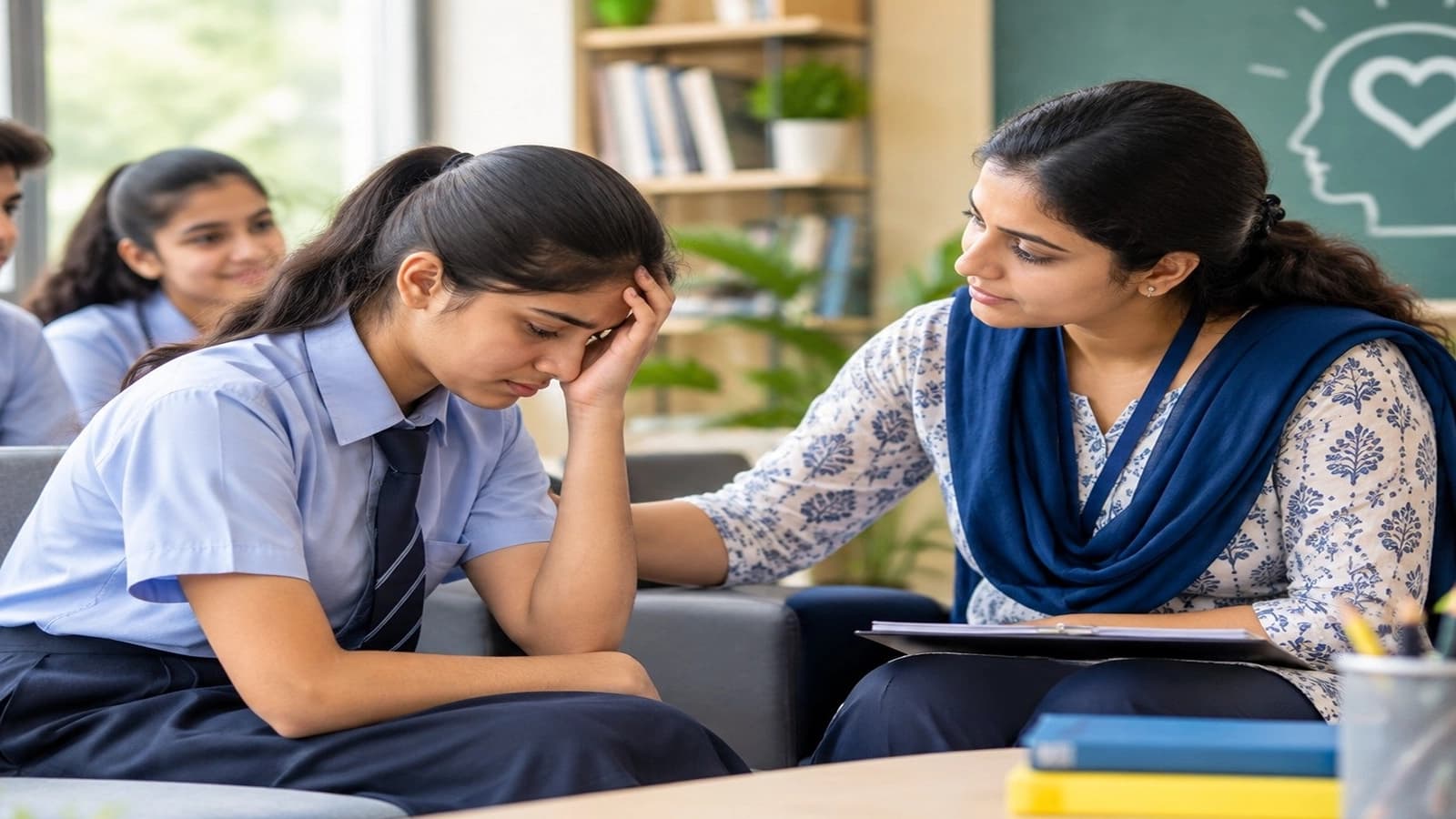
The Gujarat government has introduced mandatory mental health support and suicide prevention measures in secondary and higher secondary schools to address growing concerns over student stress, examination pressure and emotional well-being.
Under the new provisions of the Gujarat Secondary and Higher Secondary Education Regulations, 1974, schools affiliated with the Gujarat Secondary and Higher Secondary Education Board (GSHSEB) offering Classes 9 to 12 will have to establish dedicated mechanisms to identify mental health concerns and provide timely support to students.

The initiative aims to give equal importance to students' emotional well-being and academic performance. Factors such as examination pressure, competition for marks, excessive social media use, family expectations and uncertainty about future careers have been identified as potential sources of student stress.
The state government has also adopted the National Council of Educational Research and Training's (NCERT) UMMEED guidelines as a reference framework for implementing the new measures.
One of the major provisions requires every school offering Classes 9 to 12 to constitute a School Wellness Team (SWT) at the beginning of each academic year. The team's functioning will be reviewed annually.
The school principal will head the team, while a qualified counsellor or designated teacher will coordinate its activities.
The team will include:
The school principal as its head.
A counsellor or designated teacher as coordinator.
One teacher each from the secondary and higher secondary sections.
A representative of the School Management Committee.
One non-teaching staff member.
Two student peer-support representatives, known as 'Mano-Mitra', representing the secondary and higher secondary sections.
The teams will be responsible for identifying early signs of emotional distress, coordinating student support and responding promptly to situations involving potential self-harm or suicide risk.
The new framework makes professional mental health support compulsory, with specific provisions based on student strength.
Schools with 100 or more students: Must appoint at least one qualified counsellor, psychologist or social worker trained in child and adolescent mental health.
Schools with fewer than 100 students: Must establish formal referral arrangements with external mental health professionals and nearby healthcare facilities.
Smaller institutions will also be required to coordinate with Primary Health Centres (PHCs), Community Health Centres (CHCs), the District Mental Health Programme and Tele-MANAS services.
These arrangements are intended to ensure that students can access professional assistance even if their schools do not have an in-house counsellor.
The Gujarat government has also introduced a student peer-support mechanism called 'Mano-Mitra'.
Under this initiative, selected students will act as peer-support representatives and offer initial emotional support to classmates facing difficulties. They will encourage students to seek help and connect those requiring further assistance with teachers, counsellors or appropriate support services.
The initiative aims to create a more open and supportive school environment where students can discuss their concerns without fear of embarrassment or discrimination.
However, peer representatives are not substitutes for trained mental health professionals.
The regulations also seek to reduce unhealthy academic competition and the emotional pressure associated with examination results.
Schools will not be permitted to:
Segregate students inside or outside classrooms based on examination marks or academic performance.
Publicly humiliate students for securing low marks.
Make unfavourable comparisons between students that could affect their confidence and emotional well-being.
Promote practices that create fear, inferiority or discrimination among students.
Instead, schools must encourage equality, dignity, cooperation and a supportive learning environment.
Educational institutions will also be encouraged to organise activities such as yoga, meditation, music, art, gardening, dance and sports to support students' overall mental well-being.
The Gujarat government's framework also focuses on preparing school staff to recognise and respond to mental health concerns.
All teaching and non-teaching employees will have to undergo training conducted by certified mental health professionals at least twice a year.
The training will cover:
Identifying early warning signs of emotional distress.
Providing psychological first aid.
Recognising potential self-harm and suicide risks.
Responding to mental health emergencies.
Referring students to appropriate healthcare professionals.
Schools must also arrange additional mentoring and counselling during stressful academic periods, including board examinations, result announcements and transitions from Class 8 to Class 9 and Class 10 to Class 11.
The new regulations require schools to establish clear procedures for dealing with students experiencing severe emotional distress, suicidal thoughts or self-harm tendencies.
Any indication of self-harm or suicidal behaviour must be treated as an urgent concern. A student who attempts suicide or engages in self-harm must never be left alone. Schools must arrange immediate medical or emergency assistance.
Institutions must also provide confidential channels through which students can approach counsellors or designated teachers. Suggestion boxes and contact details of the School Wellness Team and child helpline services must be prominently displayed.
The framework further requires schools to maintain confidentiality of students' mental health information and counselling records, restricting access to authorised individuals directly involved in their safety and welfare.
The regulations also require schools to introduce confidential complaint-handling systems to address:
Bullying and cyberbullying.
Ragging and harassment.
Sexual harassment.
Discrimination based on caste, gender, religion, language, socio-economic background or disability.
Complaints must be investigated promptly and impartially.
The framework also provides for institutional accountability. Schools that fail to take appropriate action despite being aware, or reasonably expected to be aware, of a serious risk to a student's safety may face disciplinary or legal consequences if their failure significantly contributes to serious harm.
The government has also provided for district-level monitoring committees headed by the District Collector to oversee implementation of the new provisions.
These committees will review compliance, examine complaints and serious incidents, coordinate with educational institutions and recommend corrective measures. Schools will be required to follow their directions.
The regulations also emphasise career guidance to help students explore higher education, vocational courses, skill development and entrepreneurship opportunities. The objective is to reduce uncertainty and pressure associated with future career choices.
The Gujarat government has adopted NCERT's UMMEED guidelines as a reference framework for student mental health and suicide prevention.
UMMEED stands for:
U – Understand
M – Motivate
M – Manage
E – Empathise
E – Empower
D – Develop
The framework encourages schools to understand students' emotional needs, motivate them, help them manage challenges, demonstrate empathy and create an environment that supports their overall development.

Can Six Years of MBBS Abroad Still Leave Indian Students Unable to Practise in India?

What kind of future are schools preparing children for? Singapore educators explore question
1 in 5 Indian Children Live in Poverty; Poverty Rate Highest at 21.3% Among Adults Without Education: World Bank

Gujarat Makes Mental Health Support and Counsellors Mandatory in Schools to Prevent Student Suicides
Chennai, Tiruvallur Schools Closed Today, November 2, Due to Cyclone Murasu; Check Rain Alert and Holiday Details
Can Six Years of MBBS Abroad Still Leave Indian Students Unable to Practise in India?
What kind of future are schools preparing children for? Singapore educators explore question

Two universities, two countries, one academic bridge: China and Egypt launch joint faculty
Missed CLAT 2027 registration? Consortium extends application deadline for law aspirants

Who sets, secures and conducts exams? Centre considers separating responsibilities to prevent leaks

Can Six Years of MBBS Abroad Still Leave Indian Students Unable to Practise in India?
What kind of future are schools preparing children for? Singapore educators explore question
1 in 5 Indian Children Live in Poverty; Poverty Rate Highest at 21.3% Among Adults Without Education: World Bank
Gujarat Makes Mental Health Support and Counsellors Mandatory in Schools to Prevent Student Suicides
Chennai, Tiruvallur Schools Closed Today, November 2, Due to Cyclone Murasu; Check Rain Alert and Holiday Details
Can Six Years of MBBS Abroad Still Leave Indian Students Unable to Practise in India?
What kind of future are schools preparing children for? Singapore educators explore question
Two universities, two countries, one academic bridge: China and Egypt launch joint faculty
Missed CLAT 2027 registration? Consortium extends application deadline for law aspirants
Who sets, secures and conducts exams? Centre considers separating responsibilities to prevent leaks
Copyright© educationpost.in 2026 All Rights Reserved.