


A national study of more than 4,600 US schools found lower phone use and higher reported student well-being, but little overall change in attendance, classroom attention or standardised test scores.
School phone restrictions may reduce students’ mobile phone use during the day, but they do not necessarily lead to better academic performance, according to a national study involving Stanford University researchers.
The research team examined data from more than 4,600 US schools that introduced lockable pouches to restrict students’ access to smartphones during the school day. The findings showed that phone use among students trended lower and reported well-being increased, while several other indicators, including standardised test scores and attendance, changed little.

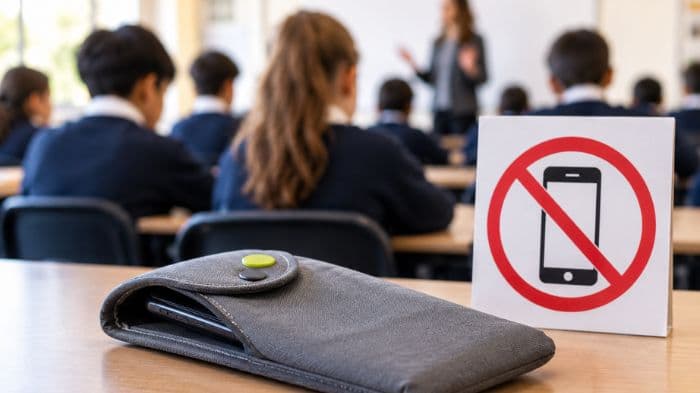
The study focused on schools that used magnetically sealed pouches manufactured by Yondr. Students placed their phones inside the pouches when they arrived at school and generally could not access them until the end of the day.
Stanford economist Matthew Gentzkow led the research alongside collaborators from Stanford, Duke University, the University of Pennsylvania and the University of Michigan. The team sought to assess how school phone policies affected student outcomes, including phone use, academic performance, attendance, well-being and online bullying.
Phone restrictions show limited academic gains
The researchers found that restricting phone access during the school day did not improve standardised test scores over a three-year period. The study also found little evidence that the policies significantly affected school attendance, classroom attentiveness or online bullying.
There was, however, a modest increase in mathematics scores among high school students. The same improvement was not observed among middle school students.
The findings suggest that restricting access to smartphones can reduce their use during school hours, but does not automatically translate into measurable improvements in academic outcomes.
The research team also noted that students themselves were not directly surveyed as part of the study. Data on subjective well-being, classroom attention and online bullying came from the technology platform Panorama Education, which conducts surveys in schools.
Educators helped shape the research
The researchers worked with teachers and school administrators to identify the concerns and outcomes that should be examined. Their input helped shape the study's survey questions and the indicators used to assess phone policies.
Angela Duckworth, a professor at the University of Pennsylvania and a member of the research team, said teachers wanted students to pay attention in class, perform academically and develop social skills and connections.
The team also gathered information on how schools enforced phone restrictions, including whether devices were kept in lockers, carried by students or collected by staff.
A separate national survey of educators, launched in 2025, had received responses from nearly 108,000 teachers and other education professionals across all 50 US states by the time of the Stanford report.
Researchers say phone bans are not a complete solution
The researchers said removing a potential distraction does not resolve all the factors that influence student engagement and achievement.
Gentzkow said the team's wider research examines measures that can help young people learn, grow and thrive in environments where smartphones are widely available.
Duckworth said future research would need to examine broader questions around school engagement, including the quality of the curriculum, teacher development and school culture.
The team also plans to explore practical questions for school leaders, such as when students should be allowed to access their phones, how restrictions should be enforced and how schools can ensure that policies are followed.
The findings add evidence to the debate over school phone restrictions, while indicating that their effects may vary across student outcomes. The researchers said further work would be needed to understand how different policies operate in schools and what approaches best support students.

India set to join EU’s €93.5 billion Horizon Europe research programme in January 2027

Australia study detects exam stress in university campus sewage

European Commission unveils education package to address falling basic skills and teacher shortages

UAE expands global research partnerships and links university innovation with industry

Researchers warn AI overuse could weaken students’ ability to think independently

UN Secretary-General to take Arctic scientists’ climate warnings to COP31

Nepali students form Japan's second-largest international academic community: Foreign Minister

'Mogging' explained: How bodybuilding term became Collins Word of the Year 2026

‘It’s actually very cut-throat’: 13-year-old wins New Zealand spelling bee title

Schoolchildren join desperate effort to save stranded whales on New Zealand coast

India set to join EU’s €93.5 billion Horizon Europe research programme in January 2027
Australia study detects exam stress in university campus sewage
European Commission unveils education package to address falling basic skills and teacher shortages
UAE expands global research partnerships and links university innovation with industry
Researchers warn AI overuse could weaken students’ ability to think independently
UN Secretary-General to take Arctic scientists’ climate warnings to COP31
Nepali students form Japan's second-largest international academic community: Foreign Minister
'Mogging' explained: How bodybuilding term became Collins Word of the Year 2026
‘It’s actually very cut-throat’: 13-year-old wins New Zealand spelling bee title
Schoolchildren join desperate effort to save stranded whales on New Zealand coast
Copyright© educationpost.in 2026 All Rights Reserved.