


New rules regulate visitor access, restrict unauthorised recording and empower principals to seek police action to protect students.
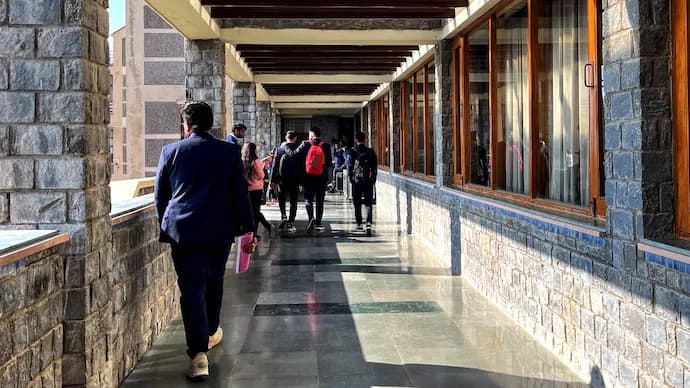
The Gujarat government has tightened entry rules for government schools, making prior written permission from the principal mandatory for outsiders and introducing stricter safeguards to protect students’ safety, privacy and dignity.
Under the new guidelines issued by the state Education Department, every visitor must record their details in the school’s visitor register before entering the premises. Only government officials duly authorised to perform their official duties are exempt from the prior written permission requirement.

The rules apply to primary, secondary and higher secondary educational institutions and aim to prevent unauthorised access, protect children from potential risks and ensure that school activities continue without disruption.
The circular underlines the government’s responsibility towards children studying in public schools under the principle of in loco parentis, which requires authorities to act in the place of parents when safeguarding children under their care.
It also draws on Article 21 of the Constitution, which protects the right to life and dignity, and the Supreme Court’s landmark K.S. Puttaswamy (Retd.) vs Union of India judgment, which recognised privacy as a fundamental right. The guidelines also refer to the National Commission for Protection of Child Rights’ school safety policy.
The circular makes it clear that no outsider can enter school premises without prior written permission from the principal or head of the institution.
Access to classrooms, laboratories, libraries, hostels, playgrounds, toilets and other areas where student activities take place will require prior written approval. Visitors must also be accompanied by the principal, a teacher or another authorised school official.
The restrictions are intended to ensure that outsiders do not gain unrestricted access to areas where students study, interact or participate in school activities.
The new rules prohibit photography, videography, interviews, audio recording and live streaming involving students, teachers or school activities without the principal’s prior written permission. Such activities may be authorised only for lawful purposes.
School authorities must ensure that photographs, videos and personal information relating to students are not collected, published or circulated in ways that could compromise their safety, dignity or privacy.
Visitors are also barred from collecting children’s personal information or publishing their identities or photographs without the required written permission, particularly when doing so could harm their interests or expose them to risks.
The guidelines empower school heads to act against unauthorised entry and other violations that threaten the safety or functioning of an institution.
If a person enters without permission, refuses to leave, attempts unauthorised photography or videography, or disrupts school operations, the principal must immediately inform the local police and the concerned education authorities.
These include the District Education Officer, District Primary Education Officer, administrative officer or Taluka Primary Education Officer, as applicable.
Principals and heads of institutions can also deny entry to visitors whose presence could jeopardise school security, violate privacy, disturb discipline or disrupt the academic environment. They may direct unauthorised visitors to leave and seek police assistance whenever necessary.
The Education Department has directed inspection officers to ensure strict implementation of the guidelines across government schools.
Depending on the nature and circumstances of a violation, action may be initiated under applicable laws, including the Bharatiya Nyaya Sanhita, 2023, the Protection of Children from Sexual Offences (POCSO) Act, 2012, the Juvenile Justice (Care and Protection of Children) Act, 2015, and the Information Technology Act, 2000.
The measures place greater responsibility on school administrations to regulate access, protect children’s personal information and respond promptly to security concerns. The government’s stated approach centres on ensuring that schools remain safe learning environments where students’ rights, privacy and well-being are protected.
Gujarat tightens school entry rules, makes principal’s written approval compulsory
Egypt insists international schools include Arabic, history in final scores

China lets students replace dissertations with practical work. Is India missing a trick?

BITS Design School Opens Applications for 2027 Admissions; Check Last Date and Selection Process
IICA Signs MoU with Association of ARCs to Strengthen Insolvency Training and Industry Collaboration
Egypt insists international schools include Arabic, history in final scores

China’s Chery unveils AI companion robot designed to ease loneliness
New Zealand reforms could leave more students without school qualifications

Alfred Nobel’s will created one of the world’s most recognised prizes. Here’s how

Pepperdine University earns Google recognition and Digital Education Council membership for AI initiatives

Gujarat tightens school entry rules, makes principal’s written approval compulsory
Egypt insists international schools include Arabic, history in final scores
China lets students replace dissertations with practical work. Is India missing a trick?
BITS Design School Opens Applications for 2027 Admissions; Check Last Date and Selection Process
IICA Signs MoU with Association of ARCs to Strengthen Insolvency Training and Industry Collaboration
Egypt insists international schools include Arabic, history in final scores
China’s Chery unveils AI companion robot designed to ease loneliness
New Zealand reforms could leave more students without school qualifications
Alfred Nobel’s will created one of the world’s most recognised prizes. Here’s how
Pepperdine University earns Google recognition and Digital Education Council membership for AI initiatives
Copyright© educationpost.in 2026 All Rights Reserved.