Campus unrest and political fallout intensify as nationwide protests erupt over UGC equity rules
A Supreme Court PIL, campus protests, and clarifications have thrust the regulations into debate, prompting scrutiny of inclusion, safeguards, due process, and their implications for higher education governance.
Pragya Kumari27 January 2026 08:09
A petition filed in the Supreme Court has brought the University Grants Commission’s Promotion of Equity in Higher Education Institutions Regulations, 2026, under judicial scrutiny, triggering protests on campuses and prompting the government to issue clarifications as the debate escalates nationwide.
The public interest litigation, filed by advocate Vineet Jindal, challenges the constitutional validity of Regulation 3(c) of the UGC regulations notified on Jan 13.
The plea argues that the provision defines caste-based discrimination narrowly by extending protection only to Scheduled Castes, Scheduled Tribes, and Other Backward Classes, while excluding general or upper-caste students.
It contends that this amounts to an exclusionary and caste-specific framework that violates Articles 14, 19, and 21 of the Constitution and denies equal protection of law.
“Regulation 3(c) defined ‘caste-based discrimination’ in a narrowly confined manner as discrimination ‘only on the basis of caste or tribe against the members of the Scheduled Castes, Scheduled Tribes, and Other Backward Classes,’” stated the PIL.
“By design and operation, this definition accords legal recognition of victimhood exclusively to certain reserved categories and categorically excludes persons belonging to general or upper castes from its protective ambit, regardless of the nature, gravity, or context of discrimination suffered by them. Such a definition institutionalizes exclusion at the threshold, creates a hierarchy of victimhood, and introduces a constitutionally impermissible bias into a regulatory framework that purports to be neutral and inclusive,” the petition submitted.
“This presumption ignores the evolving social realities. The definition is manifestly arbitrary and violative of Article 14 of the Constitution. It creates a hostile classification founded solely on caste, without any intelligible differentia and without a rational nexus to the professed objective of promoting equity in higher education,” the petition said.
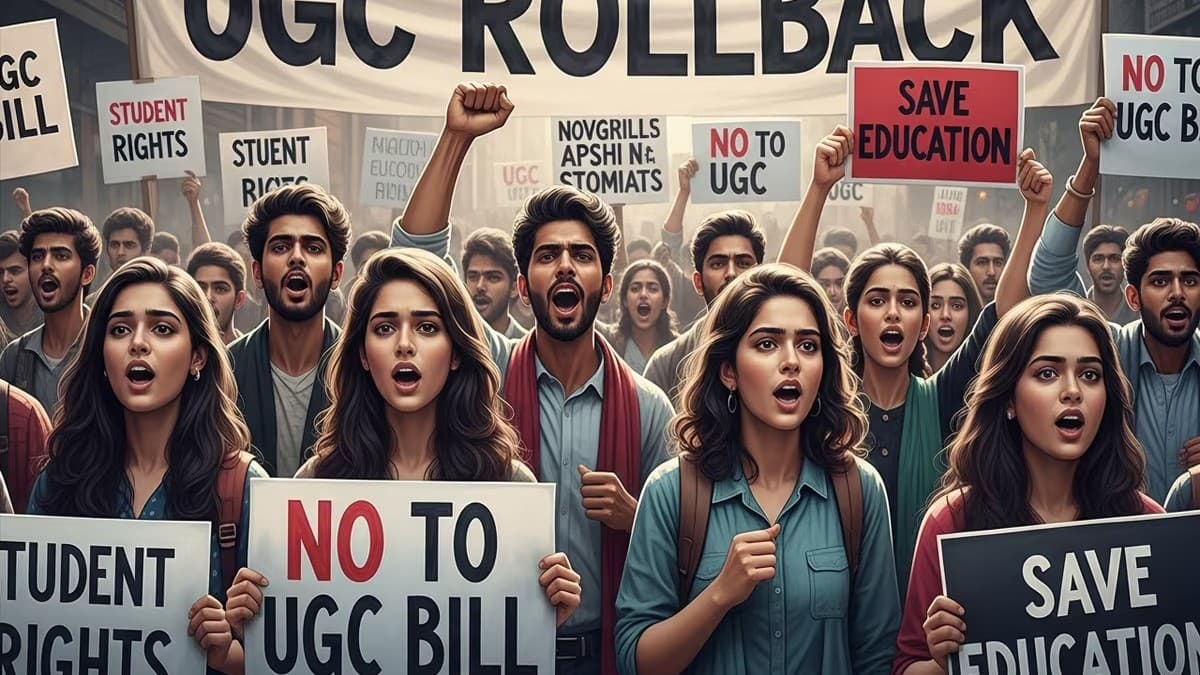
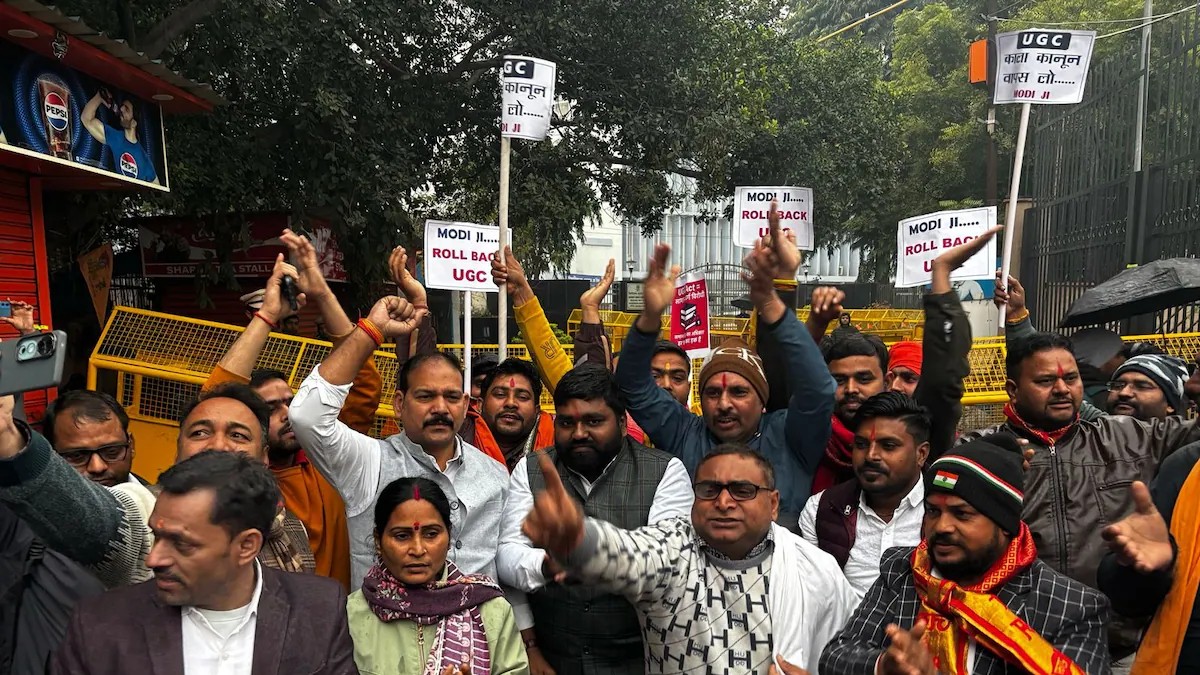
The student groups, particularly from the general category, called for protests outside the UGC headquarters in Delhi and across several universities. Protest organizers appealed for unity, urging students to oppose what they described as discriminatory rules.
Posters circulated online called for a peaceful gherao of the UGC office, while social media campaigns under hashtags such as #RollbackUGC gained traction. Delhi colleges are among those expected to join the demonstrations.
The Ministry of Education has said it is preparing to present all relevant facts about the regulations to the public to counter misinformation. Government sources have maintained that the rules will not be misused and are intended to promote fairness, accountability, and inclusivity in higher education.
Officials have clarified that the regulations expand the definition of discrimination to cover caste, religion, gender, place of birth, and disability and ensure representation of OBC students on institutional equality committees.
The UGC has defended the move by pointing to a sharp rise in discrimination-related complaints between 2020 and 2025 and to judicial directions issued following cases such as those of Rohith Vemula and Payal Tadvi.
It has stated that direct or indirect acts of discrimination against SC, ST, and OBC students will be treated as offenses and attract strict action.
Despite these assurances, concerns persist among general category students and faculty members.
Critics argue that the final version of the regulations omits clear safeguards against false or malicious complaints, does not mandate representation of general category students on Equity Committees, and assigns broad monitoring powers to Equity Squads.
They fear this could lead to a presumption of guilt, affect free expression, and undermine institutional autonomy.
At the center of the controversy are the UGC regulations aimed at preventing caste-based discrimination in higher education institutions.
Notified on Jan 13, the rules make it mandatory for all colleges and universities to establish Equal Opportunity Centers, Equity Committees, round-the-clock grievance helplines, and Equity Squads to identify and address complaints, particularly involving SC, ST, and OBC students.
Institutions that fail to comply face penalties, including withdrawal of UGC recognition and funding.
The 2026 regulations replace the University Grants Commission Promotion of Equity in Higher Education Institutions Regulations, 2012, and are aligned with the objectives of the National Education Policy, 2020.
Critics argue that key provisions are vague, one-sided, and vulnerable to misuse. Speaking to PTI, Alokit Tripathi, a PhD student at Delhi University, said the regulations could disrupt campus life.
“The new regulations are draconian in nature. The definition of "victim" is already predetermined. Victims can be anyone on campus,” he said. He added, “With the proposed Equity squads, it will be akin to living under constant surveillance inside the campus.”
Opposition to the regulations has extended beyond campuses into the political and administrative sphere. The row has been accompanied by resignations in Uttar Pradesh and public statements from political figures.
Commenting on the resignation of the Bareilly City Magistrate, Uttar Pradesh minister Sanjay Nishad said, “This is his personal matter. I will only say that the laws passed by Parliament are in the best interest of the public. If there are any flaws after implementation, they are reviewed. It is wrong to say that there were flaws before that.”
He added, “There were some discriminatory practices; whatever they were, they were based on the commission's report. A Supreme Court committee was formed. General caste people have also received a 10% reservation, and no one has opposed that. The laws made by the elected representatives should be followed.”
Indian poet and higher education teacher Kumar Vishwas voiced his opposition to the revised UGC regulations on X, expressing solidarity with protesters concerned about the new rules’ implications.
He shared a poem by the late poet Ramesh Ranjan to capture the frustration and anxiety felt by some members of society.
"Chahe til lo ya taad lo raja, raai lo ya pahad lo raja, main abhaga 'savarn' hoon mera, rounya rounya ukhad lo raja," Kumar wrote, adding the hashtag #UGC_RollBack.
What began as an education reform has now turned into a nationwide legal, political, and social debate.
With protests continuing, social media discourse intensifying, and the Supreme Court set to examine the petition, the impact of the UGC’s new equity regulations on campus life and higher education governance remains under close scrutiny.