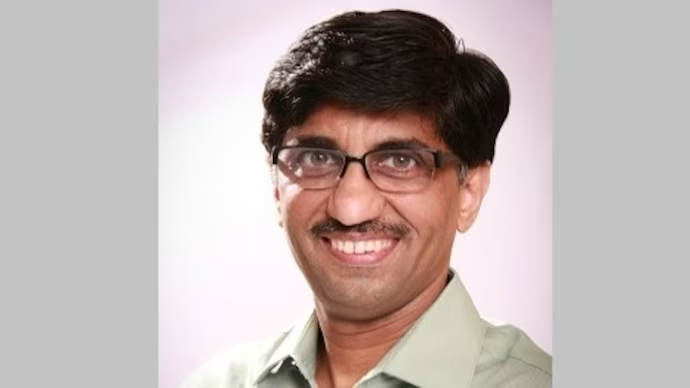
Abhay Karandikar began his journey as an engineering student at IIT Kanpur and went on to spend nearly three decades teaching and researching at IIT Bombay. Along the way, he worked on wireless networks, affordable rural broadband and telecom standards, contributing to technologies and frameworks that have shaped India’s 5G journey. His academic career eventually led him into institutional leadership and national science policy, including the directorship of IIT Kanpur and his current role at NITI Aayog.
Karandikar, who served as Director of IIT Kanpur from 2018 to 2023, is now a member of NITI Aayog, having been appointed in 2026. Across these transitions, telecommunications and wireless networking have remained a constant thread in his work.

He completed his MTech in Electrical Engineering from IIT Kanpur in 1988 and his PhD from the same institute in 1994. His academic training focused on communications networks, a field that would later become central to the expansion of mobile communications and the internet.
From IIT Kanpur to IIT Bombay
In 1997, Karandikar joined the Electrical Engineering Department of IIT Bombay, where he spent nearly three decades, with periods on lien while serving in public positions.
His responsibilities at the institute expanded over the years. He headed the Computer Centre, led the Electrical Engineering Department, became the first Professor-in-Charge of the IIT Bombay Research Park and later served as Dean of Faculty Affairs.
His research covered wired and wireless networks, resource allocation and software-defined networking. A significant part of his work focused on a challenge particularly relevant to India — how to provide broadband connectivity in areas where conventional infrastructure could be expensive or difficult to deploy.
That work led to the development of what became known as “Frugal 5G”, an approach aimed at creating more affordable and accessible broadband networks, particularly for rural and underserved areas.
The research eventually took him beyond laboratories and academic papers into the broader world of telecom standards and policy.
Karandikar helped establish the Telecom Standards Development Society, India (TSDSI), the country’s telecom standards body, and served as a founding member and former chairman.
His research also contributed to IEEE standards, including IEEE 1930.1 and IEEE 2061, which addresses architecture for affordable broadband networks. His team’s work on rural broadband won the Mozilla Open Innovation Challenge prize in 2017.
From technology research to institutional leadership
In April 2018, Karandikar took a temporary break from IIT Bombay to become Director of IIT Kanpur. He remained in the position until September 2023.
During his tenure, the institute expanded its academic and research infrastructure, strengthened its incubation ecosystem and advanced plans for a medical school focused on medical technology.
IIT Kanpur also consolidated its incubation activities under the Foundation for Innovation and Research in Science and Technology, while pursuing new research facilities, faculty expansion, industry partnerships and international collaborations.
For Karandikar, the move into institutional leadership represented another extension of his academic work. The focus shifted from individual research projects to creating systems in which research, innovation and industry could interact more effectively.
From the laboratory to national science policy
On October 3, 2023, Karandikar moved to the Union government as Secretary of the Department of Science and Technology.
His tenure coincided with the operationalisation of the Anusandhan National Research Foundation and the National Quantum Mission, two major initiatives aimed at strengthening India’s research ecosystem and advancing capabilities in emerging technologies.
The department also worked on a ₹1 lakh crore Research, Development and Innovation Fund intended to support research in the private sector and deep-tech start-ups.
Other areas of focus included clean energy, green hydrogen, advanced materials, geospatial technologies, advanced manufacturing, research infrastructure and technology incubation.
The transition from professor to policymaker was therefore less a departure from his earlier work than a widening of its scope. Telecommunications had already taken Karandikar from research into standards and regulation. Leading an IIT added institutional administration to that experience. Heading the Department of Science and Technology brought him into national research policy.
In May 2026, he moved to NITI Aayog as a member.
NITI Aayog lists his areas of interest as telecommunications, wireless networking, electronics and semiconductors, artificial intelligence and quantum communication.
His career now spans the classroom, laboratory, standards-setting bodies, university administration and the government. At each stage, the questions have grown larger, but the underlying theme has remained familiar: how scientific knowledge and technological innovation can be translated into systems that serve the wider country.
For a student who began his journey at IIT Kanpur, the road has ultimately led well beyond academia — into the institutions shaping how India researches, develops and deploys the technologies of the future.