Beyond Counselling: Why IITs Are Being Forced to Rethink What Student Safety Really Means
As IIT Bombay faces scrutiny after a student’s death and IIT Kharagpur turns to peer support, the growing toll of student suicides is forcing India’s premier engineering institutes to look beyond counselling and confront campus culture, belonging and institutional responsibility.
Prabhav Anand24 September 2026 09:36
IITs are increasingly looking beyond conventional counselling as student mental health becomes a wider institutional concern.
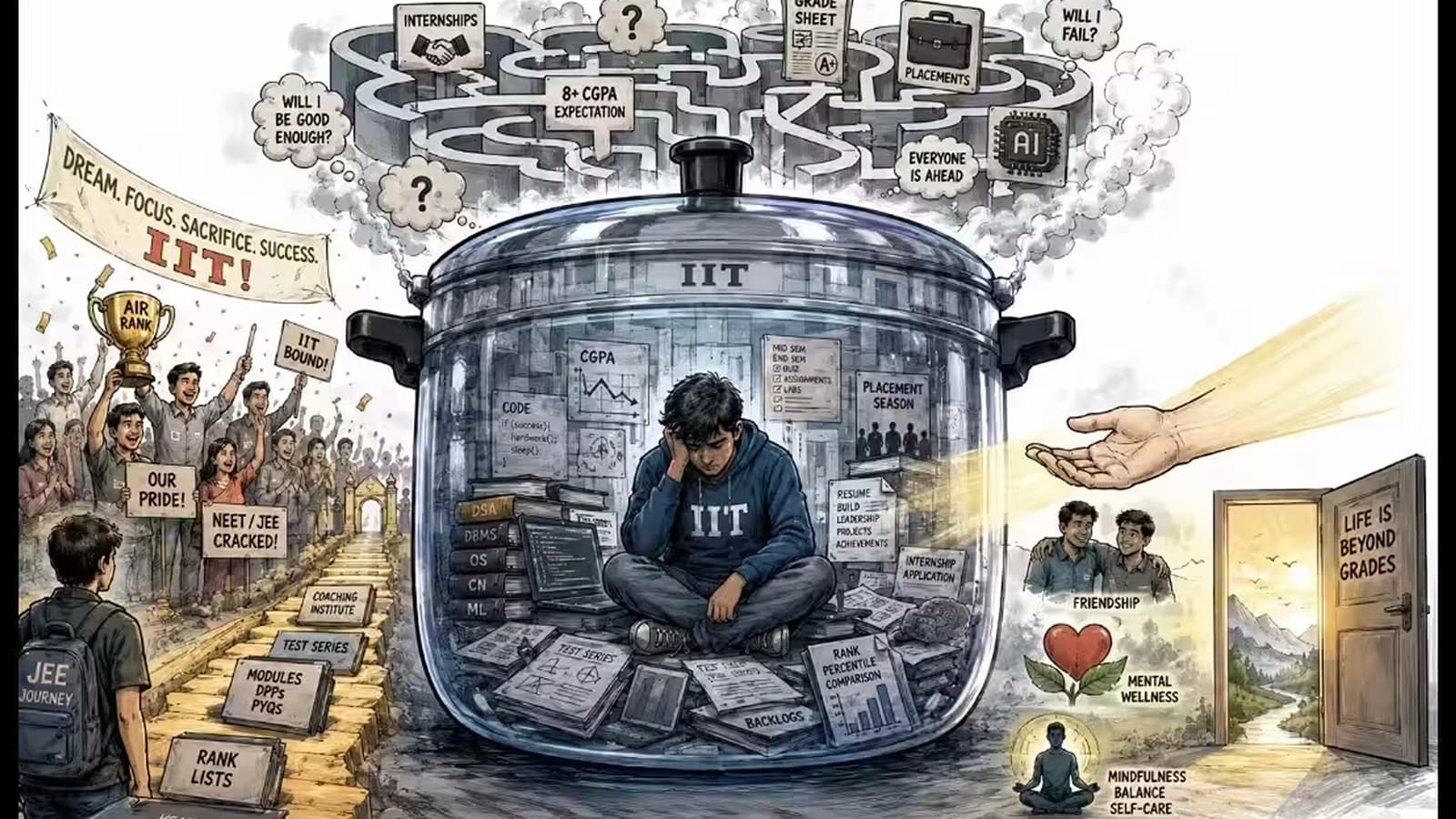
For years, the response to student distress inside India’s premier engineering institutions has largely been framed around one familiar solution: counseling. The student is struggling, so there is a counselor. The student is anxious before examinations, so there is a helpline. A suicide takes place, and the institution announces additional mental-health support. But the recent sequence of events across the Indian Institutes of Technology (IITs) is beginning to expose the limits of that approach.
IIT Kharagpur has now launched SAHACHAR, an in-house wellness buddy programme designed to strengthen peer support and identify students experiencing emotional distress. The initiative forms part of the institute’s wider suicide-prevention and mental-health measures. IIT Kharagpur already conducts gatekeeper training through its SETU initiative, where students and members of the campus community are trained to recognise warning signs and follow an “ask-listen-refer” approach.
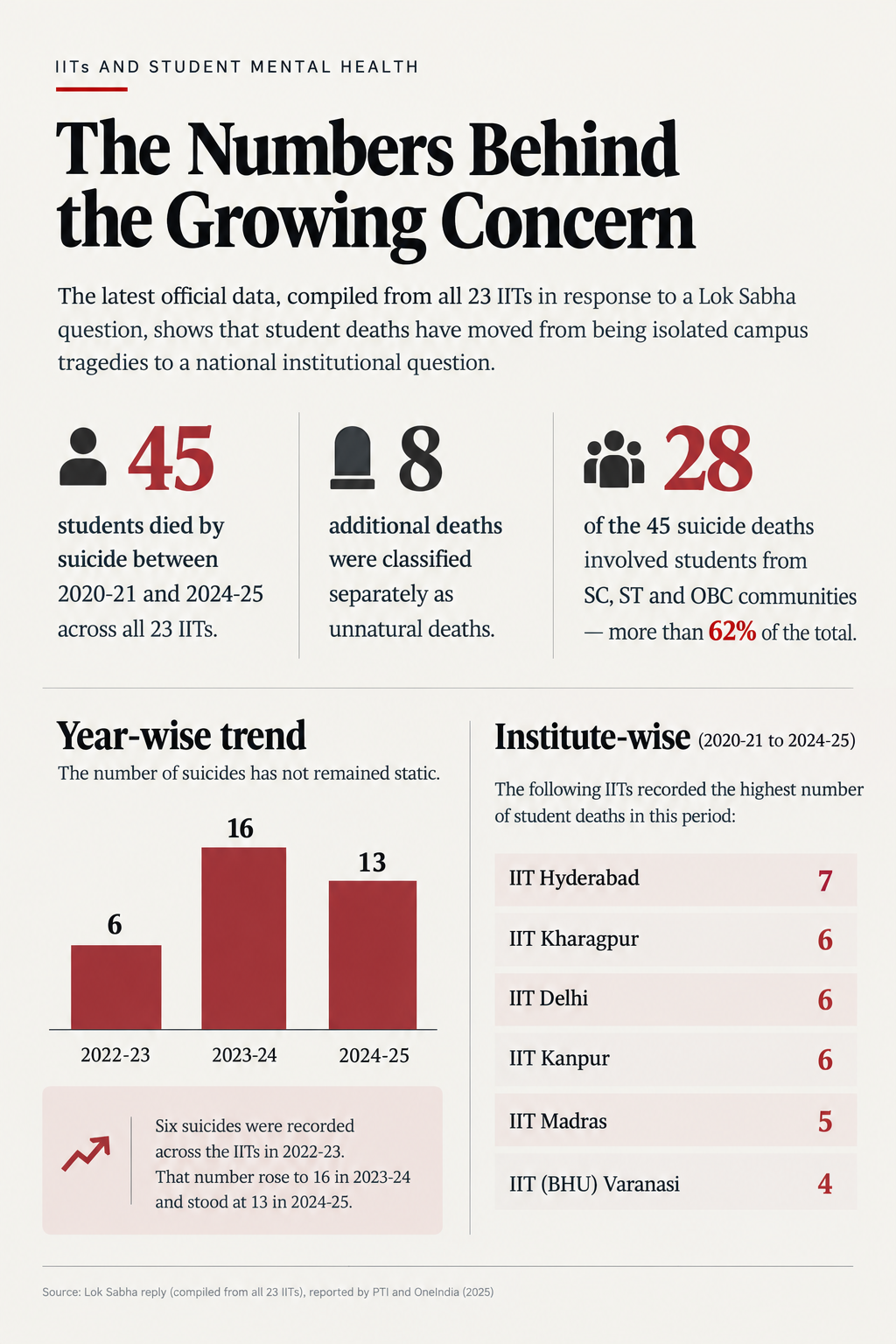
The timing is significant. The programme comes against a backdrop in which student deaths at IITs have moved from being isolated campus tragedies to a national institutional question. The latest official data, compiled from all 23 IITs in response to a Lok Sabha question, shows that 45 students died by suicide between 2020-21 and 2024-25. Another eight deaths were classified separately as unnatural deaths. Of the 45 suicide deaths, 28 involved students from SC, ST and OBC communities, more than 62 per cent of the total.
The numbers also show that the problem has not remained static. Six suicides were recorded across the IITs in 2022-23. That number rose to 16 in 2023-24 and stood at 13 in 2024-25. IIT Hyderabad recorded seven deaths during the five-year period, while IIT Kharagpur, IIT Delhi and IIT Kanpur recorded six each. IIT Madras recorded five and IIT (BHU) Varanasi four.
Yet the dataset comes with an important limitation: it does not contain the circumstances behind each death. The figures cannot, by themselves, establish that academic pressure, caste discrimination, faculty conduct, examinations or any other single factor caused these deaths. That is precisely why the emerging story is less about finding one explanation and more about examining whether the institutions themselves have mechanisms capable of identifying distress before it becomes a crisis.
That question has become particularly difficult after the death of an IIT Bombay student in September. The death of Sahil Wakode, a second-year student, followed an incident during an examination in which he was reportedly found using a mobile phone and attempting to use ChatGPT. IIT Bombay said that no disciplinary action had been initiated against him and that he had been assured that the examination incident would not adversely affect his academic career. The incident nevertheless triggered protests involving hundreds of students and led to the postponement of the ongoing mid-semester examinations. The police investigation is examining the circumstances surrounding his death.
The case has subsequently acquired another dimension. Wakode’s family has alleged caste-based harassment and filed a complaint against faculty members. Those allegations are disputed and remain subject to investigation. The Mumbai Crime Branch has been examining CCTV footage, recording statements and reconstructing the sequence of events. IIT Bombay’s alumni association has meanwhile urged against what it described as premature media trials and called for a fair and speedy investigation.
That distinction matters because the central question is no longer simply whether an IIT has a counselling centre. It is whether a student who is frightened, academically struggling, socially isolated, facing a disciplinary issue, dealing with discrimination or simply unable to cope with the expectations surrounding an IIT has enough places to turn before reaching a crisis.
This is where the significance of SAHACHAR becomes clearer. A peer-support system changes the point at which an institution tries to intervene. A professional counsellor may be the appropriate person for clinical care, but a student is more likely to encounter a roommate, classmate, hostelmate, senior or friend first. A peer may notice withdrawal, sudden academic deterioration or unusual behaviour long before an appointment with a counsellor is made.
IIT Kharagpur's existing gatekeeper training reflects this logic. Its programme trains participants to recognise warning signs, listen and refer students for appropriate help rather than attempting to provide professional treatment themselves. That distinction is important because the problem inside a residential institution is not confined to the counselling room.
A student spends most of the day in classrooms, laboratories, hostels, messes, examination halls and peer groups. Faculty members determine academic interactions. Wardens and senior students occupy important positions in residential life. Parents remain part of the pressure and support system. Administrative decisions can affect scholarships, grades, disciplinary proceedings and academic progression.
Mental health therefore intersects with almost every part of campus life. IIT Kharagpur appears to have been moving towards this broader understanding for some time. In 2025, the institute began engaging parents of first-year students and residents of hostels as part of a wider student-welfare effort. The initiative included discussions around wellness, counselling and the role of parents. The institute also expanded counselling support and considered placing wellness counsellors in hostels during periods when students were less likely to access conventional daytime services.
In other words, the institution has been slowly moving the question of mental health away from a single office and into everyday campus life. The national response is moving in the same direction.
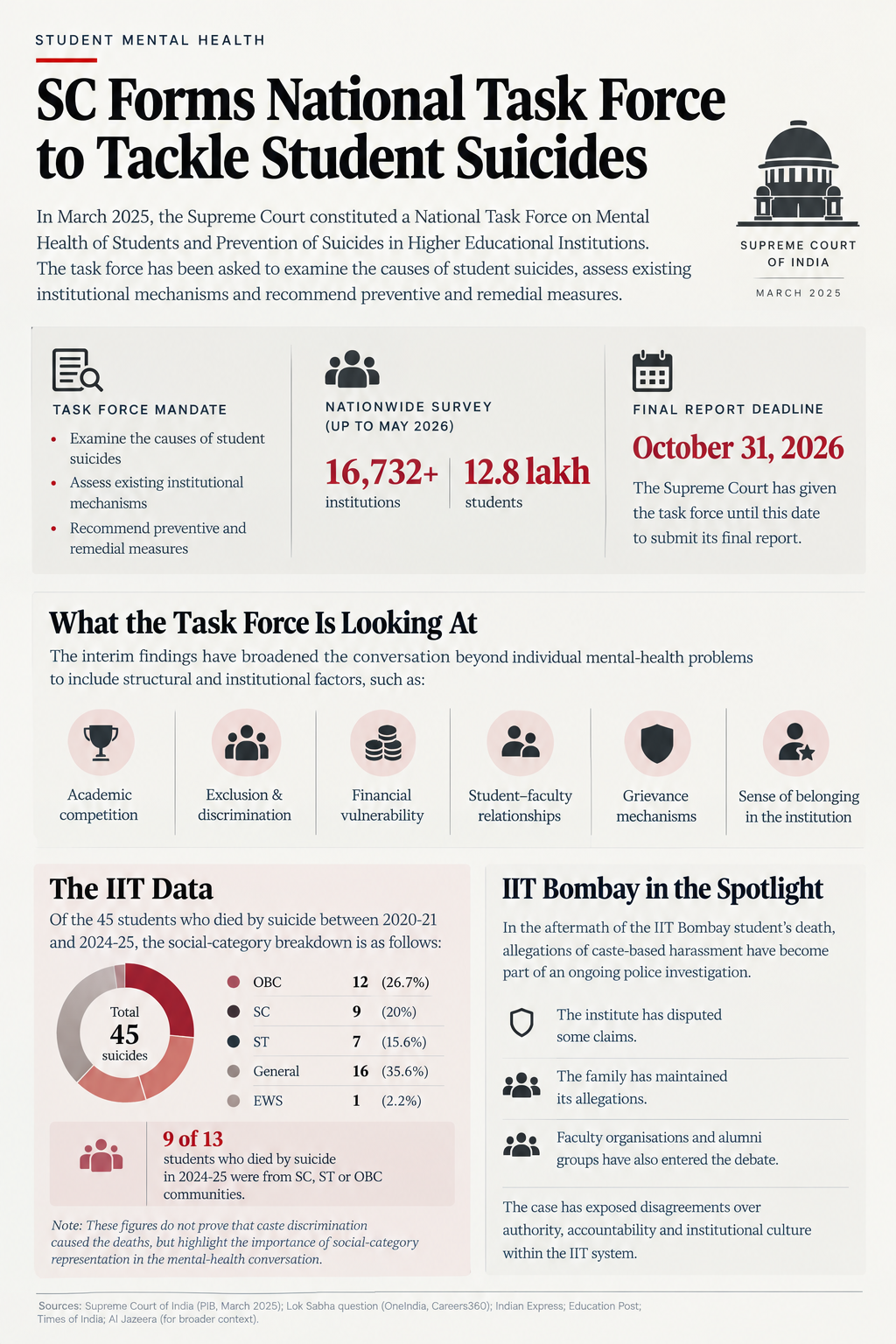
In March 2025, the Supreme Court constituted a National Task Force on Mental Health of Students and Prevention of Suicides in Higher Educational Institutions. The task force was asked to examine the causes of student suicides, assess existing institutional mechanisms and recommend preventive and remedial measures. Its interim work has argued that student suicides cannot be understood simply as individual mental-health problems and has examined structural issues within educational institutions.
The scale of the exercise itself is revealing. By May 2026, more than 16,732 institutions and 12.8 lakh students had participated in the task force's nationwide survey. The Supreme Court has given the task force until October 31, 2026, to submit its final report. The task force's work also changes the vocabulary around student suicides.
Academic competition is one issue. But so are exclusion, discrimination, financial vulnerability, relationships between students and faculty, institutional grievance mechanisms and whether students feel that they belong in the institution. The interim findings have pushed the debate towards institutional and structural conditions rather than treating every death exclusively as an individual's psychological crisis.
The latest IIT data makes that discussion harder to ignore. Of the 45 students who died by suicide between 2020-21 and 2024-25, 12 were from OBC communities, nine were from SC communities and seven were from ST communities. Sixteen belonged to the General category and one to the EWS category. In 2024-25 alone, nine of the 13 students who died by suicide were from SC, ST or OBC communities.
Again, these numbers do not prove that caste discrimination caused those deaths. They do, however, establish that social-category representation is an important dimension that institutions and policymakers cannot simply leave outside the mental-health conversation.
That becomes particularly relevant in the aftermath of IIT Bombay, where allegations of caste-based harassment have become part of an ongoing police investigation. The institute has disputed some claims, while the family has maintained its allegations. Faculty organisations and alumni groups have also entered the debate, illustrating how quickly a student death can expose disagreements over authority, accountability and institutional culture.
There is another uncomfortable problem: the absence of a consistently granular national dataset. For years, journalists, researchers and student groups have had to piece together IIT deaths from parliamentary responses, RTIs, institutional statements and news reports. Different datasets can therefore cover different periods and categories of deaths.
A 2026 Al Jazeera investigation, for example, compiled nearly 160 student deaths across premier engineering institutions over two decades, including 69 in the preceding five years, while the latest government-linked five-year IIT dataset records 45 suicides and eight other unnatural deaths between 2020-21 and 2024-25. These figures should not be treated as interchangeable because they use different definitions and periods.
That discrepancy is itself part of the story. If institutions want to prevent deaths, they first need to know what is happening inside them.
How many students approach counselors? How long do they wait? How many cases involve academic probation? How many students seek help after disciplinary proceedings? How many complaints of discrimination are made? How many are resolved? How many students drop courses, take academic breaks or leave hostels because they cannot cope? How many students never approach a counselor at all?
The number of counselors alone cannot answer these questions. And that may be the most important lesson emerging from the recent IIT crisis. A counseling centre is a service. A safe institution is a culture. The difference is substantial.
The IIT Bombay episode has placed academic discipline, faculty authority, student fear and institutional accountability under intense scrutiny. IIT Kharagpur's SAHACHAR programme, meanwhile, represents an attempt to create an additional layer between a student and a crisis. The Supreme Court's task force is examining the issue at the national level. The government has also directed higher educational institutions towards counseling, early identification of distress, suicide-prevention protocols, student-support networks and stronger grievance mechanisms.
The challenge now is whether these measures will remain programmes announced after a tragedy or become ordinary parts of campus life. The IIT system was built around the idea that only a small number of students would survive an extraordinarily competitive selection process and then thrive in an extraordinarily demanding academic environment. That model has produced some of India's most successful scientists, engineers, entrepreneurs and researchers.
But admission into an IIT is no longer the end of the competition. For many students, it is the beginning of another one — for grades, internships, projects, placements, recognition and sometimes simply the feeling that they belong among people who were all exceptional before they arrived.
That is why the next stage of the IIT mental-health debate cannot be limited to asking whether a student had access to a counselor. It has to ask a harder question: what happens to a student when they fail, make a mistake, fall behind, feel excluded or believe they have disappointed everyone around them?
The answer to that question may determine whether programmes such as SAHACHAR become meaningful institutional change — or simply another response that appears after the next tragedy.
And with the Supreme Court's national task force due to submit its final report by October 31, the IIT system is approaching a point where it will have to confront that question with more than statements, committees and counseling appointments.