


A Sri Lankan delegation visited India to learn about large-scale land governance reforms, including digitised land records, digital registration, automated mutation, ULPIN, Bharat Land Stack and modern urban land mapping.
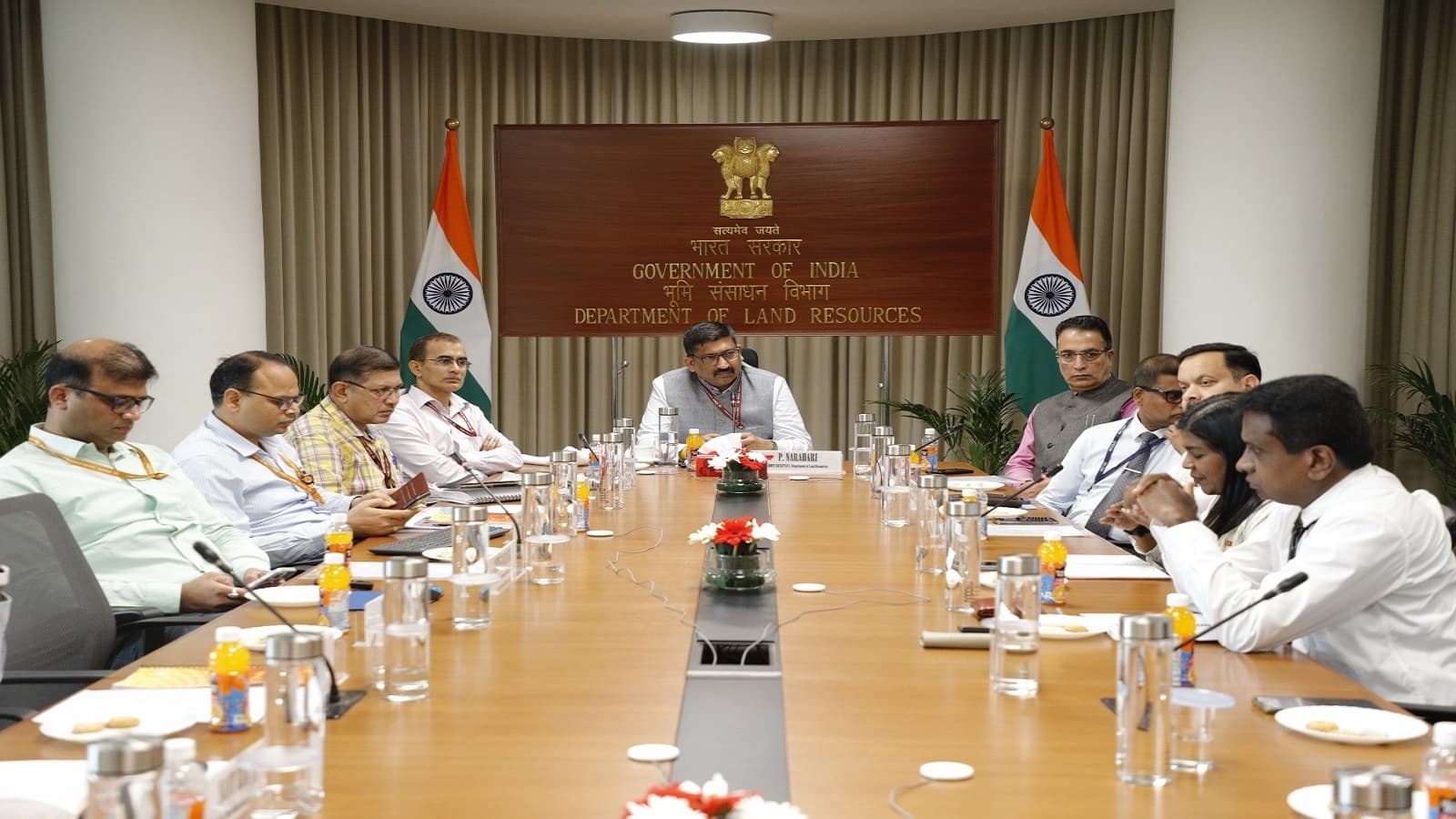
A Sri Lankan delegation witnessed India’s experience in large-scale land governance reforms, spanning digitisation of land records, spatial-textual integration, digital registration, mutation, geospatial identification of land parcels, computerisation of Revenue Courts and modern urban land mapping, an official statement said on Wednesday. The Department of Land Resources (DoLR), Ministry of Rural Development, hosted a delegation of civil servants from Sri Lanka, visiting India under an exposure programme coordinated by the National Centre for Good Governance (NCGG).
P. Narahari, Joint Secretary, Department of Land Resources, highlighted the close ties between India and Sri Lanka and the importance of sharing experiences in public administration. “Land is not merely an administrative record; it is closely linked to livelihoods, economic activity, access to government benefits and citizens’ sense of security. India’s experience has been one of continuously modernising land administration through technology, while recognising the diversity of our States and their land systems.

We are pleased to share these experiences with our Sri Lankan colleagues and equally look forward to learning from their institutional practices and reforms,” he emphasised. The meeting focused on India’s experience in digitising and modernising land records, with emphasis on the Digital India Land Records Modernisation Programme (DILRMP), computerisation of Records of Rights (RoRs), integration of registration with land records and the Unique Land Parcel Identification Number (ULPIN). Amit Kumar Singh, Director (LR), DoLR, said that the The transformation of land records is not merely about converting paper records into digital form.
“The larger objective is to create an integrated land information ecosystem where textual records, spatial information, registration data and geospatial technologies complement each other,” he mentioned. The interaction covered the integration of property registration with land records through mutation, including ongoing reforms towards paperless registration and automated mutation. Under the emerging system, registration information can be electronically transmitted to the concerned revenue authority for updating land records, reducing delays and the need for repeated visits to government offices.
The delegation was also given a walkthrough of the Bharat Land Stack, an integrated, GIS-based federated architecture bringing together satellite and drone imagery, georeferenced cadastral boundaries, Records of Rights, property registration data, master planning and zoning regulations, building approvals, restrictions and litigation, circle rates and tenancy details. The visiting officials were further briefed on ULPIN, or Bhu-Aadhaar, which assigns a unique 14-digit alphanumeric identity to land parcels based on their geospatial coordinates. The system facilitates linkage of land parcels with other land-related datasets and maintains linkages when parcels undergo subdivision. NAKSHA is an important step towards strengthening urban land governance through modern geospatial technologies.
Disclaimer: "This story has been published from a syndicated news feed. Only the headline and subtitle have been edited by EPN."
Nandan Nilekani Proposes Last-Minute Question Papers, AI to Prevent Exam Leaks

MP Board Revises Exam Pattern for Classes 9–12; Removes Internal Choice in 2-Mark Questions
UP Board Extends Registration Deadline for Classes 9 to 12; 5,905 Schools Get Extra Time

Tiger Shroff Escapes Unhurt in Mumbai Shooting, Eknath Shinde Vows Strict Action Against Attackers

Four Greater Manchester universities to offer £10,000 GREAT scholarships to Indian students

France protests turn violent as Paris reports 855 arrests, fresh clashes erupt

A whale’s death inspired him at four, now 11-year-old is set for Earth Medal
Prof. Ajay Kumar Sood named International Science Council Fellow for 2026

2.6 million Afghan girls have lost five years of education, says UNICEF

Riyadh, Diriyah extend remote learning as security concerns persist

Nandan Nilekani Proposes Last-Minute Question Papers, AI to Prevent Exam Leaks
MP Board Revises Exam Pattern for Classes 9–12; Removes Internal Choice in 2-Mark Questions
UP Board Extends Registration Deadline for Classes 9 to 12; 5,905 Schools Get Extra Time
Tiger Shroff Escapes Unhurt in Mumbai Shooting, Eknath Shinde Vows Strict Action Against Attackers
Four Greater Manchester universities to offer £10,000 GREAT scholarships to Indian students
France protests turn violent as Paris reports 855 arrests, fresh clashes erupt
A whale’s death inspired him at four, now 11-year-old is set for Earth Medal
Prof. Ajay Kumar Sood named International Science Council Fellow for 2026
2.6 million Afghan girls have lost five years of education, says UNICEF
Riyadh, Diriyah extend remote learning as security concerns persist
Copyright© educationpost.in 2026 All Rights Reserved.