


The Infosys chairman says secure digital question banks and expanded computer-based testing could address examination security concerns following the NEET-UG 2026 paper leak controversy.
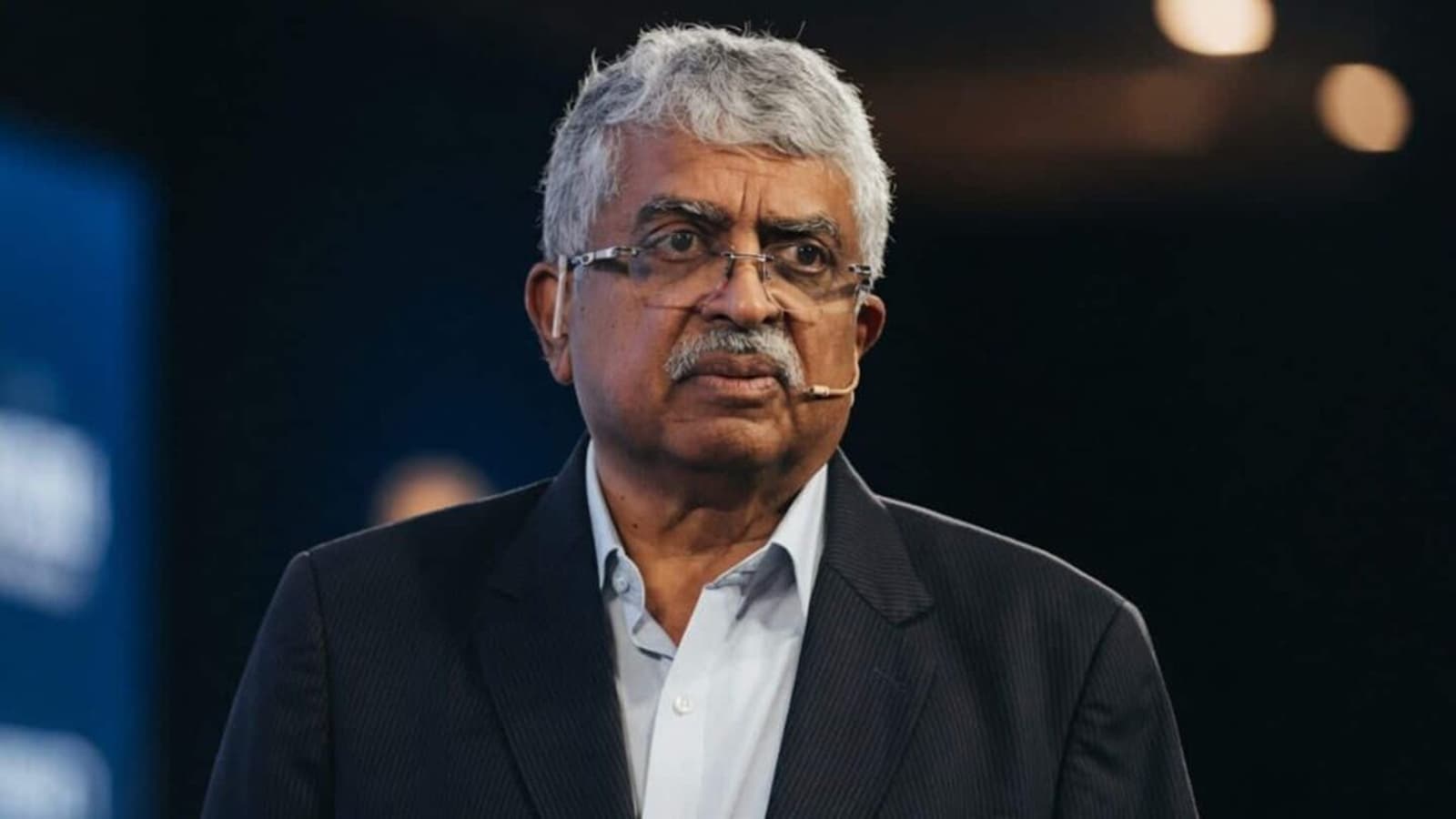
Infosys Chairman Nandan Nilekani discussed technology-based examination reforms at the Bloomberg New Economy Forum 2026 in New Delhi on October 13.
Infosys co-founder and chairman Nandan Nilekani has proposed changing how competitive examination papers are prepared and distributed in India, suggesting that questions should be drawn from large, secure digital banks shortly before an examination begins to reduce the risk of paper leaks.
Speaking at the Bloomberg New Economy Forum 2026 in New Delhi on October 13, Nilekani, who heads the Centre's High-Powered Task Force (HPTF) on examination reforms, questioned the practice of preparing complete question papers in advance, arguing that it creates opportunities for organised leaks and illegal sales.

During a conversation with Bloomberg's John Fraher, Nilekani said the existing system gives individuals who obtain confidential examination papers a financial incentive to sell them before the test.
"Why do we need to have something called a question paper? Because the moment you have a question paper, then that creates an economic incentive for that to be sold or whatever," he said.
Nilekani suggested replacing the conventional approach with a system in which examination authorities maintain a large repository of questions and assemble the final paper only shortly before the examination.
"The way to do that is to really have a massive bank of questions and only at the last minute generate the question paper for that day," he said.
The proposal comes amid growing scrutiny of India's examination system following irregularities surrounding the National Eligibility cum Entrance Test for Undergraduates (NEET-UG) in 2026. The controversy prompted renewed demands for greater transparency, accountability and safeguards in examinations that determine admissions to professional courses.
The proposed changes are still under examination by the government-appointed task force. No nationwide replacement of the existing question-paper system has been announced.
How would the proposed question vault system work?
Under the proposed system, examination authorities would develop and maintain a large collection of questions throughout the year instead of preparing a complete examination paper weeks or months in advance.
Questions would be prepared by subject experts, checked for accuracy, translated into the required languages and stored in a secure digital repository. Shortly before an examination begins, software would select questions according to predetermined requirements, including the syllabus, difficulty level and examination pattern.
According to a report by The Indian Express on October 17, the Nilekani-led task force is examining a digital question vault containing more than one lakh vetted questions, along with encrypted distribution of examination papers shortly before tests begin.
The panel is also considering separating responsibilities for question preparation, examination administration and centre management to prevent excessive control being concentrated in a single service provider. These measures remain under consideration and have not been formally adopted.
The approach is already used in some form by the Staff Selection Commission (SSC), which conducts several recruitment examinations through computer-based testing.
SSC Chairman S. Gopalakrishnan told The Indian Express that questions are selected from a secure repository according to an examination blueprint, compiled shortly before the test and transmitted electronically in encrypted form. He said the Commission had not experienced a question-paper leak in the preceding five years.
Can artificial intelligence generate examination papers?
During the Bloomberg discussion, Fraher asked Nilekani whether artificial intelligence could eventually generate an examination paper on the day of the test and distribute it to candidates.
"Sure, yeah," Nilekani responded, signalling his openness to such a system.
However, he did not explain how AI-generated questions would be validated, whether human examiners would review them or how consistency in difficulty would be maintained across candidates.
There is also an important distinction between using AI to create new questions and using software to assemble a paper from an existing bank of expert-approved questions. The latter is the more developed proposal currently under discussion.
NEET-UG 2026 controversy prompted renewed examination reforms
The examination security debate intensified after allegations of a question-paper leak surrounding NEET-UG 2026, conducted by the National Testing Agency on May 3.
On May 12, the Central Bureau of Investigation registered a case following a complaint from the Ministry of Education alleging unauthorised circulation of examination-related material before the test.
The agency said the allegations raised concerns about the examination's integrity and required a comprehensive investigation into the individuals and organisations potentially involved.
The May examination was subsequently cancelled, and the NTA conducted a fresh NEET-UG examination on June 21, 2026.
Following widespread student protests and demands for accountability, Prime Minister Narendra Modi announced the formation of the Nilekani-led task force on July 26.
The committee's mandate extends beyond question-paper security. According to the Department of Personnel and Training, it is examining examination design, institutional accountability, infrastructure, accessibility, grievance redressal and student well-being.
The government also invited suggestions from students, parents, educational institutions and other stakeholders, with September 13 as the deadline for public submissions.
The Nilekani panel follows an earlier reform exercise launched in June 2024 under former ISRO chairman K. Radhakrishnan. That committee submitted 101 recommendations covering examination procedures, cybersecurity, institutional restructuring and testing infrastructure.
Despite measures introduced since then, the recurrence of examination irregularities in 2026 has raised questions about the pace and effectiveness of implementing earlier recommendations.
Parliamentary panel also recommends question banks and computer-based NEET
Nilekani's suggestions broadly align with recommendations made by the Parliamentary Standing Committee on Education, Women, Children, Youth and Sports in its 382nd report, presented on October 9, 2026.
The committee, chaired by Rajya Sabha MP Mukul Wasnik, recommended that the NTA establish continuously updated question banks and generate final papers as close to examination time as possible.
It also called for greater investment in government-controlled computer-based testing infrastructure, including a phased network of 1,000 secure centres and at least one examination centre in every district.
The report identified institutional weaknesses alongside technological vulnerabilities. It found that only 23 of the NTA's 39 sanctioned officer positions were filled, leaving approximately 41% vacant.
It also warned that computer-based examinations could face hacking and other forms of digital manipulation unless accompanied by dedicated cybersecurity teams, secure software and monitoring systems.
These findings point to challenges beyond protecting question papers. An expanded digital examination system would also need sufficient testing facilities, reliable connectivity, trained personnel and safeguards for candidates in rural and underserved areas.
Nilekani referred to an existing network of "150,000 locations" where students could take tests and said it needed expansion. He did not clarify whether the figure referred to physical examination centres, testing seats or another category of locations.
When will the Nilekani committee submit its report?
Nilekani said he had been asked to prepare the examination reform report on July 28 and had been given three months to complete the assignment, indicating a deadline towards the end of October 2026.
He also expressed confidence that the recommendations would receive government attention.
"I think the Prime Minister is very keen to implement our suggestions," he said.
Asked why examination irregularities had persisted despite previous committees and reform exercises, Nilekani argued that the problem could be addressed by identifying its causes and applying suitable technology.
"If you look at it systematically and go to root causes of why it's happening and use technology to solve it, they are solvable issues," he said.
The task force is expected to submit its recommendations later this month. The government has not yet announced which measures it will adopt or a timetable for implementing them.
Nandan Nilekani Proposes Last-Minute Question Papers, AI to Prevent Exam Leaks

MP Board Revises Exam Pattern for Classes 9–12; Removes Internal Choice in 2-Mark Questions

UP Board Extends Registration Deadline for Classes 9 to 12; 5,905 Schools Get Extra Time

Tiger Shroff Escapes Unhurt in Mumbai Shooting, Eknath Shinde Vows Strict Action Against Attackers

Four Greater Manchester universities to offer £10,000 GREAT scholarships to Indian students

France protests turn violent as Paris reports 855 arrests, fresh clashes erupt

A whale’s death inspired him at four, now 11-year-old is set for Earth Medal
Prof. Ajay Kumar Sood named International Science Council Fellow for 2026

2.6 million Afghan girls have lost five years of education, says UNICEF

Riyadh, Diriyah extend remote learning as security concerns persist

Nandan Nilekani Proposes Last-Minute Question Papers, AI to Prevent Exam Leaks
MP Board Revises Exam Pattern for Classes 9–12; Removes Internal Choice in 2-Mark Questions
UP Board Extends Registration Deadline for Classes 9 to 12; 5,905 Schools Get Extra Time
Tiger Shroff Escapes Unhurt in Mumbai Shooting, Eknath Shinde Vows Strict Action Against Attackers
Four Greater Manchester universities to offer £10,000 GREAT scholarships to Indian students
France protests turn violent as Paris reports 855 arrests, fresh clashes erupt
A whale’s death inspired him at four, now 11-year-old is set for Earth Medal
Prof. Ajay Kumar Sood named International Science Council Fellow for 2026
2.6 million Afghan girls have lost five years of education, says UNICEF
Riyadh, Diriyah extend remote learning as security concerns persist
Copyright© educationpost.in 2026 All Rights Reserved.