


Ban on secondary and higher education leaves millions of girls without a path to university, exposing them to child marriage, exploitation and violence.
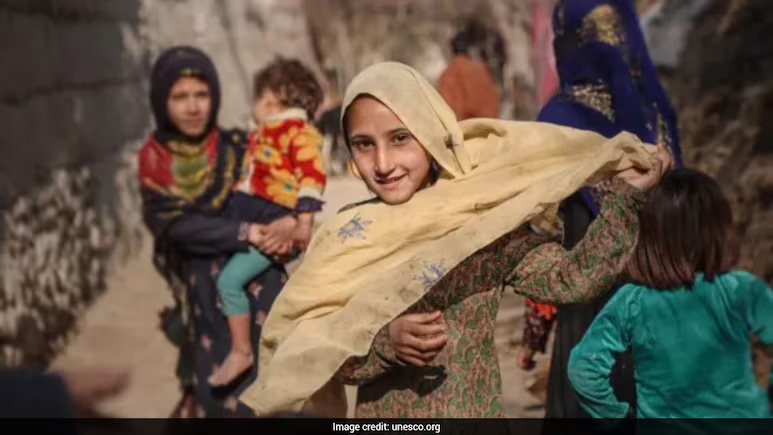
More than 2.6 million girls in Afghanistan have been denied secondary education since the Taliban-led de facto authorities took power in 2021, UNICEF has said, warning that years of lost learning are putting girls’ futures and the country’s social and economic development at risk.
Afghanistan remains the only country in the world where secondary and higher education are effectively closed to girls and women, according to the United Nations Children’s Fund (UNICEF).

The restrictions have kept girls out of formal education beyond Grade 6 since September 2021. Women have also been barred from attending universities since December 2022, leaving millions unable to continue their studies or pursue higher qualifications.
UNICEF Executive Director Catherine Russell said five years might be a short period in a country’s history, but it represents a defining stage in a girl’s life.
“A classroom offers more than learning. It gives a young person a voice and the ability to reach their full potential,” Russell said, highlighting the role schools play in protecting children from labour, early marriage, exploitation and violence.
She warned that the closure of classrooms had stripped girls of an important layer of protection at a time when they needed it most.
Girls deprived of education face heightened risks of child labour, early marriage, abuse, exploitation and gender-based violence, UNICEF said. These dangers become more acute when families struggle with poverty or are forced to leave their homes.
The situation is further complicated by the return of millions of Afghans from neighbouring countries. More than 2.7 million people have returned from Iran and Pakistan since 2023, with children and young people accounting for 60% of the total, according to UNICEF.
For girls in these circumstances, the loss of access to education can deepen existing vulnerabilities, limiting their opportunities to develop skills, gain financial independence and build secure futures.
The consequences extend well beyond classrooms, with restrictions on girls’ education and women’s employment threatening Afghanistan’s future workforce and economic growth.
A UNICEF analysis published in April 2026, titled The Cost of Inaction on Girls’ Education and Women’s Labour Force Participation in Afghanistan, warned that the country could lose up to 20,000 women teachers and 5,400 female health workers by 2030.
The decline is already visible in the education sector. The number of female teachers in basic education fell by more than 9%, from nearly 73,000 in 2022 to around 66,000 in 2024. Women’s representation in the civil service also dropped, from 21% in 2023 to 17.7% in 2025.
The analysis estimated that restrictions on girls’ education and women’s employment are costing Afghanistan $84 million annually in lost economic output. The economic losses are expected to accumulate for as long as the restrictions remain in place.
UNICEF warned that the impact of denying girls an education could extend into the next generation, affecting children’s health and development.
As more girls grow up without education, the number of mothers without formal schooling is likely to rise, potentially increasing the risks of low birthweight, inadequate vaccination and childhood stunting among their children.
These outcomes could place additional pressure on Afghanistan’s already strained health system, reinforcing the wider consequences of excluding girls and women from education.
For millions of Afghan girls, the restrictions mean more than missed lessons or delayed qualifications. They represent years of lost opportunities, diminished independence and uncertain futures, with consequences that could shape the country for generations.

Q Manivannan loses St Andrews rector race after rape comments controversy

Riyadh, Diriyah extend remote learning as security concerns persist

NSF commits over $110 million to advance next-generation wireless technology

Oregon teacher tackles teenage gunman as father shoots attacker dead

China advances vocational education partnerships with Bangladesh, Mali and Tanzania
Riyadh, Diriyah extend remote learning as security concerns persist
.jpg&w=256&q=75)
From Class 8 to hospital owner: Rajasthan Police expose alleged fake doctor registration

Who will lead Keralam's universities? Government begins steps to appoint permanent VCs
%20(1)%20(1).jpeg&w=256&q=75)
Why does cracking JEE Advanced depend on coaching? IIT Kanpur Director calls for a revamp
.jpg&w=256&q=75)
NEET-PG 2026 answer key row: Supreme Court seeks NBEMS response on missing question papers

Q Manivannan loses St Andrews rector race after rape comments controversy
Riyadh, Diriyah extend remote learning as security concerns persist
NSF commits over $110 million to advance next-generation wireless technology
Oregon teacher tackles teenage gunman as father shoots attacker dead
China advances vocational education partnerships with Bangladesh, Mali and Tanzania
Riyadh, Diriyah extend remote learning as security concerns persist
From Class 8 to hospital owner: Rajasthan Police expose alleged fake doctor registration
Who will lead Keralam's universities? Government begins steps to appoint permanent VCs
Why does cracking JEE Advanced depend on coaching? IIT Kanpur Director calls for a revamp
NEET-PG 2026 answer key row: Supreme Court seeks NBEMS response on missing question papers
Copyright© educationpost.in 2026 All Rights Reserved.