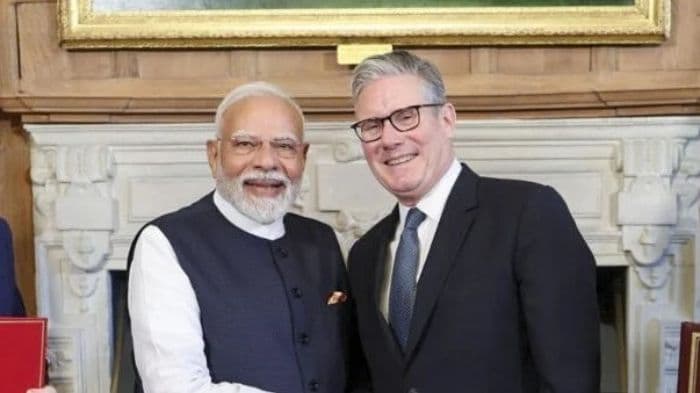
UK Prime Minister Keir Starmer began a two-day visit to India aimed at reinforcing the recently signed UK-India free trade agreement and promoting expanded business, investment, and institutional partnerships between the two countries.
Starmer arrived in Mumbai on October 8, 2025, leading a delegation comprising over 120 leaders from British corporate, educational, and cultural sectors.

The trade mission comes in the wake of a free trade agreement signed in July 2025, which lowered tariffs on a wide range of British exports to India, including in sectors like apparel, whisky, and aerospace.
While his visit emphasizes business and trade, Starmer has been clear that visa liberalization is not part of the agenda. When questioned about proposals from business groups to ease visa access for Indian professionals and students, he stated that “the issue is not about visas” and asserted the current agreement does not include changes on immigration.
During his visit, Starmer is expected to meet Indian Prime Minister Narendra Modi and hold discussions on implementation of the trade pact, broader economic cooperation, and strategic sectors including tech, infrastructure, education, and energy.
The UK-India trade deal projects an increase in bilateral trade of £25.5 billion (~USD 34 billion) by 2040, with UK exports to India anticipated to rise nearly 60 percent under the lower tariffs.
On the aviation front, British Airways has announced plans to add a third daily flight between New Delhi and London in 2026, and Manchester Airport may also inaugurate a Delhi route, underlining connectivity ambitions tied to stronger economic engagement.
Starmer’s India visit is being closely watched as a key diplomatic and commercial moment. Beyond tariffs and trade figures, it will test whether deeper institutional linkages—across education, technology, and cultural exchange—can accompany the economic agreement.