


A Pakistani naval vessel reportedly moved close to an Indian warship during a surveillance mission, prompting India to invoke the 1991 maritime safety agreement.
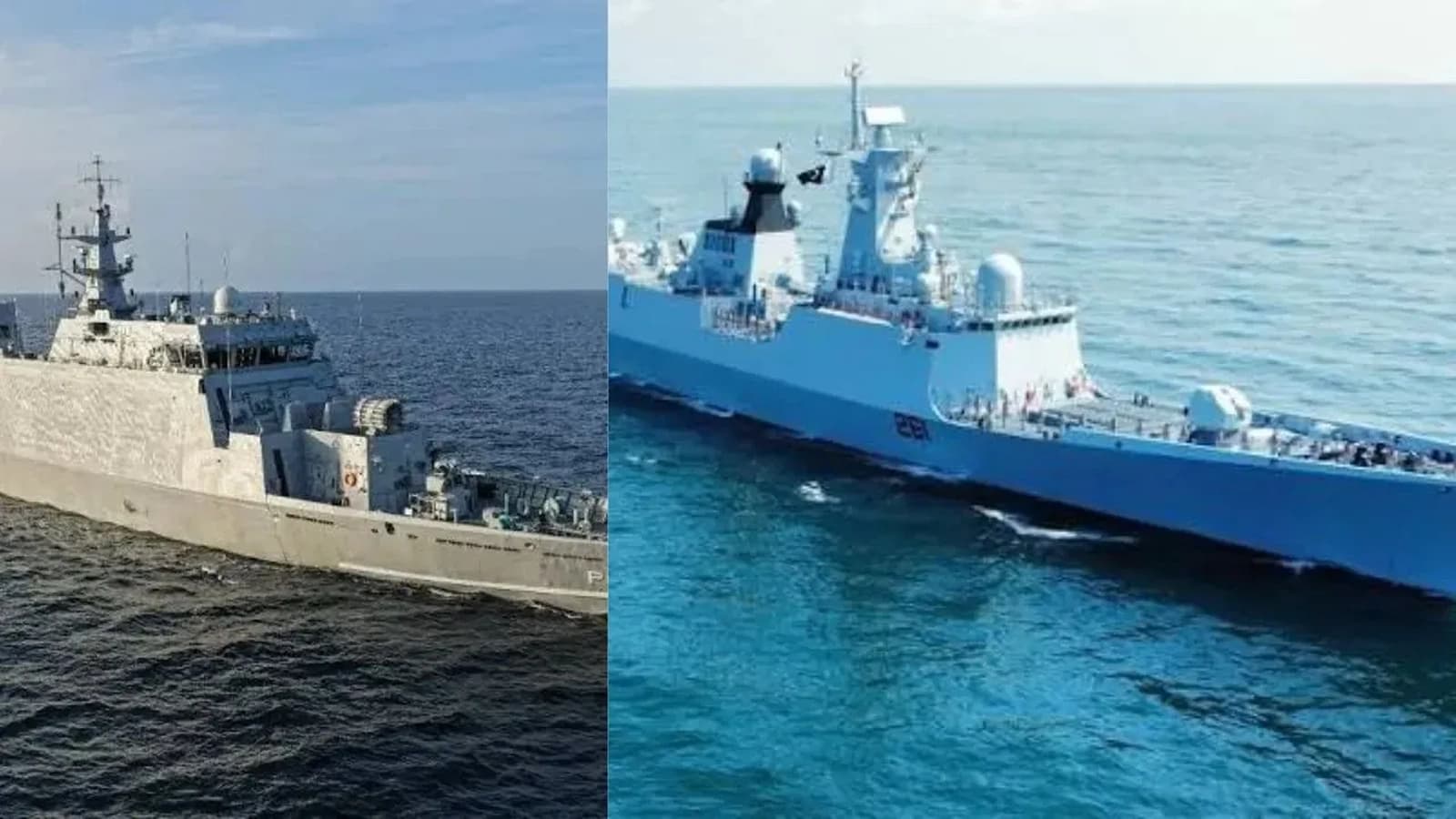
A high-speed encounter between Indian and Pakistani naval vessels in the North Arabian Sea has triggered a fresh diplomatic exchange between New Delhi and Islamabad after the two ships came into contact in international waters on September 15.
The incident occurred when an Indian Navy warship was carrying out a routine surveillance mission. According to Indian sources cited by multiple news organisations, a Pakistani naval vessel approached the Indian warship at high speed and carried out manoeuvres that brought the two vessels dangerously close. The encounter eventually resulted in a collision, although no major damage or injuries were reported on the Indian side.

The incident came to light on September 16 after the Ministry of External Affairs (MEA) summoned Pakistan's Charge d'Affaires in New Delhi and lodged a strong protest. India described the conduct of the Pakistani naval units as “unacceptable and unprofessional” and said the actions were contrary to provisions contained in the 1991 India-Pakistan agreement governing military activities and movements.
The precise sequence of manoeuvres has not been independently established by either side in a publicly released investigation. However, reports citing Indian sources provide a more detailed account of the encounter.
According to India Today, the Indian warship was conducting routine surveillance in the North Arabian Sea when the Pakistani vessel PNS Hunain began shadowing it. Indian sources said repeated warnings were issued through Channel 16, the maritime radio channel used for distress and safety communications.
The Pakistani vessel allegedly then increased its speed and crossed the Indian warship's path from the starboard side. Its bow subsequently brushed against the Indian vessel, resulting in the reported collision. India Today reported that the Indian ship suffered no structural damage, no personnel were injured and the vessel continued with its mission after the encounter.
The identity of the Pakistani vessel as PNS Hunain has been reported by India Today and other publications. The MEA's public statement, however, referred more generally to a “Pakistani naval ship” and did not publicly identify the vessel.
Moneycontrol, citing media reports, identifies PNS Hunain as a Yarmook-class offshore patrol vessel commissioned into the Pakistan Navy in 2024. The vessel is designed for maritime security, surveillance and other naval operations.
The Indian government's response was diplomatic rather than a military escalation.
The MEA summoned Pakistan's Charge d'Affaires in New Delhi on September 16 and lodged what it described as a strong protest over the conduct of the Pakistani naval units.
According to the ministry, the incident occurred in international waters and did not result in major damage. At the same time, India said the conduct of the Pakistani vessel was in “direct contravention” of Article 10 of the Agreement between India and Pakistan on Advance Notice on Military Exercises, Manoeuvres and Troops Movements, signed in April 1991.
India also asked the Pakistani diplomat to communicate to the relevant authorities that military units from both sides should exercise due care and follow the bilateral agreements in order to prevent similar incidents.
The Indian Charge d'Affaires in Islamabad has separately been instructed to lodge a similar protest with Pakistan's Ministry of Foreign Affairs.
A central element of the diplomatic dispute is Article 10 of the 1991 agreement.
The provision includes safety arrangements for Indian and Pakistani naval ships and submarines operating in international waters. Current reporting on the incident states that the agreement requires naval vessels and submarines from the two countries to maintain a minimum separation of three nautical miles, or approximately 5.6 kilometres, to reduce the possibility of accidents.
The agreement is formally titled the Agreement between India and Pakistan on Advance Notice on Military Exercises, Manoeuvres and Troops Movements. Although its broader purpose concerns advance notification of military activities, Article 10 addresses the conduct and separation of naval vessels operating in international waters.
India's contention is that the circumstances surrounding the September 15 encounter breached these safety provisions.
According to the information publicly available so far, no major damage was reported.
India Today reported that the Indian warship suffered no structural damage, there were no injuries and no loss of operational capability. The vessel reportedly continued its surveillance mission after the encounter.
The MEA likewise said the incident did not cause any major damage.
The absence of significant physical damage is an important distinction because the diplomatic dispute is centred primarily on the conduct and circumstances of the encounter rather than on extensive material damage.
The collision is significant because it involves the naval forces of India and Pakistan, two nuclear-armed neighbours whose military relationship remains sensitive.
Reuters described the episode as the first overt military tension between the two countries since their four-day military conflict in 2025, after which a ceasefire was reached.
The encounter also took place in international waters rather than within either country's territorial waters. That makes established maritime safety procedures and bilateral arrangements particularly relevant.
For naval vessels operating at sea, high-speed manoeuvring and insufficient separation can sharply reduce the time available to avoid a collision. In this case, India has specifically linked the incident to the bilateral 1991 agreement.
Pakistan's government and military had not immediately responded to Reuters' request for comment when the agency published its September 16 report. Therefore, the publicly available account of how the collision occurred remains largely based on Indian government statements and sources cited by Indian media.
The latest incident also brings back memories of a 2011 confrontation involving INS Godavari and PNS Babur in the Gulf of Aden.
In June 2011, INS Godavari was involved in an anti-piracy operation around the merchant vessel MV Suez, which had been released after being held by Somali pirates. Pakistan Navy's PNS Babur was also involved in the operation.
According to an official statement recorded by India's Press Information Bureau, PNS Babur approached INS Godavari from astern at high speed and manoeuvred close enough to touch the Indian vessel, marginally damaging the extended safety net on the helicopter deck. India subsequently lodged a protest with Pakistan over what it described as a violation of navigational safety regulations and Article 10 of the 1991 agreement.
Pakistan had presented a different account of that 2011 incident and lodged its own protest, alleging that INS Godavari had interfered with the humanitarian operation involving MV Suez. The competing accounts were documented at the time by both governments.
The 2011 episode is therefore relevant background, but it should not be treated as evidence that the circumstances of the September 2026 incident were identical.
For now, the immediate response has remained at the diplomatic level.
India has lodged a formal protest in New Delhi and instructed its diplomatic representative in Islamabad to raise the matter with Pakistan's Foreign Ministry. The MEA has also called for military units to exercise greater caution and comply with existing bilateral arrangements to prevent a recurrence.
Further details about the September 15 encounter could emerge if either side releases additional information or if a formal inquiry provides a fuller account of the manoeuvres.
For the moment, the key facts are that an Indian and Pakistani naval vessel came into contact in international waters in the North Arabian Sea, India says the Pakistani vessel approached at high speed and acted unsafely, no major damage was reported, and New Delhi has formally protested the incident by invoking the 1991 bilateral agreement.

Bihar’s classrooms go digital: 11 IT companies to train teachers in AI and technology

University of Liverpool’s Bengaluru campus eyes biosciences, competitive fees to attract students

Mubadala, Khalifa University launch life sciences research programme in UAE

Birla Open Minds, Burlington English Join Hands to Introduce Digital English Learning for Grades 1–8

Australian universities back student-feedback benchmark for education agents

Centre Amends Motor Vehicle Rules to Allow E100 Ethanol Fuel in Flex-Fuel Vehicles

Study in Malaysia for Indian Students 2026: Universities, Fees, Scholarships, Visa and Career Opportunities
Delhi BS6 Entry Ban From November 1 Could Affect Over 10 Lakh NCR Vehicles

Study in Indonesia for Indian Students 2026: Top Universities, Fees, Scholarships, Visa and Career Opportunities

Study in China 2027: Top Universities, Fees, Scholarships, Visas and Career Options for Indian Students

Bihar’s classrooms go digital: 11 IT companies to train teachers in AI and technology
University of Liverpool’s Bengaluru campus eyes biosciences, competitive fees to attract students
Mubadala, Khalifa University launch life sciences research programme in UAE
Birla Open Minds, Burlington English Join Hands to Introduce Digital English Learning for Grades 1–8
Australian universities back student-feedback benchmark for education agents
Centre Amends Motor Vehicle Rules to Allow E100 Ethanol Fuel in Flex-Fuel Vehicles
Study in Malaysia for Indian Students 2026: Universities, Fees, Scholarships, Visa and Career Opportunities
Delhi BS6 Entry Ban From November 1 Could Affect Over 10 Lakh NCR Vehicles
Study in Indonesia for Indian Students 2026: Top Universities, Fees, Scholarships, Visa and Career Opportunities
Study in China 2027: Top Universities, Fees, Scholarships, Visas and Career Options for Indian Students
Copyright© educationpost.in 2026 All Rights Reserved.