


Developed under the IndiaAI Mission, the three models aim to strengthen India's AI capabilities, support 22 Indian languages and expand access to artificial intelligence in sectors such as education, banking, defence and cybersecurity.
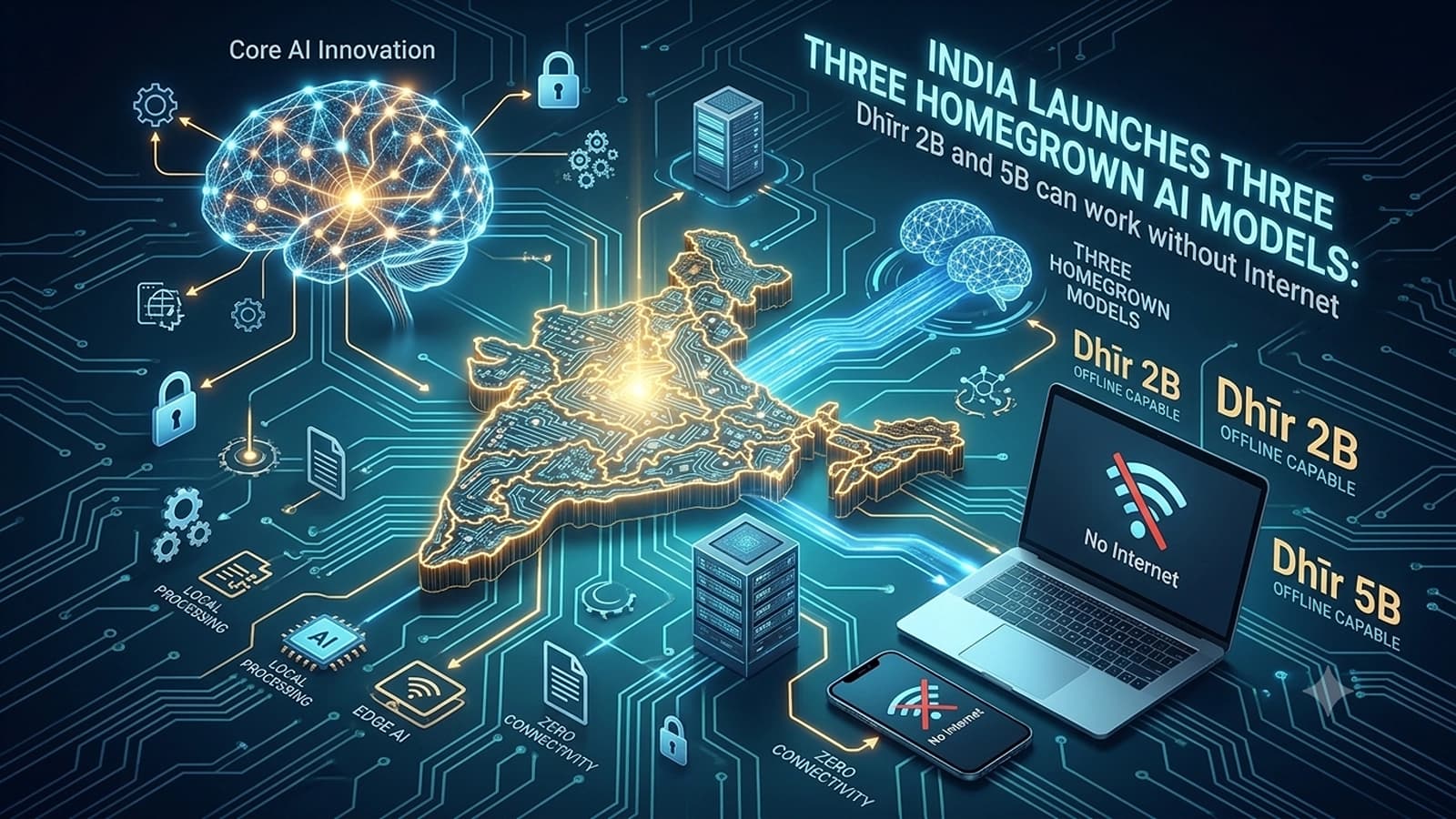
Representational Image
India has taken another step towards developing its own artificial intelligence technology with the launch of three indigenous AI models: EKA-1, Dhīr 2B and Dhīr 5B. Announced on November 3, 2026, by the Ministry of Electronics and Information Technology (MeitY), the models have been developed under the government's IndiaAI Mission.
The announcement is particularly significant because two of these models, Dhīr 2B and Dhīr 5B, are designed to operate directly on supported smartphones without requiring an internet connection. The three models have been developed by two Indian companies, Soket Labs Technology and Research and ZenteiQ AiTech Innovations, with government support.

EKA-1: AI Model Supporting 22 Indian Languages
Developed by Soket Labs, EKA-1 is the largest of the three models, featuring 26.3 billion parameters and trained on approximately 7.5 trillion tokens. It supports all 22 scheduled Indian languages, along with English, and is designed to perform tasks involving mathematics, coding and complex problem-solving. The company has developed EKA-1 keeping India's banking, financial services and cybersecurity requirements in mind. It can also be deployed on private systems, including networks that are disconnected from the internet.
Dhīr 2B and Dhīr 5B: AI Without Internet Connectivity
Developed by ZenteiQ, Dhīr 2B and Dhīr 5B are smaller AI models designed for smartphones and other compatible devices. Both models support English and 10 Indian languages. They can perform tasks such as retrieving information from documents and assisting with information processing without depending on cloud-based services.
This could make AI more accessible in areas with limited internet connectivity. Their local processing capabilities may also help organizations handle sensitive information without routinely sending it to external servers. However, their performance will depend on device compatibility and available processing capacity.
How Is the Government Supporting These AI Models?
The development of all three models comes under the IndiaAI Mission, approved by the Union Cabinet on March 7, 2024. The initiative aims to strengthen India's artificial intelligence ecosystem through computing infrastructure, research, startup support, skill development and responsible AI development. According to MeitY, the developers received access to subsidized computing infrastructure and support for additional research expenses. The government also plans to make these models accessible through AIKosh, its AI resources platform.
The launch could create opportunities for AI applications in education, government services, defence, banking and cybersecurity. However, questions remain about their accuracy, performance across Indian languages and ability to compete with established international AI models. Independent performance comparisons and wider real-world testing will be important to establish their capabilities. The launch marks progress in India's domestic AI development. Its long-term impact will depend on how effectively these models are adopted and used beyond their initial release.

HABIT Foundation Hosts INNOVATE 2026 in Mumbai to Showcase Student Innovations and Prototypes

Want to prepare for married life? Goa college introduces a certificate course on relationships

Vedanta Power Wins Two India CSR Awards 2026 for Healthcare and Agricultural Development

University of Cumbria appoints Susan Foyle as honorary Professor of Practice

NCTE forms panel to include ITEP graduates in CTET, STET eligibility criteria
Want to prepare for married life? Goa college introduces a certificate course on relationships
NCTE forms panel to include ITEP graduates in CTET, STET eligibility criteria

Australia to introduce Holocaust and Jewish history lessons in 2027 curriculum overhaul

India Launches Three Homegrown AI Models; Dhīr 2B and 5B Can Work Without Internet

IIT Delhi announces new measures to strengthen student mental health support system

HABIT Foundation Hosts INNOVATE 2026 in Mumbai to Showcase Student Innovations and Prototypes
Want to prepare for married life? Goa college introduces a certificate course on relationships
Vedanta Power Wins Two India CSR Awards 2026 for Healthcare and Agricultural Development
University of Cumbria appoints Susan Foyle as honorary Professor of Practice
NCTE forms panel to include ITEP graduates in CTET, STET eligibility criteria
Want to prepare for married life? Goa college introduces a certificate course on relationships
NCTE forms panel to include ITEP graduates in CTET, STET eligibility criteria
Australia to introduce Holocaust and Jewish history lessons in 2027 curriculum overhaul
India Launches Three Homegrown AI Models; Dhīr 2B and 5B Can Work Without Internet
IIT Delhi announces new measures to strengthen student mental health support system
Copyright© educationpost.in 2026 All Rights Reserved.