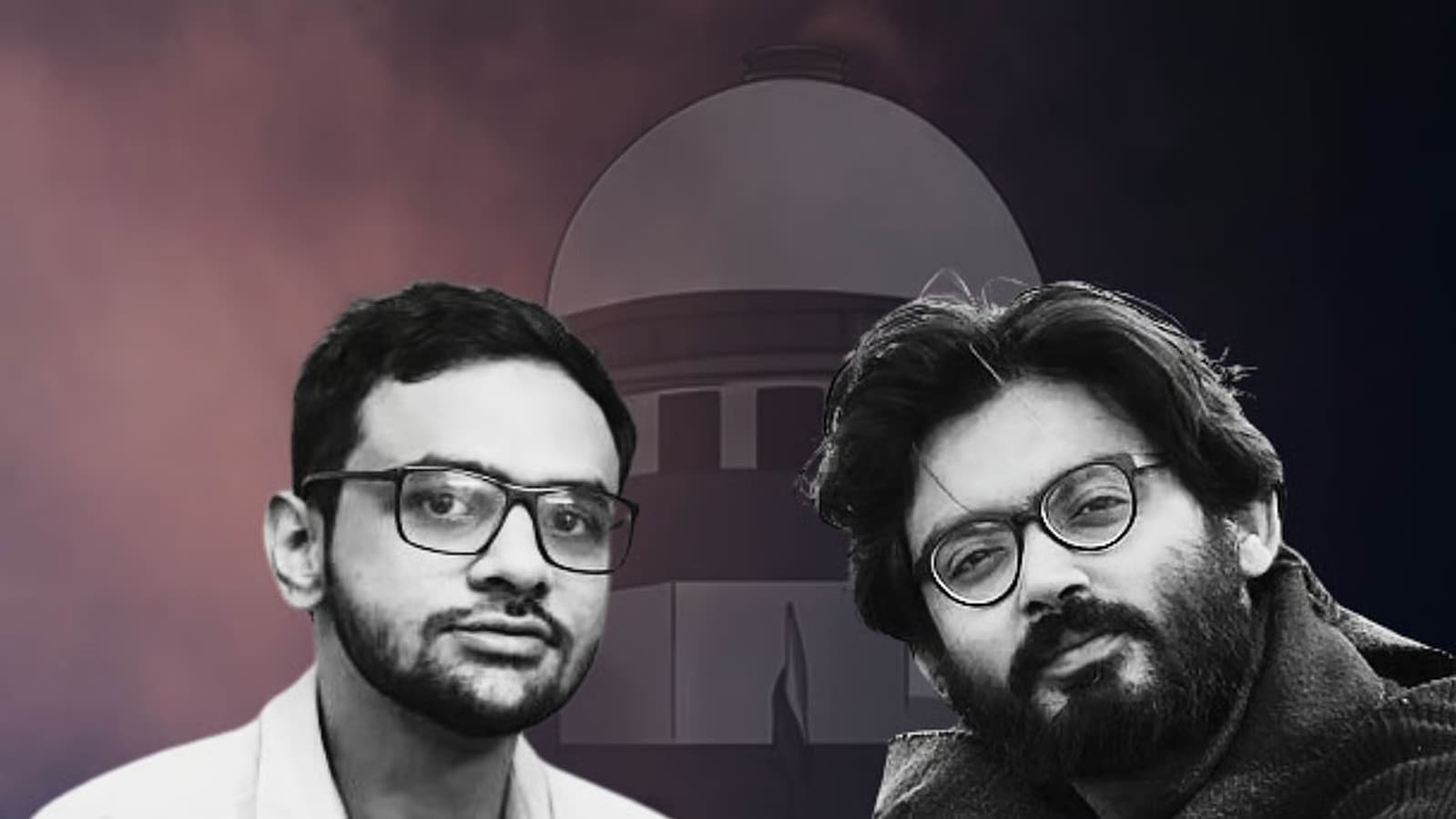
The Supreme Court on Monday strongly reaffirmed that prolonged incarceration and delay in trial remain valid grounds for granting bail in cases under the Unlawful Activities (Prevention) Act (UAPA), while expressing clear reservations over recent judgments that denied bail to activists, including Umar Khalid and Sharjeel Imam in the Delhi riots conspiracy case.
A bench of Justice B V Nagarathna and Justice Ujjal Bhuyan made the observations while granting bail to Syed Iftikhar Andrabi, who has spent more than six years in custody in a terror-funding case linked to narcotics trafficking.

The court said a two-judge bench cannot dilute or sidestep a binding precedent laid down by a larger bench of the Supreme Court. The judgment specifically referred to the 2021 ruling in Union of India v. K.A. Najeeb, which held that prolonged delay in trial can justify bail even under the stringent provisions of the UAPA.
The bench expressed disapproval of the 2025 judgment in Gulfisha Fatima v. State, which denied bail to Umar Khalid and Sharjeel Imam, and the 2024 ruling in Gurwinder Singh v. Union of India for allegedly failing to properly apply the principles laid down in K.A. Najeeb.
Justice Bhuyan, authoring the judgment, said the three-judge bench ruling in K.A. Najeeb clearly established that constitutional courts can grant bail in UAPA cases if there is prolonged incarceration and delay in trial, despite the restrictions imposed under Section 43D(5) of the anti-terror law.
The court observed that the later two-judge bench rulings adopted a “somewhat divergent view,” making it difficult to reconcile them with the larger bench precedent.
“A judgment rendered by a bench of lesser strength is bound by the law declared by the bench of greater strength. Judicial discipline mandates that such a binding precedent must either be followed or, in case of doubt, be referred to a larger bench. A smaller bench cannot dilute, circumvent or disregard the ratio of a larger bench,” the judgment stated.
The bench also clarified that the 2019 ruling in NIA v. Zahoor Ahmed Shah Watali could not be used to justify indefinite pre-trial detention under the UAPA. It questioned the interpretation adopted in Gurwinder Singh that effectively treated denial of bail as the norm in terror-related cases.
The court took particular exception to the “two-prong test” evolved in Gurwinder Singh, under which bail could only be considered if the accused established that the prosecution’s case lacked prima facie merit. According to the bench, such a standard neither emerged from the UAPA nor from the K.A. Najeeb ruling.
Warning against the dangers of this interpretation, Justice Bhuyan observed that the state would only need to establish a low prima facie threshold while trials continue for years, effectively converting pre-trial incarceration into punishment without conviction.
“If this test is accepted, the State needs only to satisfy a low prima facie threshold while the trial may continue for years, with the result that pre-trial incarceration begins to acquire a post-trial punitive character,” the judgment noted.
The court emphasized that Section 43D(5) of the UAPA should not become the sole basis for denying bail if it results in a violation of the constitutional guarantee of speedy trial under Article 21.
The bench also disagreed with the interpretation in the Gulfisha Fatima judgment that K.A. Najeeb applied only in exceptional situations. Clarifying the law, the court stated that prolonged custody arising from surrounding circumstances must be meaningfully considered while deciding bail pleas.
“We make it clear that KA Najeeb is binding law and entitled to the protection of stare decisis. It cannot be diluted, circumvented or disregarded by the trial court, the High Court or even by benches of lower strength of this court,” Justice Bhuyan said.
The Supreme Court further reiterated that the principle of “bail is the rule, jail is the exception” continues to apply even in UAPA cases.
“Therefore, we have no manner of doubt in stating that even under the UAPA, bail is the rule and jail is the exception,” the court held.
The bench stressed that Article 21 protections apply irrespective of the nature of allegations and observed that more serious accusations demand faster trials rather than prolonged incarceration.
The court also referred to the 2024 judgment in Sheikh Javed Iqbal case, where bail was granted in a UAPA matter solely because of delay in trial.
In its ruling, the court criticized the growing tendency of smaller benches to weaken larger bench precedents without openly disagreeing with them. Incidentally, both the Gurwinder Singh and Gulfisha Fatima judgments were authored by Justice Aravind Kumar.
The case before the court involved Syed Iftikhar Andrabi, a resident of Handwara in Jammu and Kashmir’s Kupwara district, who was arrested by the National Investigation Agency on June 11, 2020.
The NIA alleged that Andrabi was part of a cross-border narcotics syndicate operating through the Tangdhar border area and that proceeds from heroin trafficking were used to fund terror groups, including Lashkar-e-Taiba and Hizbul Mujahideen.
He faces charges under the NDPS Act, the UAPA and criminal conspiracy provisions of the Indian Penal Code before a Special NIA Court in Jammu.
His bail plea had earlier been rejected by the Special NIA Court in August 2024 and later by the High Court of Jammu and Kashmir and Ladakh in August 2025. The High Court had held that the seriousness of the allegations outweighed the argument of prolonged custody and noted that the trial was still at an early stage.
However, the Supreme Court has now underlined that constitutional protections cannot be indefinitely suspended because of delayed trials, particularly in cases where incarceration stretches for years without conclusion of proceedings.






.png&w=256&q=75)