


Dhaka links future ties with New Delhi to renewal of the Ganges water-sharing pact, as tensions rise over Padma barrage and unresolved river disputes.
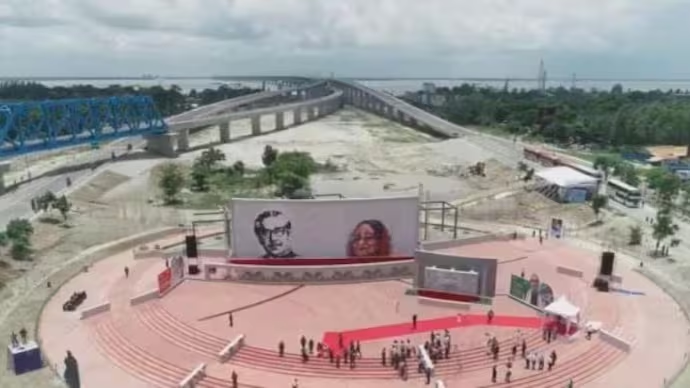
Bangladesh’s ruling Bangladesh Nationalist Party (BNP) on May 17 linked the future of Dhaka’s relationship with New Delhi to the renewal of the Ganges Water Sharing Treaty, urging India to begin immediate negotiations on a fresh pact that reflects Bangladesh’s “expectations and needs”.
The existing India-Bangladesh Ganges Water Sharing Treaty, signed in 1996 during former Prime Minister Sheikh Hasina’s tenure, is due to expire in December 2026.

Addressing an event in Dhaka, BNP secretary general and Minister of Rural Development and Co-operatives Mirza Fakhrul Islam Alamgir said Bangladesh wanted to send a “clear message” to India that a new agreement must be finalized through dialogue and aligned with the interests of the Bangladeshi people.
“The opportunity to establish good relations with India will depend on the signing of the Ganges Water Sharing Treaty, or the Farakka Agreement,” Alamgir said.
He also argued that the current treaty should remain in force until a new pact is signed, while suggesting future water-sharing agreements between the two neighbors should not be tied to fixed deadlines.
The Ganges river, known as the Padma after entering Bangladesh through Chapai Nawabganj district, remains critical to the country’s agriculture, biodiversity and water supply.
Bangladesh, which is criss-crossed by hundreds of rivers including 54 that originate in or flow through India, depends heavily on cross-border water-sharing arrangements. According to Alamgir, nearly one-third of Bangladesh’s 170 million people rely on this river system for livelihoods and ecological stability.
The Farakka issue has long remained politically and emotionally charged in Bangladesh. Successive governments and water experts have argued that reduced dry-season flows downstream from the Farakka Barrage have worsened salinity intrusion, damaged river systems and hurt agriculture and ecosystems across several regions.
India, however, has consistently maintained that the Farakka Barrage was built primarily to preserve navigability at Kolkata Port by diverting water into the Hooghly river to flush out sediment.
The BNP leader’s remarks came days after Bangladesh approved a major project to build a barrage on the Padma river, aimed at offsetting what Dhaka calls the “negative impact” of the Farakka Barrage.
The project, expected to be completed by 2033, was cleared earlier this week by Bangladesh’s Executive Committee of the National Economic Council during a meeting chaired by Prime Minister Tarique Rahman.
Bangladesh Water Resources Minister Shahiduddin Chowdhury Anee said the proposed barrage was linked to the country’s national interests and did not require consultations with India.
“Discussions are necessary regarding the Ganges, and those are ongoing,” Anee said.
The project has triggered mixed reactions among experts. Water expert Ainun Nishat, who helped draft the original Ganges treaty, cautiously welcomed the move but said its success would depend on the continuation of the water-sharing agreement with India.
Other experts warned that the proposed barrage could worsen sediment accumulation and raise riverbeds in Bangladesh, potentially intensifying concerns already associated with the Farakka Barrage.
Earlier this month, BNP leaders also criticized former West Bengal Chief Minister Mamata Banerjee over the long-pending Teesta water-sharing agreement.
Speaking to ANI, BNP Information Secretary Azizul Baree Helal accused Banerjee’s government of blocking progress on the proposed Teesta pact between India and Bangladesh.
He also welcomed the Bharatiya Janata Party’s victory in West Bengal, saying the result could strengthen ties between Bangladesh and the neighboring Indian state.
Praising Suvendu Adhikari, Helal expressed hope that a political shift in West Bengal could help revive stalled negotiations on the Teesta agreement.
India has maintained that all water-related concerns with Bangladesh are being addressed through established bilateral mechanisms.
Earlier this month, Ministry of External Affairs spokesperson Randhir Jaiswal said India and Bangladesh share 54 rivers and already have structured platforms to discuss transboundary water issues.
“These bilateral mechanisms continue to meet at regular intervals,” Jaiswal said.
During the same briefing, he also reiterated India’s position on the Indus Waters Treaty, saying it remained “in abeyance” because of Pakistan’s support for cross-border terrorism. Referring to Operation Sindoor, he said India had every right to defend itself against terrorism and accused Pakistan of using cross-border terror as an instrument of state policy.
.jpg&w=256&q=75)
Karnataka introduces 7.5% sub-quota for rural government school students in professional course admissions

NEET PG Counselling 2026 Round 1 registration begins Oct 12, check schedule and key dates

Odisha Governor Inaugurates Boeing STEM Lab, Aeromodelling Centre in Bargarh
PM Modi praises NEP impact, Tamil Nadu CM Vijay seeks ₹5,110 crore in dues

Learning, earning, research, innovation and building must all come together
Karnataka introduces 7.5% sub-quota for rural government school students in professional course admissions
NEET PG Counselling 2026 Round 1 registration begins Oct 12, check schedule and key dates
PM Modi praises NEP impact, Tamil Nadu CM Vijay seeks ₹5,110 crore in dues

JNU dismissal row: Bimol Akoijam challenges university's claims, JNUTA flags procedural lapses

US probes nine universities over J-1 visas, halts PERM processing for eight firms

Karnataka introduces 7.5% sub-quota for rural government school students in professional course admissions
NEET PG Counselling 2026 Round 1 registration begins Oct 12, check schedule and key dates
Odisha Governor Inaugurates Boeing STEM Lab, Aeromodelling Centre in Bargarh
PM Modi praises NEP impact, Tamil Nadu CM Vijay seeks ₹5,110 crore in dues
Learning, earning, research, innovation and building must all come together
Karnataka introduces 7.5% sub-quota for rural government school students in professional course admissions
NEET PG Counselling 2026 Round 1 registration begins Oct 12, check schedule and key dates
PM Modi praises NEP impact, Tamil Nadu CM Vijay seeks ₹5,110 crore in dues
JNU dismissal row: Bimol Akoijam challenges university's claims, JNUTA flags procedural lapses
US probes nine universities over J-1 visas, halts PERM processing for eight firms
Copyright© educationpost.in 2026 All Rights Reserved.