


Laboratory tests commissioned by the Karnataka government reportedly found ethanol levels exceeding the 20% E20 benchmark in several petrol samples. The state has demanded an investigation, action against oil companies and compensation for motorists who may have suffered losses.
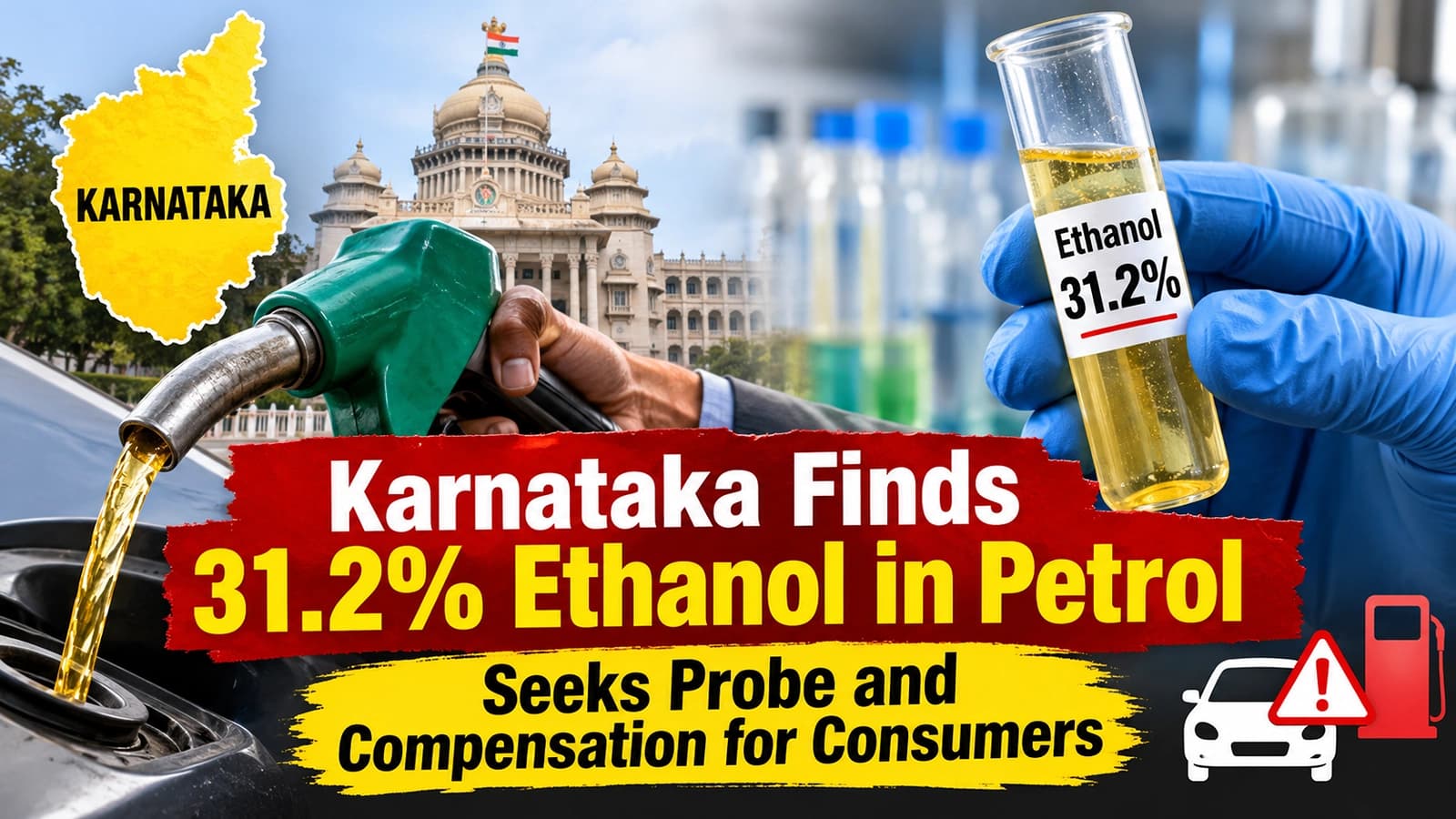
Karnataka flags excessive ethanol levels in petrol, raising consumer concerns.
The debate over India's ethanol-blended petrol programme has intensified after the Karnataka government reported finding ethanol concentrations as high as 31.2% in petrol samples collected across the state. The findings have raised concerns about fuel quality, vehicle compatibility and the possible financial burden on motorists. On November 6, Karnataka Food, Civil Supplies and Consumer Affairs Minister Rizwan Arshad announced that laboratory tests had detected ethanol levels exceeding the 20% benchmark associated with E20 petrol in several samples.The highest concentration, 31.2%, was reportedly found in a sample collected from an Indian Oil Corporation (IOCL) outlet. Another sample from a Hindustan Petroleum Corporation Limited (HPCL) outlet reportedly contained 30.5% ethanol.
Following the findings, the state government has sought an investigation by the Centre and demanded action against oil companies if violations are established. It has also proposed a compensation mechanism for vehicle owners who may have experienced damage due to excessive ethanol blending.The development has brought India's fuel-quality monitoring system under scrutiny, particularly at a time when the country is expanding its ethanol-blending programme.

11 of 14 Reported Test Results Exceeded the E20 Benchmark
According to the findings reported by The South First, 11 of the 14 publicly detailed laboratory results showed ethanol concentrations above 20%.
The reported readings included:
The samples were reportedly collected from seven districts: Bengaluru, Kolar, Chikkaballapura, Bengaluru Rural, Ramanagara, Mangaluru and Tumakuru. The Karnataka government said it had collected 63 petrol samples. However, the detailed results publicly reported by The South First cover 14 samples. Therefore, the available figures should not be interpreted as confirmation that all 63 samples exceeded the E20 benchmark.
Why Is Karnataka Questioning Oil Companies?
According to Minister Rizwan Arshad, the state government initially sent the collected samples to the respective oil companies' laboratories for testing. The companies were reportedly asked to disclose the ethanol concentration in the samples. However, the state alleged that the reports did not provide the specific ethanol percentages it had requested.
Following this, the government approached private laboratories for further testing. The tests were reportedly conducted at Shriram Research Institute in Bengaluru, using gas chromatography, a laboratory technique that helps identify and measure the chemical components of a sample. The Karnataka government has questioned whether the fuel supplied to consumers complies with the applicable quality standards. However, the oil companies' detailed responses to these allegations remain important. Reuters reported on November 6 that the companies and the Union Petroleum Ministry had not immediately responded to its requests for comment.
Can Higher Ethanol Levels Affect Your Vehicle?
One of the biggest concerns raised by the Karnataka government is the possible impact of higher ethanol concentrations on vehicles. Ethanol has different properties from conventional petrol. Vehicles designed and tested for particular fuel blends may not necessarily be suitable for significantly higher concentrations.
The potential concerns include:
However, it is important to distinguish between a potential risk and proven damage. The Karnataka laboratory findings reportedly establish higher ethanol concentrations in certain samples. They do not independently prove that every vehicle using the tested fuel has suffered mechanical damage. Further technical investigations and vehicle inspections would be necessary to establish a direct connection between the fuel and reported repair problems.
Karnataka Demands Compensation Fund for Affected Motorists
Alongside its demand for an investigation, Karnataka has asked the Centre to establish an E20 spoilage fund to compensate vehicle owners who may have suffered damage because of excessive ethanol blending.
The proposed mechanism could include:
The state has also demanded that petrol pumps clearly display the ethanol percentage in the fuel being sold. It wants consumers to have greater transparency and the option to choose between different fuel blends, including E10, E20 and E30, wherever available and appropriate. However, the proposed compensation fund remains a demand by the Karnataka government. The Centre has not confirmed its approval as a national scheme.
What Does the Central Government Say About E20 Petrol?
The Karnataka findings have also brought attention to the Centre's position on ethanol-blended petrol. The Union Ministry of Petroleum and Natural Gas has previously defended the E20 programme, stating that its implementation involved consultations with automobile manufacturers, research institutions, oil companies and technical agencies.
In a July 23, 2026, clarification, the government said it had no decision to increase nationwide ethanol blending beyond 20%. It also stated that E85 fuel was intended exclusively for flex-fuel vehicles designed and certified to use it. According to the Ministry, more than 20 crore two-wheelers and over three crore petrol cars had operated on E15-plus and E19-E20 blends without verified evidence of widespread engine failure attributable to ethanol blending. In another clarification issued on July 30, 2026, the government said E20 petrol complied with BIS specifications and underwent quality checks throughout the supply chain.
The Ministry also referred to testing and field validation involving institutions such as NITI Aayog, the Automotive Research Association of India (ARAI), the Indian Institute of Petroleum and the Society of Indian Automobile Manufacturers. However, the Karnataka allegations raise a separate question. The Centre's defense of properly specified E20 fuel does not automatically address reports of samples containing 25% to 31.2% ethanol. Whether these samples violated applicable specifications requires a specific investigation.
The Karnataka government has indicated that it will continue testing petrol samples and has sought explanations from the Union ministers responsible for Petroleum and Natural Gas and Road Transport and Highways. The state wants the Centre to investigate the reported ethanol levels, examine the role of oil marketing companies and introduce stronger monitoring of fuel quality.
The next important development will be whether the Union government orders an independent investigation and whether the oil companies release their own detailed laboratory findings. For motorists, the issue goes beyond the ethanol-blending policy. It concerns whether the petrol they purchase meets the required quality standards and whether they have access to compensation if violations are established. India's ethanol programme aims to reduce dependence on imported crude oil and support domestic production. However, achieving these objectives also requires transparent testing, effective regulation and accountability across the fuel supply chain.
Anthropic’s Mythos AI Model: How Artificial Intelligence Is Transforming Cybersecurity

Democratic Control of Congress Raises Hopes of Iran Deal and Lower Crude Prices

Market Rally Follows Three Years of Weak Performance Amid Global Uncertainty and High Valuations
Supreme Court Reconsiders 2003 Two-Child Norm Ruling, Questions Its Relevance Amid Changing Demographics

SC Says Police Cannot Delay Constitutional Safeguards Through Searches and Questioning

Nepali students form Japan's second-largest international academic community: Foreign Minister

'Mogging' explained: How bodybuilding term became Collins Word of the Year 2026

‘It’s actually very cut-throat’: 13-year-old wins New Zealand spelling bee title

Schoolchildren join desperate effort to save stranded whales on New Zealand coast

New Zealand school hostel shut down after damning inspection raises concerns over student welfare

Anthropic’s Mythos AI Model: How Artificial Intelligence Is Transforming Cybersecurity
Democratic Control of Congress Raises Hopes of Iran Deal and Lower Crude Prices
Market Rally Follows Three Years of Weak Performance Amid Global Uncertainty and High Valuations
Supreme Court Reconsiders 2003 Two-Child Norm Ruling, Questions Its Relevance Amid Changing Demographics
SC Says Police Cannot Delay Constitutional Safeguards Through Searches and Questioning
Nepali students form Japan's second-largest international academic community: Foreign Minister
'Mogging' explained: How bodybuilding term became Collins Word of the Year 2026
‘It’s actually very cut-throat’: 13-year-old wins New Zealand spelling bee title
Schoolchildren join desperate effort to save stranded whales on New Zealand coast
New Zealand school hostel shut down after damning inspection raises concerns over student welfare
Copyright© educationpost.in 2026 All Rights Reserved.