


While every state and territory now has a pathway to 100% needs-based funding, millions of students could spend their entire school lives in underfunded public education systems.

Every Australian public school system now has a funding agreement aimed at delivering full needs-based funding, following Victoria’s long-awaited deal with the federal government. However, the milestone comes with a significant caveat: many schools will have to wait until 2034 to receive their full funding entitlement.
Victoria signed the agreement last week, giving its public schools a timeline to reach the 100% funding benchmark established through the landmark 2011 Gonski review. The deal came after a prolonged delay, with all other states and territories having signed long-term agreements by mid-2025.

The Albanese government has described the development as a major step towards ensuring every public school in the country is on a path to full and fair funding. But while the agreements mark progress towards a more equitable school funding system, the pace of implementation raises questions about how many generations of students will pass through underfunded schools before the promised changes take full effect.
What do the funding agreements promise?
Under the Better and Fairer Schools Agreement, every public school system is expected to reach 100% of the Schooling Resource Standard (SRS) by 2034 at the latest. The SRS is a needs-based benchmark designed to estimate the funding required to provide students with a quality education, taking into account their individual and school-level needs.
Under the agreements, the federal government will contribute 25% of the SRS for public schools, while state and territory governments will provide the remaining 75%. The Northern Territory operates under a different arrangement, with a 40:60 funding split.
The benchmark emerged from the Gonski review of school funding, but it has taken nearly 15 years for every jurisdiction to commit to bringing its public school system to that level. The agreements are expected to deliver an additional A$16.5 billion in federal funding for public schools over the next decade, followed by around A$50 billion more in the decade after.
Full funding remains years away for several states
Despite the nationwide agreements, the road to full funding is far from complete. Public schools in New South Wales, Queensland and South Australia are not expected to reach the 100% benchmark until 2034. This means many children currently attending these schools will graduate before their education systems receive the full funding promised under the agreements.
Some jurisdictions have a shorter journey. Public schools in the Australian Capital Territory, Western Australia and Tasmania have already reached the full funding benchmark, while the Northern Territory is expected to achieve it by 2029. Victoria, meanwhile, currently receives 70.43% of the SRS from the state government and 20% from the Commonwealth, taking its total funding to 90.43%. Under the new agreement, Victoria has committed to increasing its contribution to 75% by 2031. The state has also left open the possibility of bringing forward that commitment to 2029, subject to its budget position.
However, the agreement is heavily weighted towards the later years. The Commonwealth's contribution will not reach its full 25% share until 2034, meaning Victorian public schools will have to wait until then to achieve the 100% benchmark.
Private schools already receive their full funding entitlement
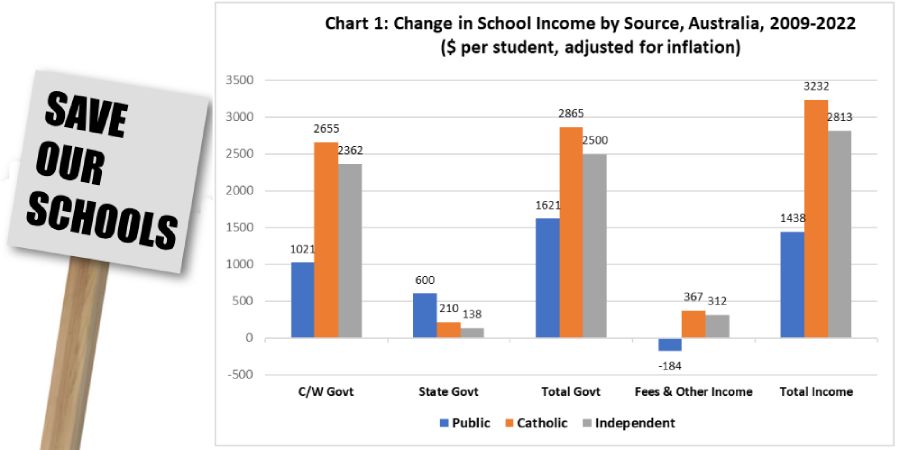
The funding gap between public and non-government schools remains another significant feature of Australia's education system. Nationally, non-government schools are already funded at or above their SRS entitlement on average, or are in the process of transitioning to full funding. In the Northern Territory, non-government schools are expected to reach full funding by 2029. The contrast has renewed attention on the pace at which public schools are receiving the resources required to meet the needs of their students.
Two generations of students could miss out
The long implementation timeline has consequences extending well beyond government budgets and funding agreements.
Consider a child who began school in 2012, shortly after the Gonski review was released. That student completed Year 12 in 2024, having spent their entire school life in a public education system that, in most jurisdictions, remained below the recommended funding benchmark.
A child who started school in 2022 will complete Year 12 in 2034, the final year of the current agreements. In effect, two generations of students could pass through public schools without experiencing a fully funded system throughout their education.
The delay is particularly concerning as educational inequalities continue to widen. Federal Education Minister Jason Clare has pointed out that the reading gap between eight-year-olds from the poorest and wealthiest families has doubled over the past 15 years. The disparity becomes even more pronounced as students progress through school. Analysis by the Mitchell Institute shows that Year 9 students whose parents hold a bachelor's degree or higher are now six years and eight months ahead in reading of those whose parents did not complete school. The gap stood at six years in 2023.
These figures underline the challenge facing policymakers: increasing overall funding is important, but ensuring that disadvantaged students receive the support they need is equally critical.
Are Australia's school funding problems finally fixed?
Not yet. The agreements extend until the end of 2034 and must survive multiple federal and state elections, changing political priorities and competing budget demands. The experience of the original Gonski funding arrangements offers a reminder of the risks.
Under those agreements, around two-thirds of the additional funding was scheduled for the fifth and sixth years. However, the incoming Coalition government did not retain those commitments. The current agreements could face similar pressures, particularly where governments have deferred a substantial share of their funding contributions until the final years. Victoria has already acknowledged the financial challenge, saying it will seek to bring forward its contribution if its budget permits.
For the agreements to deliver their intended outcomes, governments will need to maintain their commitments well beyond the political cycles in which they were signed.
What needs to happen next?
Reaching the 100% funding benchmark is an important step, but funding alone will not resolve every challenge confronting public schools. Four priorities will be critical to ensuring the agreements translate into meaningful improvements for students.
First, school infrastructure needs greater attention. The SRS covers recurrent education funding but does not include major capital expenditure. School buildings, classrooms and facilities require separate investment. Reports from Victoria have highlighted public schools struggling to afford even basic maintenance, raising questions about how effectively additional recurrent funding can address broader infrastructure needs.
Second, equity must become a measurable national priority. Current agreements include targets for improving NAPLAN results among priority equity groups. However, they do not establish a specific target for closing the achievement gap between disadvantaged and more privileged students. Without such a measure, overall performance could improve even as educational inequality continues to grow.
Third, funding must be translated into effective classroom support. The agreements link additional resources to reforms such as phonics checks, small-group tutoring and evidence-based teaching. While these initiatives can support learning, teachers and school leaders must retain the professional judgement to respond to the different needs and circumstances of their students.
Finally, governments need to accelerate the funding timetable. Public schools in Australia's largest states face another eight years before reaching the benchmark first proposed in 2011. The Commonwealth could bring forward its full 25% contribution, while states could increase their own shares sooner.
For students currently sitting in classrooms, 2034 is a distant promise. Bringing full funding forward would ensure that the benefits reach children who need them today, rather than leaving another generation to wait.

Students shut down dozens of French high schools over education reforms

3D Australian school designs give teachers and students a voice before construction begins

Australia’s public schools get funding deals but full support still years away

UK and EU plan three-year mobility scheme for young people as student fee talks continue

Auckland Writers Festival unveils first four authors for 2027 schools programme
Students shut down dozens of French high schools over education reforms
UK and EU plan three-year mobility scheme for young people as student fee talks continue

Japan's Okayama University uses robotics competitions to build engineering and workplace skills

Indian Navy Rescues 20 Crew from Hijacked Iranian Vessel off Somalia

Learning Mandarin, earning degrees in China: How Indonesian youth are preparing for global careers

Students shut down dozens of French high schools over education reforms
3D Australian school designs give teachers and students a voice before construction begins
Australia’s public schools get funding deals but full support still years away
UK and EU plan three-year mobility scheme for young people as student fee talks continue
Auckland Writers Festival unveils first four authors for 2027 schools programme
Students shut down dozens of French high schools over education reforms
UK and EU plan three-year mobility scheme for young people as student fee talks continue
Japan's Okayama University uses robotics competitions to build engineering and workplace skills
Indian Navy Rescues 20 Crew from Hijacked Iranian Vessel off Somalia
Learning Mandarin, earning degrees in China: How Indonesian youth are preparing for global careers
Copyright© educationpost.in 2026 All Rights Reserved.