Can AI become greener? NTU Singapore and Canaan launch S$7 million research initiative
The four-year collaboration will explore energy-aware computing, privacy-preserving edge AI, distributed inference and curriculum development while supporting four PhD researchers and developing industrial prototypes.
By Pragya Kumari · Updated
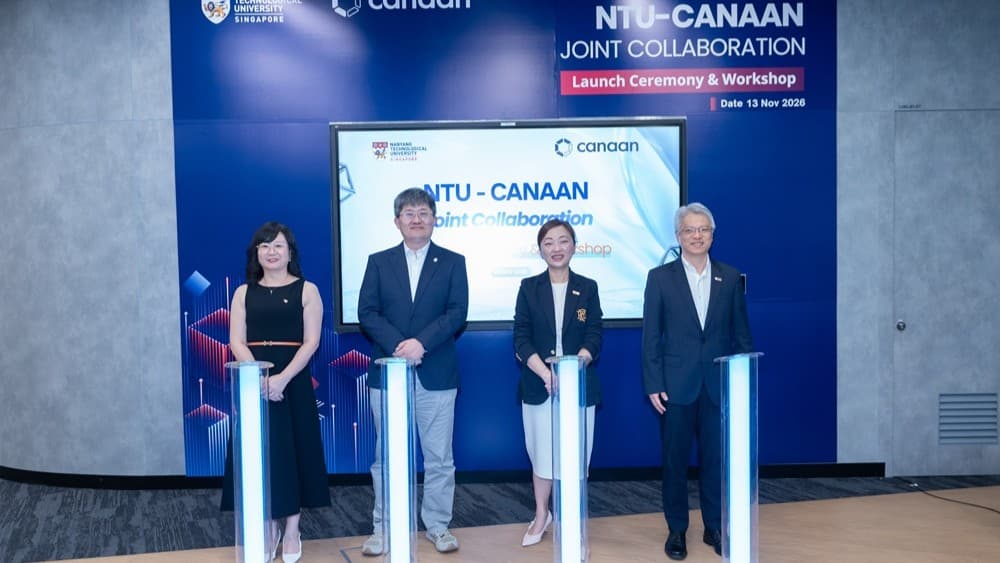
Nanyang Technological University, Singapore (NTU Singapore), has partnered with computing technology and semiconductor developer Canaan Inc. to launch a S$7 million research initiative focused on developing energy-efficient computing technologies and edge artificial intelligence (AI).
The four-year partnership, known as the NTU-Canaan Green Intelligent Compute (GIC) Collaboration, will explore the research theme "Towards Green Intelligent Compute for Advanced Systems and Applications.”
Hosted by NTU's Centre in Computational Technologies for Finance (CCTF), the initiative seeks to address the growing demand for computing resources driven by rapid developments in AI.
As AI models become larger and their industrial applications expand, computing infrastructure faces increasing pressure to deliver high performance while limiting energy consumption and environmental impact.
The research will focus on making AI workloads more energy-efficient, secure, and suitable for real-world deployment. Its outcomes are expected to benefit businesses, consumers, and developers by improving the way computing resources are managed across different applications.
In sectors such as smart retail, the proposed technologies will enable devices to process video and sensor data locally instead of relying entirely on centralized cloud servers. This approach could reduce network traffic, improve processing efficiency, and strengthen data privacy.
NTU and Canaan focus on energy-efficient computing systems
Professor Shirley Meng, Vice President (Industry) at NTU Singapore, said the partnership would help address the environmental challenges associated with the expansion of AI and translate research developments into practical industrial applications.
“As artificial intelligence expands across every sector, managing its environmental footprint has become a critical global challenge. This partnership with Canaan reflects NTU's commitment to translating scientific breakthroughs into viable industrial solutions. By co-developing energy-efficient edge computing systems and establishing joint training modules, we are strengthening Singapore's position as a hub for sustainable digital innovation and equipping our talent to meet future technological demands.”
Nangeng Zhang, Founder, Chairman and CEO of Canaan, said improving computing efficiency requires coordinated developments across semiconductor hardware, software, workload management, and energy consumption.
“As AI moves beyond centralised data centres and into more diverse real-world environments, computing efficiency is becoming a system-level challenge - spanning chips, software, workload scheduling and energy use. Our collaboration with NTU brings together academic research and Canaan’s engineering experience to explore how computing systems can become more energy-efficient, adaptive and practical for deployment. We also see this collaboration as part of our long-term commitment to Singapore’s research and technology ecosystem.”
Canaan's semiconductor expertise to support NTU research
The collaboration will combine Canaan's industry experience in application-specific integrated circuit (ASIC) design, specialized computing, and systems engineering with NTU's academic and research capabilities in artificial intelligence, computer engineering, and data science.
Under the arrangement, NTU researchers will provide scientific leadership and academic testbeds for the research activities. Canaan will contribute hardware platforms, engineering expertise, computing infrastructure, and practical industry scenarios to help test and develop the proposed technologies.
The partnership is designed to connect algorithm development with physical hardware and industrial applications, allowing researchers to assess how computing systems perform under real-world operating conditions.
Four research areas under NTU-Canaan green computing initiative
The four-year programme will cover four major research areas aimed at improving energy efficiency, data protection, computing performance, and technical education.
1. Green and energy-aware computing
The first research area will examine ways to predict energy requirements, manage computing resources dynamically, and schedule energy-intensive workloads more efficiently.
Drawing on Canaan's experience in operating computing systems, researchers will investigate how computing tasks can be adjusted according to electricity grid availability, system workloads, and task priorities.
The work will explore approaches that allow computing infrastructure to make more efficient use of available energy while maintaining operational requirements.
2. Privacy-preserving edge AI for smart retail
The second area will focus on developing privacy-preserving AI technologies for retail environments, where cameras and sensors continuously generate large volumes of data.
Rather than transmitting unprocessed visual information to centralized cloud servers, the research team will explore local edge inference and data minimization techniques.
These methods are intended to allow devices to analyze information closer to where it is generated while reducing the amount of sensitive data transferred across networks.
The research will also consider compliance with Singapore's Personal Data Protection Act (PDPA), which governs the collection, use, and disclosure of personal data.
3. Cloud-edge-end collaborative inference
The third research direction will examine how AI workloads can be distributed across cloud servers, edge gateways, and endpoint devices.
Cloud-based and device-based AI models have different computing capabilities and operational limitations. The research will therefore investigate model partitioning and workload allocation techniques to determine how tasks can be divided across multiple computing environments.
This approach is expected to support more flexible AI deployment by allowing complex workloads to be processed across different layers of computing infrastructure.
4. Edge AI education and curriculum development
The fourth area will focus on incorporating research findings into education and technical training.
The partnership plans to develop educational software development kits, laboratory modules, and teaching materials based on the research outcomes.
These resources will be integrated into NTU's academic curriculum to help students understand chip architectures, hardware and system constraints, and software deployment.
The initiative aims to strengthen practical knowledge of edge AI and equip students with skills relevant to the development and deployment of energy-efficient computing technologies.
NTU-Canaan project to support four PhD researchers
Apart from advancing research and developing industrial applications, the collaboration will also support academic publications and the training of future technology professionals.
The four-year initiative will fund four PhD researchers and aims to produce approximately 10 academic papers. The joint research team also plans to prepare four technical work-package reports.
Other expected outcomes include functional industrial prototypes and patent applications wherever the research produces commercially applicable innovations.
The project will establish a direct feedback mechanism between university research and industrial engineering, allowing findings from academic investigations to inform practical technology development and deployment.
Singapore's national AI and green computing priorities
The NTU-Canaan collaboration aligns with Singapore's broader priorities for developing sustainable digital infrastructure, strengthening AI research, and expanding technology adoption across industries.
Following the updated National AI Strategy in 2026, Singapore has continued to expand its focus on AI research, workforce development, and enterprise adoption.
The initiative also supports national green computing efforts, including the Green Data Centre Roadmap and Singapore Standard SS 715:2025, which emphasize energy efficiency across digital facilities and information technology equipment.
By focusing on low-power edge computing, distributed AI inference, and energy-aware resource management, the research partnership aims to contribute to more sustainable computing infrastructure.
The collaboration will bring together semiconductor engineering, academic research, and AI education to explore computing systems that can meet growing technological demands while reducing energy consumption and supporting Singapore's transition toward a sustainable digital economy.
Also read