


The bench asked authorities to examine the rollout timeline, language choices and availability of qualified teachers while suggesting an expert panel to address implementation challenges across schools.
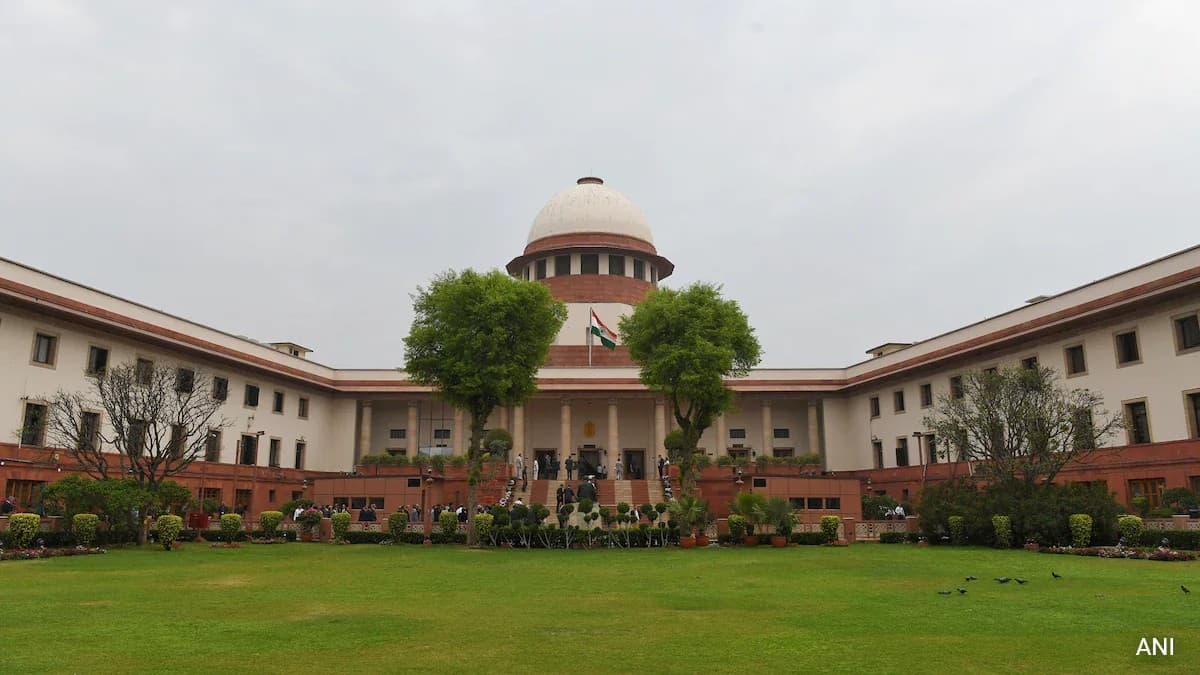
The Supreme Court on Aug 20 questioned the rollout of the CBSE’s three-language requirement for Class 9, emphasizing that the new policy should not place undue academic pressure on students.
A bench headed by Chief Justice Surya Kant and comprising Justices Joymalya Bagchi and V Mohana said introducing the policy itself was not problematic, but its implementation required closer examination.

The court was hearing petitions challenging the CBSE decision to make three languages mandatory for Class 9 students from July 1, 2026.
It raised concerns over several aspects of the rollout, including the availability of qualified language teachers and the appropriate class from which the policy should be introduced.
The bench suggested that if Class 6 is intended to be the starting point, students entering the class this year could be given a reprieve, with implementation beginning from the following academic session.
It also asked authorities to consider whether the language policy should instead start from Class 6, Class 4, or Class 3, depending on the curriculum and the stage at which students are required to choose between studying two or three languages.
Teacher availability emerged as another key issue during the hearing. The bench said schools offering additional languages must have adequate teachers and other necessary resources.
The court also suggested setting up an expert committee to assess challenges arising from the implementation of the policy and propose possible solutions.
The petitioners have questioned CBSE’s authority to prescribe curriculum-related changes for Classes 6 to 8.
Senior advocate Anand Grover, representing some of the petitioners, argued that the curriculum for these classes comes under the jurisdiction of the National Council of Educational Research and Training (NCERT).
The bench also asked the Centre to examine how the three-language framework could be implemented across school boards other than CBSE.
Under the new framework, CBSE has made 23 languages available as options. The court stressed that regional and indigenous languages should not be treated as inferior and highlighted the broader importance of language learning.
Justice Bagchi also raised an issue with the terminology used in the policy, questioning the use of the word “native” and observing that it carried a colonial connotation. He said “indigenous” would be more appropriate.
According to the CBSE circular issued on May 15, students entering Class 9 from July 1, 2026, must study three languages designated as R1, R2 and R3. At least two of these must be Indian languages.
A foreign language can be selected as R3 only after students choose two Indian languages, or it can be taken as a fourth additional language.
CBSE has said the policy is part of its efforts to align school education with the National Education Policy (NEP) 2020 and the National Curriculum Framework for School Education (NCF-SE) 2023.
For the 2026-27 academic session, Class 9 students will use Class 6 R3 textbooks until dedicated textbooks for the third language are made available.
The board has also sought to reduce the academic load by stating that there will be no separate Class 10 Board examination for R3. Schools have been directed to update their available R3 language choices for Classes 6 to 9 through the OASIS portal.
The Centre told the court that thousands of experts were consulted during the formulation of the policy and maintained that the measure is intended to promote multilingual education.
The government will seek further instructions on the concerns and suggestions raised during the hearing. The matter has been listed for further hearing after 10 days.

Southeast European teachers’ unions call for greater public education funding

Jammu and Kashmir Unemployment: Economic Growth Has Yet to Resolve Job Crisis

MIT-developed surgical adhesive could offer an alternative to stitches

China’s Chery unveils AI companion robot designed to ease loneliness

Varanasi Air Show 2026: Schools in Two Chandauli Blocks to Hold Online Classes on October 22, 24
China’s Chery unveils AI companion robot designed to ease loneliness
.jpg&w=256&q=75)
New Zealand reforms could leave more students without school qualifications

Alfred Nobel’s will created one of the world’s most recognised prizes. Here’s how

Pepperdine University earns Google recognition and Digital Education Council membership for AI initiatives
Dhirubhai Ambani International School breaks into global top 10 with record IB score

Southeast European teachers’ unions call for greater public education funding
Jammu and Kashmir Unemployment: Economic Growth Has Yet to Resolve Job Crisis
MIT-developed surgical adhesive could offer an alternative to stitches
China’s Chery unveils AI companion robot designed to ease loneliness
Varanasi Air Show 2026: Schools in Two Chandauli Blocks to Hold Online Classes on October 22, 24
China’s Chery unveils AI companion robot designed to ease loneliness
New Zealand reforms could leave more students without school qualifications
Alfred Nobel’s will created one of the world’s most recognised prizes. Here’s how
Pepperdine University earns Google recognition and Digital Education Council membership for AI initiatives
Dhirubhai Ambani International School breaks into global top 10 with record IB score
Copyright© educationpost.in 2026 All Rights Reserved.