


The bioadhesive developed by MIT researchers can stick to wet tissues and form air- and fluid-tight seals. While the technology has regulatory approval for trauma bleeding control, human trials for surgical applications are planned for 2027.
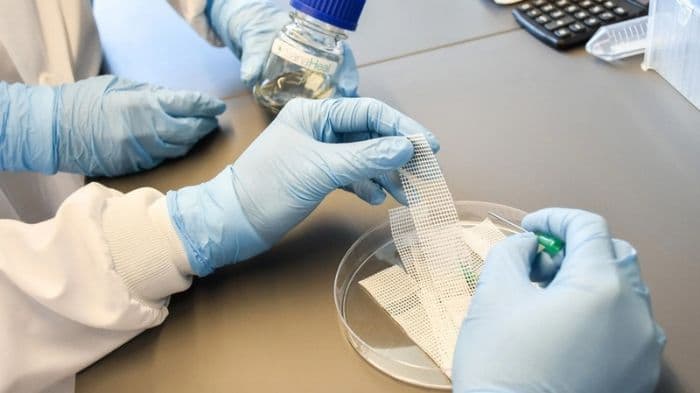
A technology developed at the Massachusetts Institute of Technology (MIT) could offer surgeons an alternative to stitching or stapling tissues together, using a bioadhesive that works more like applying a sticky note.
The technology, developed by SanaHeal, is designed to bond wet, uneven biological surfaces and create air- and fluid-tight seals. Its potential applications include procedures in which surgeons must reconnect delicate tissues, repair injuries or prevent leakage after an operation.

The adhesive has already received regulatory approval for controlling bleeding from traumatic injuries. However, its use in surgical procedures remains under development, with human trials for controlling surgical bleeding and repairing injured tissues planned for 2027.
How the adhesive works
Traditional tissue repair often relies on sutures or staples to hold tissues together. These methods require precision, particularly during operations involving small blood vessels or delicate structures. Errors can lead to leakage and other complications, while needles passing through tissue can cause additional damage.
SanaHeal’s technology uses a bioadhesive made from hydrogels, soft materials composed of polymers and water. The material was developed to adhere rapidly to wet tissue surfaces, where conventional adhesives can struggle to form a reliable bond.
Early versions used polyacrylic acid, an absorbent material also found in products such as diapers, to draw moisture away from the tissue surface and help the adhesive bond within seconds.
The approach was inspired partly by natural sticking mechanisms, including those found in barnacles and spider webs. The aim is to provide a seal that can withstand contact with wet tissue while remaining compatible with the body.
Hyunwoo Yuk, SanaHeal’s co-founder and chief technology officer, said the approach could make difficult tissue-joining procedures less invasive and easier to perform, including with surgical robots.
From MIT research to a medical technology company
The technology emerged from research conducted by Yuk during his master’s and doctoral studies in the laboratory of Xuanhe Zhao, an MIT professor of mechanical engineering.
Conversations with clinicians helped the researchers identify surgical tissue repair as a potential application for the materials. The team subsequently worked to develop the adhesive beyond the laboratory, with support from MIT’s Deshpande Center for Technological Innovation and its Venture Mentoring Service.
SanaHeal was established in 2021. The company initially focused on using the adhesive to control bleeding from traumatic injuries before expanding its work towards surgical applications.
Rather than developing every product independently, SanaHeal works with larger medical-device companies to explore potential applications of its technology. These include open, laparoscopic and endoscopic surgery, as well as possible uses in hernia and nerve repair.
Surgical use still needs to be tested
Although the technology has received regulatory approval for trauma bleeding control, that approval should not be interpreted as clearance to replace stitches in routine surgery.
The surgical applications described by MIT remain at the development stage, and planned human trials in 2027 will be an important step in evaluating their safety and performance.
The company’s proposed applications also cover different procedures and tissue types, meaning the adhesive’s performance will need to be assessed for each intended use.
For now, sutures and staples remain established methods of surgical tissue repair. SanaHeal’s approach is being developed as another option for selected procedures, rather than a proven replacement for conventional techniques across surgery.
The technology illustrates how university research can move towards clinical use through startup development and partnerships with medical-device companies. Whether it can simplify operations or reduce complications will depend on the results of further testing and regulatory review.

Southeast European teachers’ unions call for greater public education funding

Jammu and Kashmir Unemployment: Economic Growth Has Yet to Resolve Job Crisis
MIT-developed surgical adhesive could offer an alternative to stitches

China’s Chery unveils AI companion robot designed to ease loneliness

Varanasi Air Show 2026: Schools in Two Chandauli Blocks to Hold Online Classes on October 22, 24
China’s Chery unveils AI companion robot designed to ease loneliness

New Zealand reforms could leave more students without school qualifications

Alfred Nobel’s will created one of the world’s most recognised prizes. Here’s how

Pepperdine University earns Google recognition and Digital Education Council membership for AI initiatives
Dhirubhai Ambani International School breaks into global top 10 with record IB score

Southeast European teachers’ unions call for greater public education funding
Jammu and Kashmir Unemployment: Economic Growth Has Yet to Resolve Job Crisis
MIT-developed surgical adhesive could offer an alternative to stitches
China’s Chery unveils AI companion robot designed to ease loneliness
Varanasi Air Show 2026: Schools in Two Chandauli Blocks to Hold Online Classes on October 22, 24
China’s Chery unveils AI companion robot designed to ease loneliness
New Zealand reforms could leave more students without school qualifications
Alfred Nobel’s will created one of the world’s most recognised prizes. Here’s how
Pepperdine University earns Google recognition and Digital Education Council membership for AI initiatives
Dhirubhai Ambani International School breaks into global top 10 with record IB score
Copyright© educationpost.in 2026 All Rights Reserved.