


The directions cover free menstrual products, functional toilets, water and safe waste disposal, while states must identify infrastructure gaps and verify school-level compliance through district inspections.
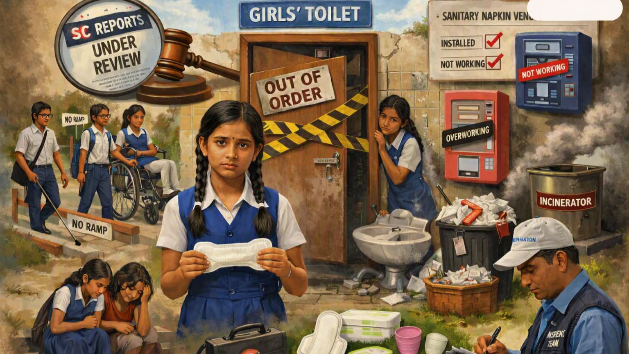
The Supreme Court has questioned discrepancies in compliance reports submitted by States and Union Territories on menstrual hygiene facilities in schools, observing that some responses appeared to be formal exercises rather than an accurate reflection of conditions on the ground.
A bench of Justices JB Pardiwala and R Mahadevan was monitoring compliance with its directions in Jaya Thakur v Government of India, concerning implementation of the national Menstrual Hygiene Policy for School-going Girls.

While noting that substantial progress had been made, the court said further measures were needed to make menstrual health a meaningful part of the rights of school-going girls.
SC flags discrepancies in state reports
According to the Union government's affidavit, 39,439 girls' toilets had earlier been identified as requiring functionalization. Of these, 30,458 had been constructed, 4,236 were under construction and 4,745 remained as gaps.
The court, however, found inconsistencies between claims of complete or near-complete compliance and the data submitted by some states.
Several states reported saturation in toilet facilities despite having fewer toilets accessible to children with special needs than their total number of schools.
The court also flagged discrepancies in Assam's handwashing data and questioned Tamil Nadu's claim of saturation of gender-segregated toilets.
Similar inconsistencies were found in data on sanitary-napkin vending machines and distribution in Karnataka, Jammu and Kashmir, Odisha and Arunachal Pradesh.
The court also pointed to gaps in sanitary-waste disposal data from Bihar, Gujarat, Delhi, Jharkhand, Rajasthan and Uttar Pradesh. Punjab's report was found to be illegible.
States asked to report remaining gaps
The Supreme Court has changed the format in which States and UTs must submit future compliance reports.
Authorities will now have to identify schools that still lack functional gender-segregated toilets, usable water connectivity, accessibility and privacy, menstrual absorbents and functional waste-disposal systems.
They must also state the reasons for each gap and the time required to address it.
The court specifically emphasized the needs of children with disabilities and directed authorities to ensure that school infrastructure is accessible to them.
District-level surprise inspections
The court has directed District Education Officers to form teams of teachers to conduct surprise inspections of schools across their districts.
The inspections will assess toilets, water availability, menstrual absorbents, waste-disposal facilities and menstrual hygiene management measures. States and UTs must place the inspection findings and student feedback on record.
The directions are intended to establish whether reported compliance corresponds with the facilities actually available to students.
Sanitary-napkin requirement modified
The Supreme Court has also modified its earlier requirement concerning free sanitary napkins in schools.
The previous requirement referred to oxo-biodegradable sanitary napkins complying with ASTM D-6954 standards. It has now been replaced by a requirement for biodegradable, biocompatible and compostable sanitary napkins complying with ISO 17088 read with IS 5405 standards.
The court referred to bamboo, jute, banana, starch and corn as possible sources for biodegradable and compostable products. It also encouraged States to gradually adopt sustainable menstrual products such as reusable sanitary napkins, menstrual cups and period underwear.
What the latest school data shows
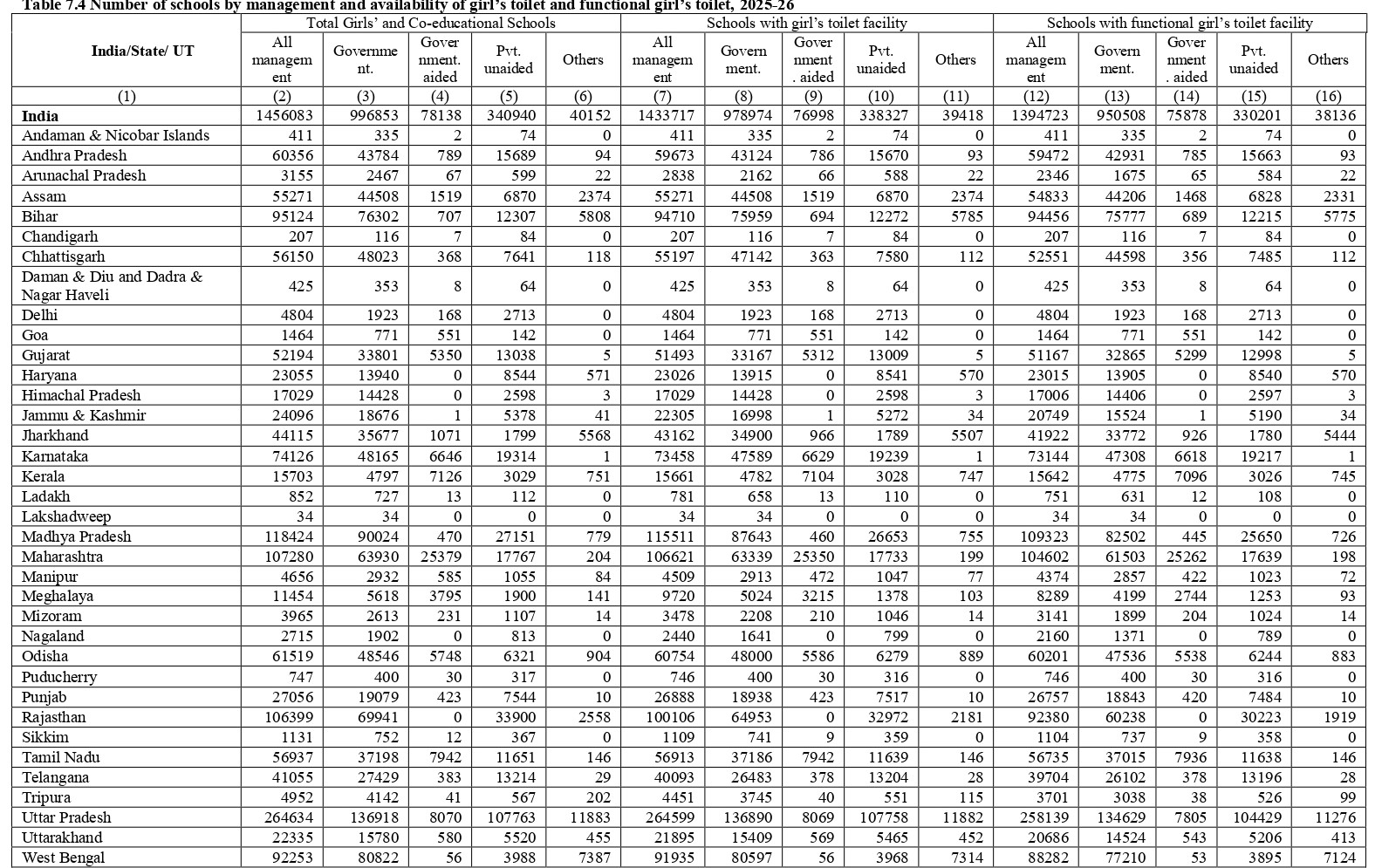
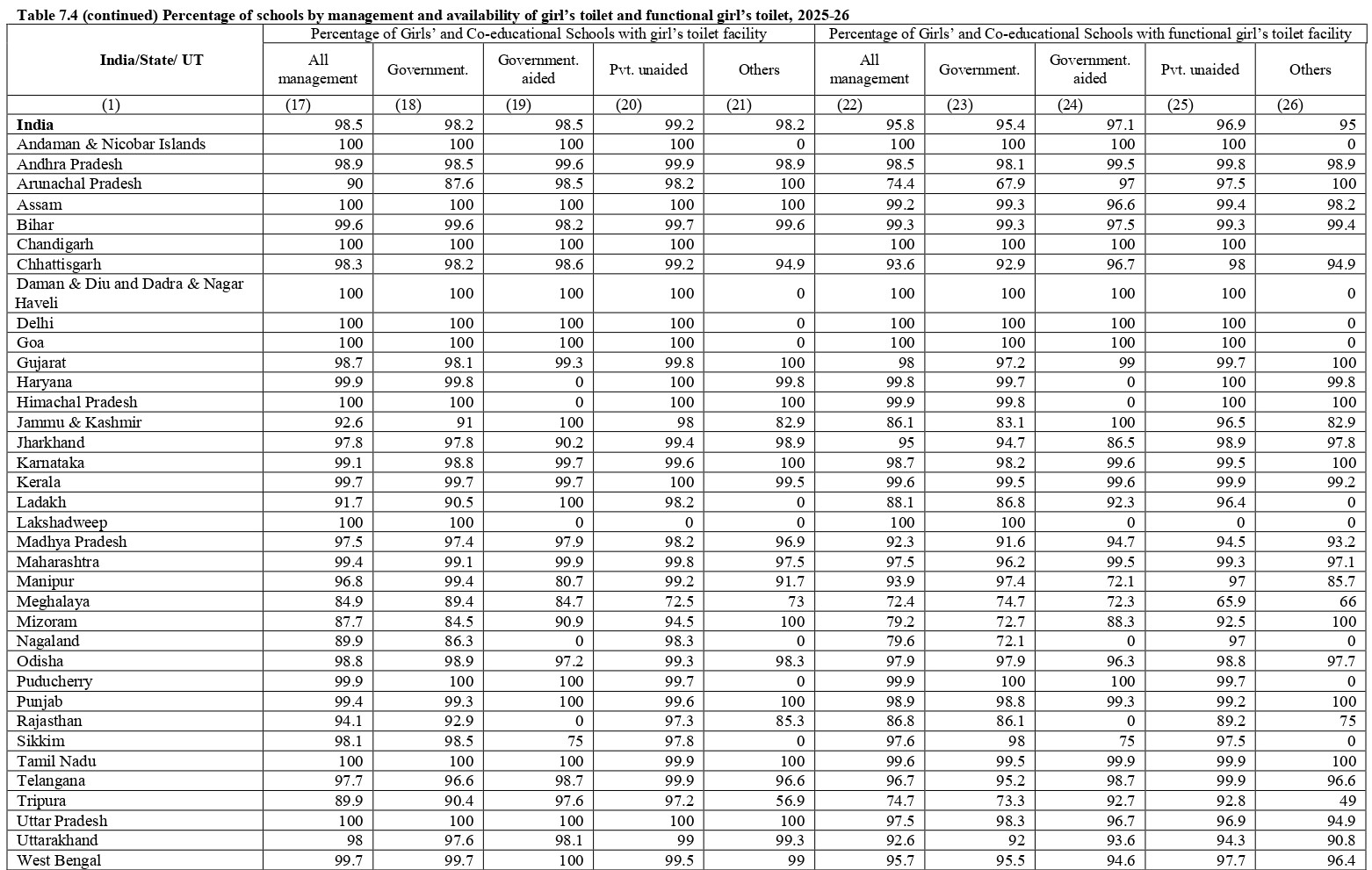
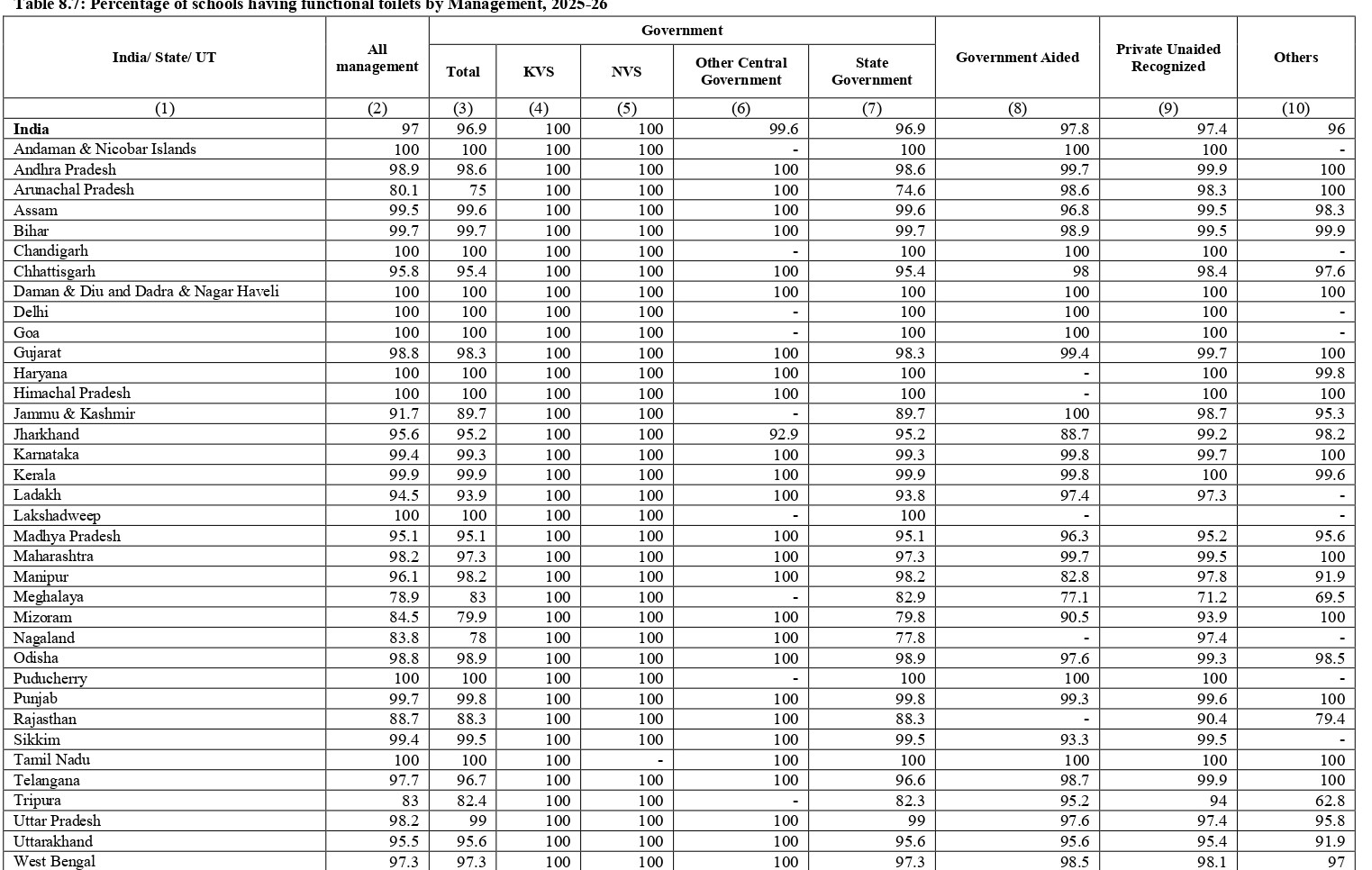
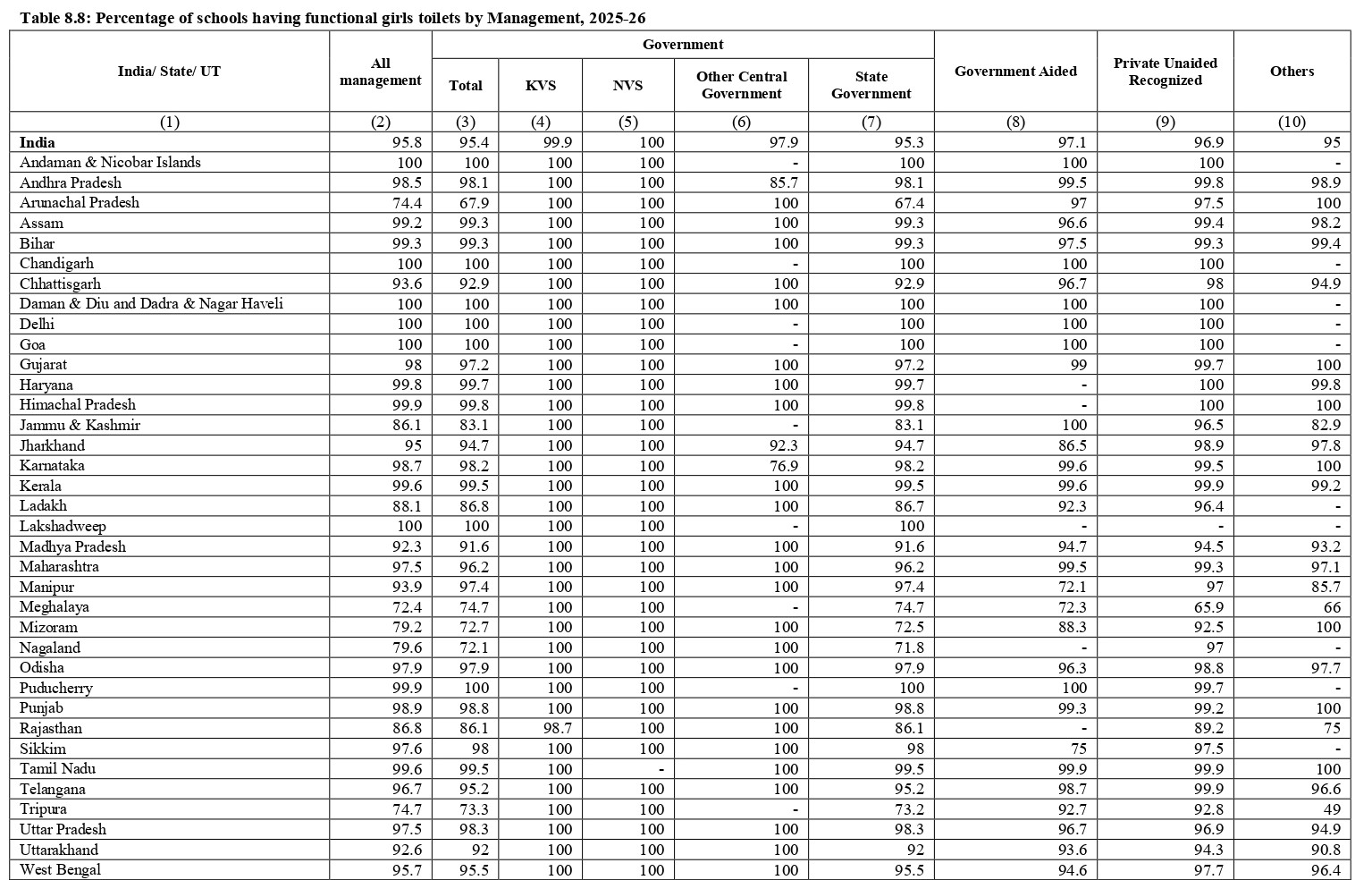
The UDISE+ 2025-26 school data shows that 1,433,717 schools reported having girls' toilets, of which 1,394,723 were functional. Overall, 98.5% of schools reported girls' toilets, while more than 95% reported functional facilities.
Handwashing facilities were reported in 1,421,554 schools, with 96.9% reported as functional.
State-level figures also show high reported coverage in several large States. Bihar had girls' toilets in 94,710 schools, including 93,605 functional facilities, giving reported coverage of 99.4% and functionality of 98.8%.
Uttar Pradesh reported 264,599 schools with girls' toilets, of which 260,316 were functional. Kerala reported 15,661 schools with girls' toilets, including 15,478 functional facilities.
Meghalaya reported around 85% availability, below the national figure, while its data also contained an anomaly because the reported number of functional toilets exceeded the number of schools reporting girls' toilets.
The data was collected up to March 31, 2026. However, basic availability does not necessarily mean that facilities are accessible to every student. Only 40.1% of schools reported toilets accessible to children with special needs.
What schools are required to provide
The Supreme Court's directions cover adolescent girls in Classes 6 to 12 in government and private schools.
Schools are required to provide functional gender-segregated toilets, usable water connectivity, washing facilities, soap and water, along with free sanitary napkins.
They must also establish menstrual hygiene management corners with emergency supplies such as spare innerwear, uniforms and disposable pads.
Safe disposal systems, including covered waste bins and functioning incinerators or other appropriate mechanisms, are also part of the broader requirements.
The framework is intended to address more than toilet availability. Privacy, regular water supply, cleanliness, maintenance, access to menstrual products and safe disposal are essential for effective menstrual hygiene management.
Government schemes supporting menstrual hygiene
India's menstrual hygiene response also includes programs under the National Health Mission and education and sanitation initiatives.
The Menstrual Hygiene Scheme was launched by the Ministry of Health and Family Welfare in June 2011 for adolescent girls aged 10 to 19. It focuses on awareness, access to affordable sanitary napkins, safe disposal and counseling on menstrual practices.
The Rashtriya Kishor Swasthya Karyakram, launched in 2014, incorporates menstrual health into broader adolescent health services.
The 2015 National Guidelines on Menstrual Hygiene Management under the Swachh Bharat framework emphasized separate girls' toilets, running water, washing facilities and safe menstrual-waste disposal.
Samagra Shiksha also supports school sanitation, water and toilet facilities through school grants and related planning.
At the state level, initiatives include Kerala's She Pad Scheme, Odisha's Khushi Scheme, Rajasthan's Udaan Yojana and menstrual hygiene interventions supported through Bihar's Jeevika network.
Bihar's Mukhyamantri Kanya Uthan Yojana has also provided support to adolescent girls, including assistance related to hygiene products.
The Pradhan Mantri Bhartiya Janaushadhi Pariyojana has made Jan Aushadhi Suvidha sanitary pads available at ₹1 per pad.
Why menstrual hygiene facilities matter
Menstrual hygiene is closely connected with attendance, health and learning. Inadequate toilets, lack of water and limited access to sanitary products can make it difficult for girls to manage menstruation while at school.
An older 2014-15 study by the Liverpool School of Tropical Medicine and UNICEF found that about a quarter of schoolgirls in India took time off during menstruation because of inadequate gender-specific toilets and non-availability of sanitary pads.
The Rapid Survey on Children 2013-14 also found that nearly 22% of schools lacked appropriate toilets for girls.
These older figures should not be read as a measure of current 2025-26 coverage, but they illustrate the infrastructure and access problems that menstrual hygiene policies have sought to address.
The wider school WASH framework also calls for safe drinking water, group handwashing facilities, clean and functional toilets, hygiene education and regular maintenance.
The Supreme Court's latest proceedings therefore shift attention from simply reporting infrastructure coverage to verifying whether facilities are functional, accessible and usable by students.
States and UTs will have to identify remaining gaps, explain why they exist and provide timelines for addressing them.
The matter is next listed before the Supreme Court on Sept 29, 2026.

Southeast European teachers’ unions call for greater public education funding

Jammu and Kashmir Unemployment: Economic Growth Has Yet to Resolve Job Crisis

MIT-developed surgical adhesive could offer an alternative to stitches

China’s Chery unveils AI companion robot designed to ease loneliness
Varanasi Air Show 2026: Schools in Two Chandauli Blocks to Hold Online Classes on October 22, 24
China’s Chery unveils AI companion robot designed to ease loneliness
.jpg&w=256&q=75)
New Zealand reforms could leave more students without school qualifications

Alfred Nobel’s will created one of the world’s most recognised prizes. Here’s how

Pepperdine University earns Google recognition and Digital Education Council membership for AI initiatives
Dhirubhai Ambani International School breaks into global top 10 with record IB score

Southeast European teachers’ unions call for greater public education funding
Jammu and Kashmir Unemployment: Economic Growth Has Yet to Resolve Job Crisis
MIT-developed surgical adhesive could offer an alternative to stitches
China’s Chery unveils AI companion robot designed to ease loneliness
Varanasi Air Show 2026: Schools in Two Chandauli Blocks to Hold Online Classes on October 22, 24
China’s Chery unveils AI companion robot designed to ease loneliness
New Zealand reforms could leave more students without school qualifications
Alfred Nobel’s will created one of the world’s most recognised prizes. Here’s how
Pepperdine University earns Google recognition and Digital Education Council membership for AI initiatives
Dhirubhai Ambani International School breaks into global top 10 with record IB score
Copyright© educationpost.in 2026 All Rights Reserved.