India’s annual exercise to decide which universities and higher education institutions are the country’s best is facing an unusual problem this year: the research papers that once helped institutions build their academic credentials are increasingly being examined for what happened to them after publication.
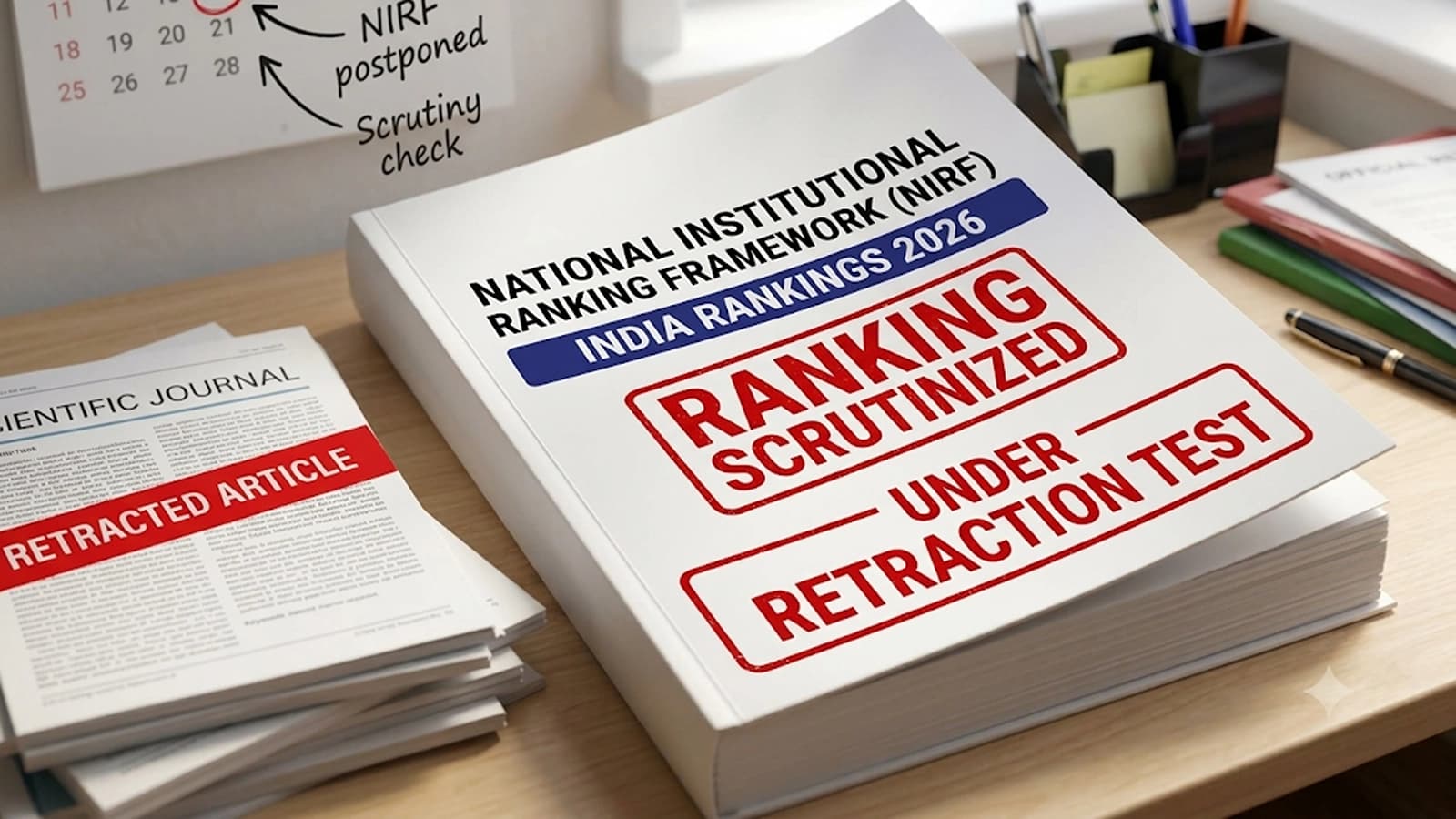
A significant number of research papers submitted or linked to institutions participating in the National Institutional Ranking Framework (NIRF) 2026 assessment have reportedly been flagged as retracted. The scrutiny has contributed to a delay in this year’s rankings, which have traditionally been released around August or September.

The issue is no longer limited to individual papers or researchers. The National Board of Accreditation (NBA), which conducts the NIRF exercise under the Ministry of Education, is examining institutional patterns of retractions. Officials have indicated that repeated problems could invite stronger action, including possible exclusion from future rankings.
The development marks a significant shift in how academic performance is being judged in India. For years, universities have competed to increase publication numbers, citations, research funding and other indicators that contribute to their ranking positions. The new approach asks a more difficult question: how much of that research output remains credible after it has faced scrutiny?
The ranking system has already changed
This is not the first year that NIRF has confronted the issue. The India Rankings 2025 methodology introduced negative marking for retracted publications for the first time in the Overall, Engineering, Universities and Research Institutions categories.
According to the official NIRF 2025 report, the new system was specifically developed to account for the number of retracted publications. Research and Professional Practice is already one of the five major components of the NIRF framework and carries a 30 per cent weight in the Overall category. Within that component, publications and citations each carry a 35 per cent share, while patents and research projects account for the remaining 30 per cent.
That makes the integrity of published research more than an academic-ethics issue. It can directly influence how an institution performs in a national ranking that affects reputation, student choices and institutional competition. The official NIRF methodology says data is obtained both from institutions and third-party databases. Publications and citations are sourced through Scopus and Web of Science, while patent data comes from Derwent Innovation.
The 2025 NIRF report also says the ranking exercise involves multiple levels of data validation, including checks for inconsistencies, anomalies and possible inflation. The question now is whether the new retraction checks can become an equally effective filter for research quality.
India’s retraction problem is bigger than rankings
Data from Retraction Watch shows that India recorded 887 research-paper retractions in 2025, placing it second globally behind China, which recorded 1,701. But the numbers need to be read carefully. A retraction does not automatically mean that a researcher committed fraud.
A paper can be withdrawn because of fabricated or manipulated data, plagiarism, duplicate publication, manipulated peer review or ethical violations. But journals can also retract papers because of genuine errors, methodological problems, incorrect data or other issues discovered after publication. That distinction becomes crucial when rankings begin imposing institutional penalties.
An institution with one paper retracted because of an honest scientific error is not necessarily in the same situation as an institution repeatedly associated with plagiarism, manipulated peer review or systematic publication problems. Nature has highlighted precisely this complexity in its reporting on India's retraction problem. A 2025 Nature analysis of research-integrity patterns found that retractions are increasingly concentrated in particular institutions and countries. Nature also cautioned against treating every retraction as evidence of deliberate misconduct, noting that detection systems are improving and that some withdrawals result from legitimate errors.
The problem, therefore, may not simply be that India has more retracted papers. It may be that the country's research system has not always been designed to distinguish between high-volume research, high-quality research and research that survives scrutiny.
What the research itself reveals
A 2026 study published in Global Knowledge, Memory and Communication examined 3,796 retracted research records involving Indian affiliations, using data from Retraction Watch, SCImago and NIRF. The study found that Indian retractions had risen sharply, reaching 837 in 2024. It identified duplication and plagiarism among the leading reported reasons for retraction.
The researchers also found a relationship between retractions and institutional ranking systems, arguing that ranking frameworks that focus heavily on publication volume and citations can create incentives that do not always align with research quality. That finding matters because NIRF itself acknowledges the centrality of research to institutional performance. Its 2025 report states that Research and Professional Practice has the strongest correlation with overall rankings among the five broad NIRF parameters. In other words, research is not a side metric. It is one of the engines driving institutional reputation.
The pressure to publish is becoming part of the investigation
The deeper issue is the incentive structure surrounding academic research. Universities compete for rankings. Rankings influence reputation. Reputation affects student demand, faculty recruitment, collaborations, funding and international visibility. That creates an environment where publication numbers and citations can become institutional targets. The danger arises when the pressure to produce more research begins to outrun the systems designed to verify it. Nature India reported in 2025 that Indian research retractions are connected to a wider set of problems, including ethical compliance, peer-review manipulation and institutional oversight.
Researchers quoted by Nature pointed to gaps in research training and differences in the quality of institutional ethics and oversight mechanisms. The publication also reported concerns over practices such as questionable authorship and multiple institutional affiliations being used to influence publication-related metrics. This suggests that the problem cannot be solved simply by telling researchers not to commit misconduct. Universities themselves may need to examine how researchers are rewarded, promoted and evaluated.
A striking concentration of retractions
The concentration of retractions at particular institutions makes the issue even more significant. An analysis published in India Today using Retraction Watch data showed several Indian universities among the institutions with the highest numbers of retracted papers globally in 2025. The list included Anna University, Dr APJ Abdul Kalam Technical University, Saveetha Institute, JNTU Hyderabad, Lovely Professional University, Visvesvaraya Technological University and VIT Vellore, among others.
The numbers alone, however, should not be interpreted as a list of institutions guilty of research misconduct. A university producing tens of thousands of papers is naturally exposed to a larger absolute number of corrections and retractions than a small institution. What deserves closer attention is the pattern, the reason for the retractions, their frequency, whether they involve the same researchers or journals, whether institutional systems detected problems before publication and how universities responded after a paper was withdrawn. That is where an institutional integrity assessment becomes more meaningful than simply counting retracted papers.
NIRF now has a difficult balancing act
The government's move to introduce negative marking is therefore significant, but it also creates a new challenge. If NIRF penalises institutions solely according to the number of retracted papers, it risks treating fundamentally different cases as equivalent. If it does not penalise retractions strongly enough, institutions could continue to benefit from research output that later proves unreliable.
The system must therefore answer several questions. Should a retraction caused by an honest methodological error receive the same penalty as plagiarism? Should a paper retracted because of manipulated peer review be treated differently from a paper withdrawn because of a journal-wide investigation? Should institutional rankings consider whether a university immediately investigated a paper after its retraction?
And should repeated retractions by the same researcher affect the institution differently from isolated cases involving unrelated researchers? These questions become particularly important because NIRF's own methodology emphasises data verification and institutional accountability.
The 2026 rankings may become a test of research credibility
The latest scrutiny suggests that the 2026 NIRF exercise is moving beyond simply asking universities what they have published. It is increasingly asking what happened to those publications afterwards. A senior government official cited in the latest reporting said authorities had identified a large number of retracted papers and that institutions were being warned, with negative marking to be applied during assessment. The official also indicated that repeated offenders could face stronger consequences in future ranking cycles.
That would represent a considerable escalation from the first year of negative marking. It would also send a message to institutions that research output cannot be treated as a one-time achievement: a paper can continue to affect an institution's reputation even after publication, particularly if questions later emerge about its reliability. For India's higher education system, this could ultimately be more consequential than the ranking positions themselves. The country is rapidly expanding its research footprint and seeking greater global recognition for its universities and scientific institutions. But a research system cannot build credibility simply by producing more papers.
It has to demonstrate that those papers can withstand scrutiny. The NIRF 2026 delay has therefore brought an uncomfortable issue into the open. The real measure of a university's research strength may not be how many papers it can publish, how many citations it can accumulate or how high it can climb in a ranking. It may increasingly be how much of that research survives after someone starts asking difficult questions.