


Student groups question limits on organizational participation, seek clarity on campaigning guidelines, and demand elected bodies at universities to raise concerns over faculty shortages, fees, and campus facilities.
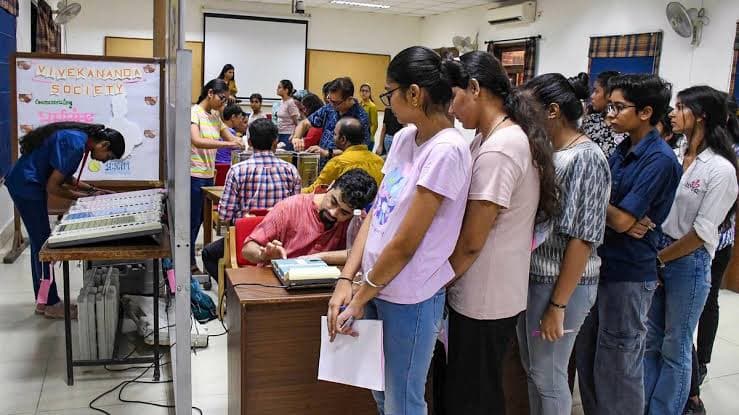
Karnataka’s decision to revive student union elections after a 37-year gap has prompted discussions among student organizations and educationists over political participation, campus democracy, and the role of elected representatives in addressing student grievances.
“Student elections cannot be separated from politics because education itself is a political space,” said B Sripad Bhatt, an educationist and social activist, questioning restrictions on politically affiliated student organizations in Karnataka’s campus polls.

The state government issued an order in September to resume student union elections, with the first phase covering government, aided, and private colleges under the Department of Collegiate Education.
Universities have subsequently directed their affiliated colleges to begin preparations, although detailed guidelines and a common election schedule are yet to be finalized.
Student union elections were last conducted in Karnataka colleges during the 1989-90 academic year. Their proposed return has generated interest among student organizations, which have started mobilizing students and identifying potential candidates while awaiting clarity on the rules governing participation and campaigning.
Under the proposed framework, candidates are expected to contest without displaying the names of student organizations or political party symbols on the ballot.
However, questions remain about the extent to which student organizations will be permitted to support candidates during campaigns. Student leaders have also sought clarity on whether the elections will be extended beyond colleges to universities.
Karnataka colleges await election dates
B Ramesh, vice-chancellor of Dr Manmohan Singh Bengaluru City University (BCU), said the university had notified its 232 affiliated colleges, including 14 government colleges, to conduct student elections in accordance with the state government's directions.
“We also held a meeting with the principals and explained the need and importance of student elections in strengthening leadership among students. They have accepted the directions and begun preparations,” Ramesh said.
BCU has not announced a common date for the elections. Individual colleges will determine their schedules, with Ramesh expecting most institutions to complete the process by October.
According to the vice-chancellor, colleges have been instructed to comply with the government's rules, inform their respective local police stations, and explain the purpose and significance of student elections to students before the polls.
However, managing political involvement and potential conflicts between student groups could pose challenges for college administrations.
“Political interference, directly or indirectly, can be a challenge. During campaigning, conflicts may also arise between different groups and unions. The respective principals will have to manage these issues,” Ramesh said.
Bhatt, however, cautioned against using the possibility of campus violence or disagreements as a reason to prevent student elections. He argued that maintaining law and order was the government's responsibility and that the democratic process should continue despite the possibility of disputes.
“Violence may happen, but we cannot stop elections because of it. It is the government’s responsibility to control violence and ensure that the democratic process continues,” he said.
The concerns come as colleges prepare to implement the government's decision after decades without elected student unions. While university authorities have begun communicating the directions to their affiliated institutions, student organizations say they need detailed rules to understand how the elections will be conducted and what forms of campaigning will be permitted.
Student organizations begin preparations for campus polls
Student organizations across Karnataka have begun identifying potential candidates, reaching out to students, and preparing to participate in the elections. Despite the long absence of student union polls, the state has several active student groups, many of which are affiliated with major political parties.
However, organizations say their election strategies will depend on the detailed guidelines issued by the government, particularly those concerning political affiliations and the extent of their involvement in campaigning.
Kirthi Ganesh, state president of the Congress-affiliated National Students’ Union of India (NSUI) in Karnataka, said the organization was waiting for greater clarity on the rules before finalizing its plans.
“We are waiting for the detailed rules and guidelines. Once they are issued, we will know the process and the measures organisations will have to follow,” he said.
In the meantime, NSUI is identifying colleges, establishing local committees, and encouraging students to contest the elections. Although candidates are expected to appear on the ballot independently, without the names or symbols of student organizations, groups anticipate supporting their candidates through campaigning and outreach.
The proposed arrangement resembles the system followed in elections to the Delhi University Students’ Union (DUSU) and in other institutions, where student organizations support candidates even when their names and symbols do not appear on the ballot.
“We will guide our candidates, help them with the campaign and gain students’ support,” Ganesh said.
However, uncertainty remains over how far organizations will be allowed to participate in campaigning under Karnataka's proposed framework. Student leaders say the distinction between independent candidates and organizational backing will need to be clarified before the election process begins.
Basavaraj Guledal, state vice-president of the Students’ Federation of India (SFI), the student wing of the Communist Party of India (Marxist) (CPI(M)), said the organization has approximately 50,000 student members in Karnataka.
SFI has been conducting awareness programs, seminars, and campus meetings to inform students about the proposed elections and mobilize participation.
Guledal said students had shown interest in the return of student unions, although some professors viewed elections as political activities and discouraged students from participating.
The organization also wants elections to be conducted at the university level after the completion of college-level polls. According to Guledal, university elections would provide students with a broader platform to raise concerns that extend beyond individual colleges.
Sharath, an activist with the All India Students’ Association (AISA), which is associated with the Communist Party of India (Marxist-Leninist), and an LLM student at Bangalore University, said the demand for elected student bodies had been longstanding in Karnataka.
“Student-elected bodies have always been our demand in Karnataka. Students can voice their concerns and dissent through a genuinely elected body. Elections should be held at every level, including universities,” he said.
Sharath added that AISA would campaign for university-level elections, arguing that students needed elected representatives to question university administration and examine issues related to institutional expenditure.
The demand for elections at multiple levels reflects a broader disagreement over the proposed scope of the government's initiative.
While the first phase focuses on colleges under the Department of Collegiate Education, student organizations want the process to include universities so that students can participate in decisions affecting their academic and campus lives.
Political affiliations become a key point of contention
Restrictions on political affiliations have emerged as one of the principal concerns surrounding Karnataka's proposed student elections.
Although the framework seeks to limit direct political party involvement in campus polls, student organizations have questioned how the restrictions will work in practice and whether they could affect the ability of different groups to compete.
Sharath opposed restrictions on student organizations, arguing that students should be free to associate with political groups and participate in discussions about public policy and institutional governance.
He said elected student representatives should be able to raise questions concerning the use of public funds, hostel facilities, and fees charged by private colleges. According to him, student elections should allow students to organize around such issues rather than limit their participation based on political affiliations.
Bhatt also expressed concern that restrictions on direct organizational participation could create an uneven playing field.
He argued that organizations with established campus networks could continue to influence elections indirectly, while groups with fewer resources and a weaker organizational presence might find it more difficult to reach voters.
Pointing to the BJP-affiliated right-wing student organization Akhil Bharatiya Vidyarthi Parishad (ABVP), Bhatt said the restrictions could have different consequences for organizations depending on their existing campus presence and ability to mobilize students.
“If organisations cannot participate directly, they will have to work indirectly, and those with weaker organisational structures may find it difficult to compete,” he said.
The debate highlights the challenge of distinguishing between student-led political participation and direct involvement by political parties. Student leaders argue that political affiliations are often central to how student organizations identify issues and mobilize support, while the proposed restrictions seek to regulate the role of such affiliations in campus elections.
Educationists have also emphasized that the primary objective should be to strengthen democratic participation and create opportunities for students to raise academic concerns.
Niranjanaradhya V P, an educationist and former senior fellow at the Centre for Child and the Law at the National Law School of India University (NLSIU), Bengaluru, said student elections were important for giving students a collective platform to discuss issues affecting their education.
“Student union elections are very important because they give students a platform to raise serious academic issues.”
He said elected student bodies could help students question decisions concerning curriculum, faculty availability, and the content taught in classrooms, among other matters.
“Whether it is a shortage of faculty, changes in the syllabus or the removal of Mughal history from textbooks, students should have an opportunity to discuss and question such decisions,” he explained. “The purpose should be to encourage independent student leadership and democratic participation.”
Niranjanaradhya called for the recommendations of the Lyngdoh Committee to be implemented to ensure free and fair student elections. The committee's recommendations provide a framework for regulating campus polls, including measures intended to promote fairness and limit undue political influence.
The recommendations have been an important reference point in discussions about student elections in India. Their implementation, educationists argue, can help institutions establish a transparent process while ensuring that student representatives can participate meaningfully in campus governance.
Student unions seen as a platform to address grievances
Beyond questions about political affiliations and the scope of the elections, student organizations have highlighted the need for elected representatives to address everyday problems faced by students.
They argue that the absence of elected unions has limited opportunities for students to raise collective concerns and seek accountability from college administrations.
Ganesh said students often struggled to obtain responses from college authorities regarding attendance requirements, fines, and fees demanded from students who wanted to leave their courses.
According to him, an elected student union could provide a common platform for students to present complaints and negotiate with college administrations rather than requiring individuals to approach authorities separately.
Student representatives, he argued, could help bring recurring problems to the attention of college management and push for responses to concerns affecting multiple students.
Nandeesh Jayaram, president of the Ambedkar Students’ Association (ASA) at the University of Agricultural Sciences (UAS), Bengaluru, said students welcomed the return of elections because elected representatives could help them question college administrations and seek action on unresolved complaints.
He also drew attention to concerns raised by women students, including cases of harassment, which he said required attention from the institutions concerned.
The return of student elections, therefore, is being viewed by student organizations as an opportunity to establish a formal mechanism through which students can raise grievances and hold institutional authorities accountable. Their demands cover academic matters as well as campus facilities, administrative decisions, and student welfare.
Educationists have also emphasized that the value of student elections extends beyond the selection of representatives. They argue that participation in an electoral process can help students understand democratic institutions and develop an appreciation for accountability, transparency, and the rights of people holding different opinions.
Niranjanaradhya said educational institutions should encourage students to engage in debate, question decisions, and learn how democratic processes operate.
“It is better to introduce students to democracy late than never. This is also part of their education,” he said.
He added that colleges and universities should create opportunities for dialogue and discussion rather than restrict student participation in democratic activities.
As Karnataka prepares to resume student union elections after nearly four decades, the process has raised questions about how campus democracy should function, how political affiliations should be regulated, and whether elected bodies will be established at both college and university levels.
While universities have begun directing colleges to prepare for the polls, student organizations are waiting for detailed guidelines to determine how candidates can campaign, what role organizations can play, and whether their demands for university-level elections will be addressed.
The implementation of the proposed system will determine how far the revived elections can provide students with a formal platform to influence campus affairs and raise concerns about their education.

Hunter of Underwater Threats: Why INS Mangrol Is Important for the Indian Navy
Delhi Protests Renew Debate Over Constitutional Right to Peaceful Assembly

Household Inflation Rises to 5.54% in September as Price Pressures Spread
Delhi High Court Allows Urgent Hearing on Protest Site Guidelines

India Rejects China’s Objection to Standardised Names of Places in Ladakh
Karnataka student elections return after 37 years: Why political restrictions and university polls remain contentious
Global education is shifting from simply going abroad to creating more flexible routes to opportunity

Delhi Police files FIR against Congress MP Bimol Akoijam over JNU sexual harassment allegations

Utkal University tightens security after late-night explosions ahead of student polls

IET India Scholarship Award 2026: DTU’s Kush Garg wins top honor for AI device for neurodivergent children

Hunter of Underwater Threats: Why INS Mangrol Is Important for the Indian Navy
Delhi Protests Renew Debate Over Constitutional Right to Peaceful Assembly
Household Inflation Rises to 5.54% in September as Price Pressures Spread
Delhi High Court Allows Urgent Hearing on Protest Site Guidelines
India Rejects China’s Objection to Standardised Names of Places in Ladakh
Karnataka student elections return after 37 years: Why political restrictions and university polls remain contentious
Global education is shifting from simply going abroad to creating more flexible routes to opportunity
Delhi Police files FIR against Congress MP Bimol Akoijam over JNU sexual harassment allegations
Utkal University tightens security after late-night explosions ahead of student polls
IET India Scholarship Award 2026: DTU’s Kush Garg wins top honor for AI device for neurodivergent children
Copyright© educationpost.in 2026 All Rights Reserved.