


Starship Mission Marks Major Milestone With Deployment of 26 Next-Gen Starlink Satellites
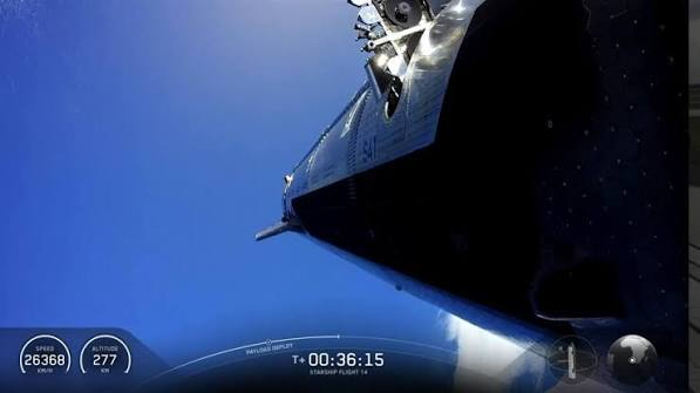
SpaceX’s Starship spacecraft successfully reached orbit and deployed 26 next-generation Starlink V3 satellites on Monday, marking another major milestone in the company’s efforts to develop a fully reusable launch system for future missions to the Moon and Mars.
The mission faced a setback during the ascent when one of Starship’s six Raptor Vacuum (RVac) engines shut down. After assessing the performance and health of the remaining engines, SpaceX engineers decided to continue the mission and proceed with the planned orbital flight.

According to SpaceX, Starship is expected to complete six orbits around Earth during a roughly 10-hour mission before splashing down in the Pacific Ocean west of Chile.
A key objective of the mission was to deploy 26 Starlink V3 operational satellites, the latest generation of SpaceX’s satellite internet constellation.
“All 26 Starlink V3 operational satellites deployed and operating nominally,” SpaceX said in a post on X.
The company said the new satellites are designed to significantly increase Starlink’s network capacity while improving connection speeds and reliability for users worldwide.
Each Starlink V3 satellite is designed to provide up to 1 terabit per second (Tbps) of downlink capacity and 160 gigabits per second (Gbps) of uplink capacity. SpaceX said this represents a tenfold increase in downlink capability and a 22-fold improvement in uplink performance compared with Starlink V2 satellites.
Following deployment, the satellites will unfold their antennas, deploy solar arrays and establish initial communications with ground stations and the wider Starlink network using radio-frequency and laser links.
The satellites will subsequently use onboard thrusters to gradually raise themselves to their designated operational orbit.
SpaceX said the enhanced capabilities of the V3 satellites are supported by next-generation beamforming chips developed by the company. The technology enables more efficient routing of data traffic across multiple beams and increases modem throughput capacity by 64 times compared with earlier systems.
According to the company, the upgraded technology will allow Starlink to serve customers more efficiently across densely populated urban areas as well as remote regions, while dynamically allocating network capacity according to demand.
The successful deployment marks another step in SpaceX’s efforts to expand the capabilities of its satellite internet network while using Starship as a platform for increasingly complex space missions.

FUEL to Celebrate 20th Foundation Day and 2nd Convocation in Pune on October 24
Former Russian Test Cosmonaut Nikolai Tikhonov Discusses Space Exploration at Chennai Science Festival

Promised in 30 days, pending after 42: J&K medical interns resume strike

UAE parents urged to check if children truly learn from AI homework

Chennai School Holiday Today: Schools Closed in 5 Tamil Nadu Districts Due to Heavy Rain

Sharjah schools set boundaries for AI use in homework and exams

Former MIT scientist wins $6 million defamation verdict in misconduct dispute

McMahon highlights Trump’s push to return education powers to states

Could smarter energy solutions make data centres more sustainable?

Cambridge and AstraZeneca extend joint PhD programme for three years

FUEL to Celebrate 20th Foundation Day and 2nd Convocation in Pune on October 24
Former Russian Test Cosmonaut Nikolai Tikhonov Discusses Space Exploration at Chennai Science Festival
Promised in 30 days, pending after 42: J&K medical interns resume strike
UAE parents urged to check if children truly learn from AI homework
Chennai School Holiday Today: Schools Closed in 5 Tamil Nadu Districts Due to Heavy Rain
Sharjah schools set boundaries for AI use in homework and exams
Former MIT scientist wins $6 million defamation verdict in misconduct dispute
McMahon highlights Trump’s push to return education powers to states
Could smarter energy solutions make data centres more sustainable?
Cambridge and AstraZeneca extend joint PhD programme for three years
Copyright© educationpost.in 2026 All Rights Reserved.