


Agnikul Cosmos Gets ₹200 Crore Government Support for Reusable Launch Vehicle Development
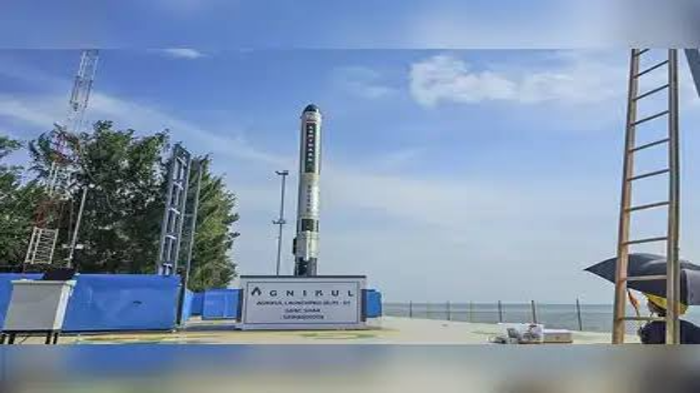
The government has signed an agreement with space-tech company Agnikul Cosmos for Rs 200 crore financial support under the Research Development and Innovation (RDI) Fund to develop an indigenous reusable launch vehicle, marking another step towards strengthening India’s capabilities in advanced space transportation.
The agreement was signed by the Technology Development Board (TDB) under the Department of Science & Technology (DST).

The project focuses on ‘Agnibaan RLV’, a reusable launch vehicle programme aimed at advancing the technology from Technology Readiness Level (TRL)-4 to TRL-8, bringing it closer to deployment.
Unlike conventional approaches that focus primarily on recovering the first stage of a launch vehicle, the programme seeks to develop a fully reusable launch architecture.
The proposed system is intended to support high-frequency and repeatable launches while reducing launch and manufacturing costs and minimising space debris.
TDB Secretary Rajesh Kumar Pathak said the next phase of India’s space programme would require technologies capable of reaching orbit with greater frequency, flexibility and efficiency. He identified reusability as an important technological frontier and said the RDI Fund was supporting indigenous technologies requiring sustained investment to move from advanced development stages towards deployment.
The Agnibaan RLV programme is expected to strengthen India’s capabilities in advanced space transportation by developing and integrating technologies required for reusable launch systems.
Agnikul Cosmos has already demonstrated several components of its technology through its development and testing programmes. Its work includes Agnibaan, an indigenous orbital-class launch vehicle, and Agnilet, a single-piece, 3D-printed rocket engine developed and manufactured in-house.
The TDB had previously supported Agnikul in developing and commercialising a modular and configurable launch vehicle for small satellite missions.
According to the company’s promoters, developing reusable launch technology requires the integration of propulsion, vehicle design, guidance, recovery systems and mission operations into a highly reliable architecture.
The government’s latest financial support is therefore aimed at helping advance indigenous technology development and strengthening India’s emerging private space sector.
The initiative comes as India seeks to expand domestic capabilities across launch vehicles, satellite technology and advanced space transportation, while reducing the cost and environmental impact associated with frequent space launches.

FUEL to Celebrate 20th Foundation Day and 2nd Convocation in Pune on October 24

Former Russian Test Cosmonaut Nikolai Tikhonov Discusses Space Exploration at Chennai Science Festival

Promised in 30 days, pending after 42: J&K medical interns resume strike

UAE parents urged to check if children truly learn from AI homework

Chennai School Holiday Today: Schools Closed in 5 Tamil Nadu Districts Due to Heavy Rain

Sharjah schools set boundaries for AI use in homework and exams

Former MIT scientist wins $6 million defamation verdict in misconduct dispute

McMahon highlights Trump’s push to return education powers to states

Could smarter energy solutions make data centres more sustainable?

Cambridge and AstraZeneca extend joint PhD programme for three years

FUEL to Celebrate 20th Foundation Day and 2nd Convocation in Pune on October 24
Former Russian Test Cosmonaut Nikolai Tikhonov Discusses Space Exploration at Chennai Science Festival
Promised in 30 days, pending after 42: J&K medical interns resume strike
UAE parents urged to check if children truly learn from AI homework
Chennai School Holiday Today: Schools Closed in 5 Tamil Nadu Districts Due to Heavy Rain
Sharjah schools set boundaries for AI use in homework and exams
Former MIT scientist wins $6 million defamation verdict in misconduct dispute
McMahon highlights Trump’s push to return education powers to states
Could smarter energy solutions make data centres more sustainable?
Cambridge and AstraZeneca extend joint PhD programme for three years
Copyright© educationpost.in 2026 All Rights Reserved.