


Mecca Pact Highlights Risks of Europe-Pakistan Economic Engagement
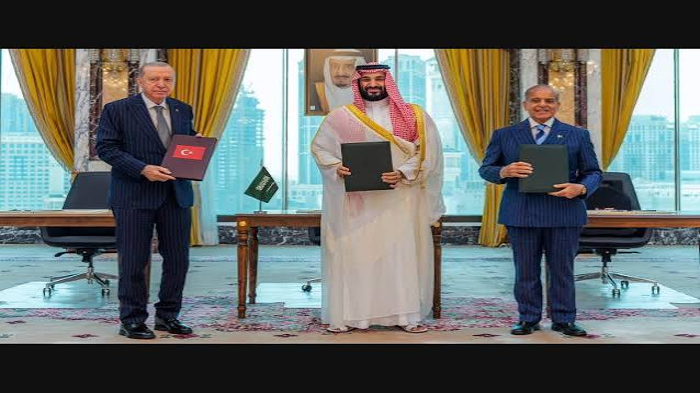
The Mecca Joint Defence Agreement between Saudi Arabia, Pakistan and Turkey has highlighted shifting security alignments in the Middle East and raised fresh questions over Europe’s long-standing economic engagement with Islamabad, according to a report.
Signed in Mecca on August 7, the agreement establishes a mutual defence arrangement under which an armed attack against any one of the three signatories would be treated as an attack against all, drawing comparisons with the collective-security principle underpinning NATO.

A report published by Belgian news website Brussels Signal described the pact as a significant geopolitical development and argued that it exposed what it called the European Union’s limited strategic influence in the region.
The report pointed to security developments in September as an early test of the new arrangement. It said Houthi drones and missiles targeted critical Saudi energy infrastructure, while drones launched from Iraq struck the East-West oil pipeline, prompting Saudi Arabia to suspend operations on September 11.
According to the report, Saudi Arabia’s growing concerns over the reliability of Western security guarantees have encouraged Riyadh to diversify its strategic partnerships. It argued that the latest regional developments, including the continuing Iran conflict that began with US and Israeli strikes on February 28, have reinforced this approach.
The report questioned why Riyadh would increasingly look beyond European capitals for security partnerships, arguing that European countries have limited military capabilities and political influence to independently protect major regional energy corridors.
It also highlighted the implications of Turkey’s participation in the new arrangement. As a NATO member, Turkey’s involvement in an autonomous security grouping involving Saudi Arabia and Pakistan could create strategic complications for the alliance, the report said.
“If Ankara is bound to defend Islamabad or Riyadh in regional escalations,” the report questioned, “where does its commitment to Atlantic security begin and end?”
A major focus of the report was Europe’s economic relationship with Pakistan. It noted that the European Union has provided Pakistan preferential access to European markets through the Generalised Scheme of Preferences Plus (GSP+) framework, under which Pakistan has been among the largest beneficiaries.
The report argued that the arrangement has created a contradiction between Europe’s economic engagement with Pakistan and concerns over Islamabad’s military and strategic partnerships.
It further criticised what it described as Europe’s continued economic support for Pakistan despite allegations of minority persecution and Islamabad’s expanding security partnerships.
The report concluded that the emergence of the Saudi-Pakistan-Turkey defence arrangement should prompt European policymakers to reassess the strategic implications of their economic and diplomatic engagement with both Pakistan and Turkey.
The Mecca pact therefore represents not only a new regional security commitment among its three signatories, but also a broader challenge for Western powers as countries in the Middle East seek greater strategic autonomy and diversify their security partnerships.
FUEL to Celebrate 20th Foundation Day and 2nd Convocation in Pune on October 24
Former Russian Test Cosmonaut Nikolai Tikhonov Discusses Space Exploration at Chennai Science Festival
Promised in 30 days, pending after 42: J&K medical interns resume strike

UAE parents urged to check if children truly learn from AI homework

Chennai School Holiday Today: Schools Closed in 5 Tamil Nadu Districts Due to Heavy Rain
Sharjah schools set boundaries for AI use in homework and exams

Former MIT scientist wins $6 million defamation verdict in misconduct dispute
McMahon highlights Trump’s push to return education powers to states

Could smarter energy solutions make data centres more sustainable?
Cambridge and AstraZeneca extend joint PhD programme for three years

FUEL to Celebrate 20th Foundation Day and 2nd Convocation in Pune on October 24
Former Russian Test Cosmonaut Nikolai Tikhonov Discusses Space Exploration at Chennai Science Festival
Promised in 30 days, pending after 42: J&K medical interns resume strike
UAE parents urged to check if children truly learn from AI homework
Chennai School Holiday Today: Schools Closed in 5 Tamil Nadu Districts Due to Heavy Rain
Sharjah schools set boundaries for AI use in homework and exams
Former MIT scientist wins $6 million defamation verdict in misconduct dispute
McMahon highlights Trump’s push to return education powers to states
Could smarter energy solutions make data centres more sustainable?
Cambridge and AstraZeneca extend joint PhD programme for three years
Copyright© educationpost.in 2026 All Rights Reserved.