


Students will appear for board examinations in five subjects, while vocational education, third language, art education, and physical education will remain compulsory curricular areas under the revised scheme.
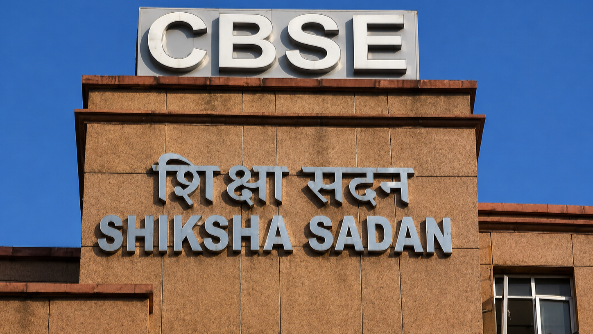
The Central Board of Secondary Education (CBSE) has revised its Scheme of Studies for students entering Class IX in the 2026-27 academic session, clarifying that three proposed subjects will not be included in their curriculum.
The decision will benefit students who are scheduled to appear for their Class X board examinations in 2028.

The subjects excluded from the curriculum for these batches are Individuals in Society, Modules on Computational Thinking (CT) and Artificial Intelligence (AI), and Environmental Education.
The clarification comes after the introduction of these curricular areas created confusion among students and raised concerns about an increased academic workload.
According to officials, the proposed changes had led students to believe they would have to prepare for nine to 10 subjects for their board examinations.
With the latest clarification, students will be required to appear for board examinations in five subjects, while continuing to study other compulsory curricular areas without the pressure of scoring marks in them.
Under the revised arrangement, the five compulsory subjects for the Class X board examinations will include two languages, mathematics, science and social science.
However, the overall curriculum will continue to cover nine compulsory curricular subjects, including a third language, art education, physical education and well-being, and vocational education.
In a circular issued to principals and heads of all CBSE-affiliated schools, the board explained that the decision was taken to align the introduction of the new curricular areas with their scheduled implementation.
“To align the introduction of this curricular area with the implementation schedule, the subject ‘Individuals in Society’ and the ‘Modules of CT & AI’ in Class IX (2026-27) and the subject ‘Environmental Education’ in Class X (2027-28) shall not be part of the curriculum for these batches,” said a CBSE circular issued to all the principals and heads of affiliated schools.
The revised arrangement will specifically apply to students enrolled in Class IX during the 2026-27 academic session, who will progress to Class X in 2027-28. They will not be required to study the three subjects as part of the curriculum applicable to their batches.
However, the changes will not affect students who are already studying in Class X during the 2026-27 academic session. The existing Scheme of Studies will continue to apply to this batch.
CBSE Class IX curriculum 2026-27: Vocational education remains compulsory
While excluding the three subjects from the curriculum for the specified batches, CBSE has clarified that vocational education will remain a compulsory curricular area for students entering Class IX in 2026-27 and moving to Class X in 2027-28.
Students will have the option to fulfill this requirement by selecting either Kaushal Vikas or one of the 22 Skill Subjects notified by the board.
“Vocational Education shall continue to be a compulsory curricular area for students of Class IX (2026–27) progressing to Class X (2027–28). To fulfil this requirement, students may opt for either the subject Kaushal Vikas, or any one of the 22 Skill Subjects notified by the Board…,” read the circular.
The clarification provides schools and students with a clearer understanding of the subjects to be covered during the two academic sessions. It also distinguishes between subjects that will remain part of the compulsory school curriculum and those that will not be included in the assessment-related requirements for the specified batches.
The revised scheme maintains the five-subject board examination structure while retaining other curricular areas as part of students' overall learning. Vocational education, art education, physical education and well-being, and the third language will continue to form part of the compulsory academic framework.
When smart glasses become cheating tools: South Korea draws tougher exam rules

Jeans out, formals in: Bihar rolls out stricter rules for government school staff

Building India's chip talent: IIT Guwahati joins hands with Tata Electronics
Auslan gains ground in Western Australian schools

Children’s Right to Internet: What Supreme Court Ruling Means for Parents, Schools and Social Media Platforms
When smart glasses become cheating tools: South Korea draws tougher exam rules
Jeans out, formals in: Bihar rolls out stricter rules for government school staff
Auslan gains ground in Western Australian schools
CBSE revises Class IX curriculum for 2028 board batch: Drops three subjects, check details

Serbia elects student-backed parliament with more than 160 PhD holders on candidate list

When smart glasses become cheating tools: South Korea draws tougher exam rules
Jeans out, formals in: Bihar rolls out stricter rules for government school staff
Building India's chip talent: IIT Guwahati joins hands with Tata Electronics
Auslan gains ground in Western Australian schools
Children’s Right to Internet: What Supreme Court Ruling Means for Parents, Schools and Social Media Platforms
When smart glasses become cheating tools: South Korea draws tougher exam rules
Jeans out, formals in: Bihar rolls out stricter rules for government school staff
Auslan gains ground in Western Australian schools
CBSE revises Class IX curriculum for 2028 board batch: Drops three subjects, check details
Serbia elects student-backed parliament with more than 160 PhD holders on candidate list
Copyright© educationpost.in 2026 All Rights Reserved.