


The three-stage design competition will invite interdisciplinary proposals for the Narol Crossroad pedestrian facility in Ahmedabad, with the selected concept advancing toward implementation through collaboration with NHAI.
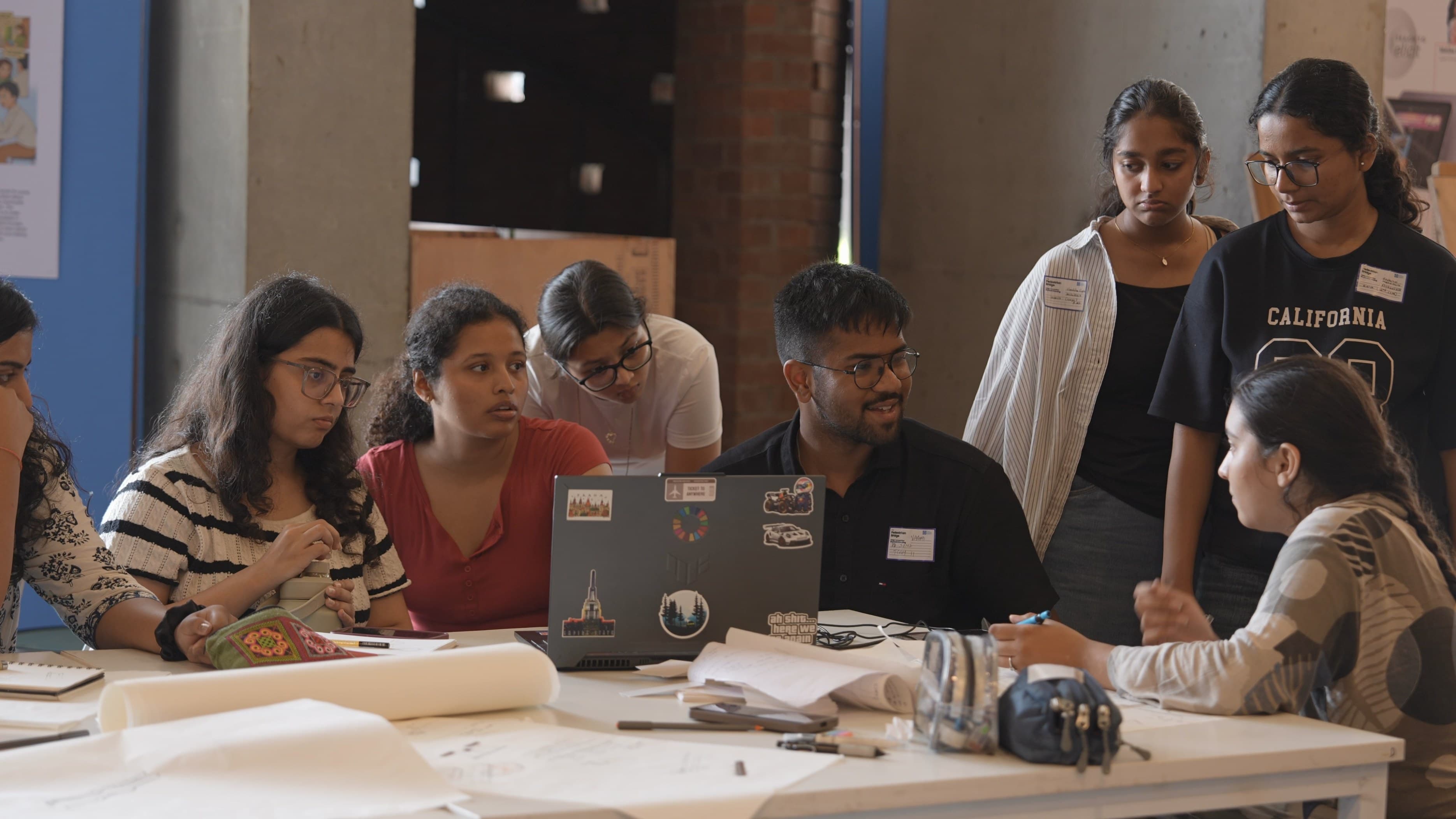
Students of Anant National University will get an opportunity to contribute to public infrastructure development by designing a proposed pedestrian bridge at Narol Crossroad in Ahmedabad, under a collaboration between the university and the National Highways Authority of India (NHAI).
The initiative aims to connect design education with real-world infrastructure requirements, allowing students to work on a public project that could move beyond academic evaluation toward actual implementation.

The proposed bridge will serve as the central focus of a three-stage design competition open to students across disciplines at Anant National University.
Through the competition, participants will be invited to develop practical and implementable design proposals for the pedestrian bridge. The challenge will require students to consider not only the structure's functionality but also its usability, visual appeal, safety and the overall experience of people using public infrastructure.
The final selected proposal will receive an award and be taken forward in close collaboration with NHAI. The process is expected to expose students to the practical considerations involved in designing public infrastructure and translating conceptual ideas into workable solutions.
The initiative is being led at Anant National University by Dr Sanjeev Vidyarthi, Provost, and Ar Jabeen Zacharias, Professor of Practice. Pradeep Atri, Chief General Manager (Technical) and Regional Officer at NHAI, along with architect Habeeb Khan, is also closely involved in the project.
Talking about the initiative and its significance, Dr Sanjeev Vidyarthi said, “Anant National University is committed to providing purposeful design education where students have the opportunity to work with the complexities of the real world. Designing for a real public site, the proposed pedestrian bridge in this case, is an example of that pedagogical approach.”
“Such public spaces are part of the everyday experience for millions of city dwellers, and their design must respond to questions of people, place, safety, usability and the larger urban context. Collaborations like these offer our students the unique opportunity to learn to negotiate real constraints, engage with multiple stakeholders and understand what it takes to move an idea from the drawing board towards implementation,” Vidyarthi added.
The project differs from conventional academic assignments that are generally limited to classroom exercises and theoretical design briefs. Students will instead engage with the stages involved in developing a proposal for a real public site, gaining an understanding of the requirements that influence the design and execution of infrastructure projects.
As the proposals advance through the three stages of the competition, participants will have to account for practical requirements, incorporate design iterations and respond to considerations that determine whether a concept can be developed into a functional public structure. This approach is intended to help them understand the gap between conceptual design and implementation.
Ar Jabeen Zacharias said, “Design is zero until it works for people. The ‘Imagine’ initiative, conceived to harvest ideas for people-oriented design, encourages students to understand and respond to people and contexts, with design as an instrument for positive change in society. A pedestrian bridge is a simple example, an everyday structure where a thoughtful intervention can transform how people experience and engage with it for the better.”
“This collaboration with the National Highways Authority of India marks an important moment for Anant, a stepping stone into the national design scene, bringing interdisciplinary design thinking into public infrastructure. It is a significant moment where collaboration, design and education come together to touch everyday lives,” Zacharias added.
The collaboration is aligned with Anant National University's emphasis on experiential learning through real-world projects, institutional partnerships and industry engagement. By involving students in an actual infrastructure-related design challenge, the university aims to provide exposure to problem-solving in practical settings rather than limiting their learning to academic exercises.
Opening the competition to students from different disciplines is also expected to bring diverse perspectives and approaches to the design brief. Participants will have the opportunity to explore how different areas of design can contribute to developing a pedestrian-friendly public space.
The selected students will gain firsthand exposure to the way public infrastructure projects develop through coordination among designers, technical experts, educational institutions and implementing agencies.
Their engagement with NHAI and other professionals involved in the initiative will also provide insights into stakeholder coordination and the technical and practical considerations that shape public projects.
Through the proposed pedestrian bridge at Narol Crossroad, the university aims to bring interdisciplinary design thinking into public infrastructure while giving students an opportunity to understand how design decisions can influence everyday urban experiences.

Schools urged to make relationship education central to fight domestic violence in Australia

The Future Belongs to Those Who Can Collaborate Intelligently with AI

Diljit Dosanjh Delhi Concert Today: Traffic Restrictions from 1 PM, Check Roads to Avoid, Metro Timings and Parking Details

Why Are Women Still Only 20% of IIT Admissions? JEE Advanced 2026 Data Explained

Australia weighs screen time curbs and AI restrictions in schools
The Future Belongs to Those Who Can Collaborate Intelligently with AI
Diljit Dosanjh Delhi Concert Today: Traffic Restrictions from 1 PM, Check Roads to Avoid, Metro Timings and Parking Details
Why Are Women Still Only 20% of IIT Admissions? JEE Advanced 2026 Data Explained

Google adds hundreds of free textbooks to Gemini Notebook for students in India and US

NBEMS opens NEET Super Specialty 2026 applications: Check eligibility, dates and registration steps

Schools urged to make relationship education central to fight domestic violence in Australia
The Future Belongs to Those Who Can Collaborate Intelligently with AI
Diljit Dosanjh Delhi Concert Today: Traffic Restrictions from 1 PM, Check Roads to Avoid, Metro Timings and Parking Details
Why Are Women Still Only 20% of IIT Admissions? JEE Advanced 2026 Data Explained
Australia weighs screen time curbs and AI restrictions in schools
The Future Belongs to Those Who Can Collaborate Intelligently with AI
Diljit Dosanjh Delhi Concert Today: Traffic Restrictions from 1 PM, Check Roads to Avoid, Metro Timings and Parking Details
Why Are Women Still Only 20% of IIT Admissions? JEE Advanced 2026 Data Explained
Google adds hundreds of free textbooks to Gemini Notebook for students in India and US
NBEMS opens NEET Super Specialty 2026 applications: Check eligibility, dates and registration steps
Copyright© educationpost.in 2026 All Rights Reserved.