A fresh political storm has erupted over the introduction of a Merchant Discount Rate (MDR) on certain UPI merchant transactions, with the Opposition accusing the government of bowing to US pressure and the Centre firmly rejecting any foreign influence behind the move.
The row began a day after the National Payments Corporation of India announced that UPI person-to-merchant transactions above ₹2,000 would attract an MDR of 0.4 per cent from October 15.

Opposition parties, led by the Congress, have demanded an immediate rollback, arguing that the new charge could eventually increase costs for consumers and weaken UPI's appeal as a low-cost digital payment system.
The government, however, has maintained that the new structure does not impose any charge on customers and is aimed at making India's digital payments ecosystem financially sustainable.
“Some claims suggest the change is due to foreign influence. This is false,” the Ministry of Finance said in a post on X.
“India's UPI policy decisions are made independently, with the clear goal of building a self-sustaining, inclusive, and affordable digital payments ecosystem,” it said.
The Finance Ministry also stressed that UPI would continue to be free for consumers.
“Sending money to friends, paying at shops, or scanning a QR code — all remain without charges,” it said. The government's clarification, however, did little to cool the political confrontation.
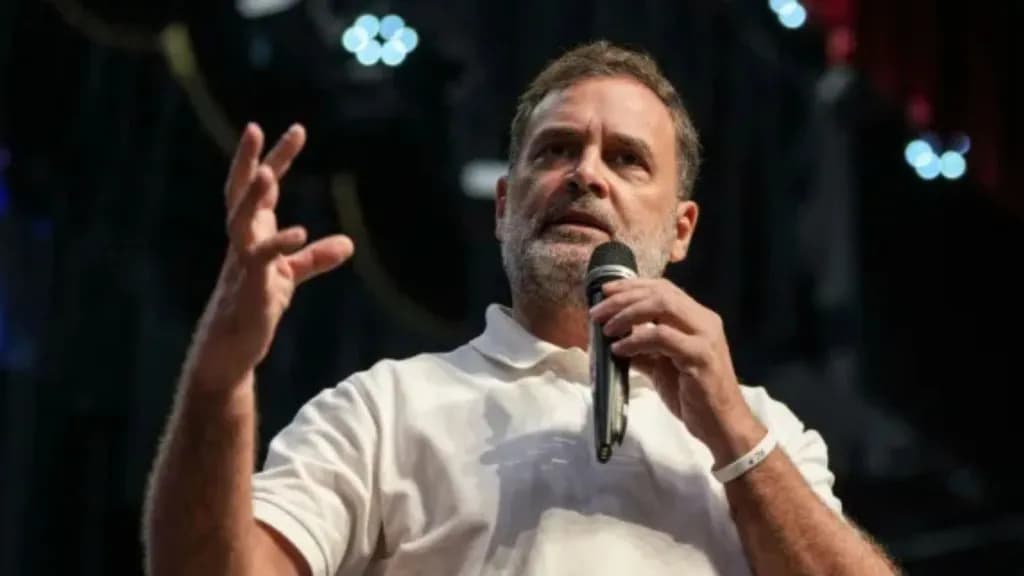
Leader of Opposition in the Lok Sabha Rahul Gandhi directly targeted Prime Minister Narendra Modi, urging him to “have a spine” and roll back what he described as a “UPI tax”.
In a video message, Gandhi compared Modi's approach with that of former Prime Minister Indira Gandhi and alleged that the decision had been taken under pressure from the United States.
“He has put a tax on every single Indian person by taxing UPI and giving a huge amount of money to the United States,” Gandhi alleged.
Congress president and Leader of Opposition in the Rajya Sabha Mallikarjun Kharge also linked the MDR decision to broader tensions in India-US relations.
In a post on X, Kharge alleged that pressure from Washington was mounting on issues ranging from tariffs and trade to H-1B visas and digital payments, and described the MDR decision as another instance of the government giving in to US pressure.
Samajwadi Party president Akhilesh Yadav questioned the rationale behind charging for UPI payments, arguing that merchants could eventually recover the additional cost through higher prices.
AAP MP Sanjay Singh also alleged that the new charge had been introduced under American pressure, while RJD leader Manoj Jha described the move as evidence of the government “bowing down” to American influence.
CPI general secretary D Raja demanded withdrawal of what he called an “anti-people decision” and insisted that UPI transactions should remain free.
The government has presented a different picture.
The Finance Ministry said person-to-person UPI transfers would remain free irrespective of the transaction amount. It also said small merchants earning up to ₹1 lakh a month through UPI QR codes would continue to pay zero charges.
According to the ministry, more than 95 per cent of merchant payments are below the ₹2,000 threshold and would therefore remain free. Only larger merchant transactions above ₹2,000 would attract the 0.4 per cent MDR, which would be borne by merchants.
The ministry said the rate was significantly lower than charges associated with credit cards and other payment networks.
Different categories of transactions will also have separate rates. Payments involving railways, fuel, telecom, bill payments and insurance above ₹2,000 will carry a flat ₹5 fee per transaction, while mutual fund and securities payments will attract an MDR of 0.02 per cent, capped at ₹300.
The government has also sought to address concerns that merchants could pass the additional cost on to customers.
It said banks had been instructed to ensure that merchants do not transfer MDR costs to consumers. The ministry further said UPI apps would not be permitted to impose platform charges, ruling out hidden fees for customers.
Amid the political controversy, Defence Minister Rajnath Singh highlighted UPI's broader impact on India's economy and financial inclusion.
Speaking in Kolkata, Singh pointed to the scale of India's digital payments network, noting that UPI completed 10 years recently and processed 23.66 billion transactions in August alone, with a combined value of about ₹29.88 lakh crore.
Singh said the system had particularly benefited lower-income groups and street vendors, including beneficiaries of the PM SVANidhi scheme.
He said street vendors had received collateral-free loans of around ₹80,000-85,000 and used the funds to expand their businesses. According to an estimate cited by Singh, the average annual income of PM SVANidhi beneficiaries had risen by 20 per cent.
The government is therefore framing the MDR change as a limited adjustment designed to strengthen the financial sustainability of the UPI ecosystem, while the Opposition sees it as a policy shift that could eventually burden merchants and consumers.
At the heart of the dispute is a question that goes beyond the 0.4 per cent charge: whether introducing fees on a section of UPI transactions can preserve the platform's affordability and mass appeal while creating a sustainable revenue model for India's rapidly expanding digital payments infrastructure.