


From driving an auto and working at Pizza Hut to building a 10 GW renewable energy business.
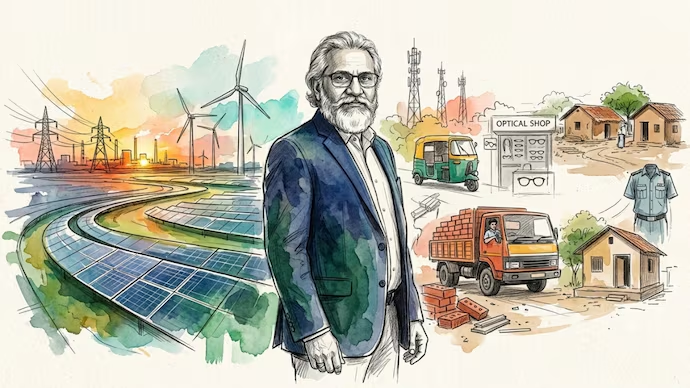
When a truck driver and labourers failed to report for work one day, Dr Faruk G Patel had two choices: tell his customer that the delivery would be delayed or do the job himself.
He chose to get behind the wheel.

The consignment had to reach Hazira Industrial Estate. Patel drove the truck, delivered the bricks and then started unloading them himself. He worked until nearly midnight, his clothes covered in red brick dust and his back bruised from carrying the heavy load.
“I have always believed in commitment. Once I give my word, I consider it my responsibility to fulfil it,” Patel recalled in a conversation with India Today Digital.
It was the kind of experience that defined Patel’s early years in business — a period when there was little money, few resources and no guarantee that the next opportunity would work.
Today, Patel is the Founder, Chairman and Managing Director of KP Group, whose listed companies include KPI Green Energy, KP Energy and KP Green Engineering. The group reported a combined market capitalisation of ₹10,964 crore as of August 2026.
His journey from driving an auto-rickshaw and working at Pizza Hut to building a renewable energy business is marked by repeated shifts — from material handling to telecom infrastructure and eventually to solar and renewable energy.
From a bus conductor’s family to odd jobs
Patel was born on March 24, 1972, in Saladra village in Gujarat’s Bharuch district. When he was two, his father, Ghulam Patel, was transferred from the Jhagadia GSRTC depot to the Adajan ST depot in Surat.
The family moved to Surat and lived in a small rented house. His father came from a farming family and worked as a bus conductor. Patel says those early years taught him the value of money and the importance of earning it through hard work.
“That environment instilled in me a strong sense of financial discipline and respect for every rupee earned through honest work,” he said.
After Class 12, Patel did not follow a conventional career path. He worked at an optical shop, drove an auto-rickshaw, worked at a dress-material shop and travelled to Mumbai to learn about the import-export trade.
He also underwent formal training in textile engineering in 1990 and experimented with a small retail venture.
Then came a major change.
In 1991, Patel moved to the UK and joined Pizza Hut, eventually becoming a team leader. The experience exposed him to a more structured workplace and a different approach to business.
But financial stability was not enough for him.
“Although working in the UK could provide financial stability, it would not fulfil my larger ambition of building something of my own and contributing to India’s growth,” he said.
He returned to India in 1993.
A ₹1 lakh beginning
Back in Surat, Patel entered carting, material handling and small construction-related assignments.
In 1994, he formally established the foundation of what would later become KP Group from a small office at Fazal Tower, Adajan Patia.
His starting capital was about ₹1 lakh.
The business involved transporting materials and handling small construction assignments for industrial companies across Gujarat. Patel was involved in almost every aspect of the operation — trucks, drivers, deliveries, customers and payments.
The Hazira brick delivery was part of this period. But Patel soon encountered another lesson that would shape his approach to entrepreneurship.
Within six to eight months, he realised that the business model was not taking him in the direction he wanted. Instead of continuing simply because he had already invested money and effort, he handed the trucks and business assets to his partner and returned to Surat to build a more focused corporate venture.
For an entrepreneur at the beginning of his career, walking away can be harder than starting.
Patel says that experience taught him that persistence does not mean refusing to change.
“Persistence does not mean being attached to one particular business model. A successful entrepreneur must be willing to recognise when circumstances require a change in direction,” he said.
That lesson would surface repeatedly in the years ahead.
From trucks to telecom towers
Patel’s next major opportunity came from India’s rapidly expanding telecommunications industry.
KP Group entered telecom infrastructure and spent around 13 years working on mobile tower infrastructure across 16 states.
The company also explored a shared-tower model in which multiple telecom operators could use common infrastructure rather than building separate towers.
As mobile connectivity expanded, so did the business.
But the telecom sector later faced major disruption following the 2G spectrum controversy. Patel once again had to look beyond the business he had built.
This time, he turned towards renewable energy.
The Charanka moment
The turning point came while Patel was working on a 105 MW solar park at Charanka in Gujarat.
The project changed the way he viewed solar power. Until then, much of his business experience had involved building or moving infrastructure for other companies. Solar offered something different: the possibility of developing and owning an energy asset capable of generating income over decades.
“I got the inspiration that solar panels last for 25 years and provide assured income over that period, while also contributing to environmental sustainability,” he said.
In 2008, Patel established KPI Global Infrastructure, which later became KPI Green Energy. KP Energy followed in 2010.
At the time, solar power was far from the mainstream investment opportunity it is today.
Patel says friends and relatives questioned the decision.
“Many of my friends and relatives mocked me and made fun of me because they felt I was gambling with my future by getting into solar,” he said.
But he stayed with the bet.
The transition was not easy. The new business required capital, land, long-term planning and the ability to operate in an industry whose commercial potential was still developing.
Patel describes the early solar years as among the most difficult periods of his career.
The pressure behind the solar bet
The uncertainty was not only financial. Patel says the pressure of building the new business also affected him personally.
“During this particularly difficult period, I experienced deep mental and emotional strain and went through a period of depression,” he said.
He credits faith, focus and persistence with helping him continue through that phase. Over time, the solar venture became the foundation of a much larger renewable energy business.
KP Group has since expanded into solar, wind, hybrid energy, engineering and related infrastructure. Its listed companies include KPI Green Energy, KP Energy and KP Green Engineering.
The group says its renewable energy portfolio has crossed 9.2 GW and that it is targeting more than 10 GW of renewable energy capacity by 2030.
KP Green Engineering has also disclosed a first US export order worth ₹23.02 crore for solar module mounting structures. Its manufacturing expansion in Bharuch includes a galvanising facility that the company describes as Asia’s largest.
The scale is a sharp contrast to Patel’s beginnings in a small office with ₹1 lakh in capital.
The lessons behind the numbers
For Patel, however, the biggest lessons from his journey are not captured by market capitalisation or installed capacity.
He points to speed, dedication, commitment and loyalty as principles that have shaped his approach to business.
“Speed is important because opportunities in emerging markets often do not remain available indefinitely,” he said. “Dedication is required because building a business involves long periods when the results may not yet be visible.”
His career has repeatedly involved decisions made before the outcome was certain.
He left a stable job in the UK to return to India. He walked away from his first business within months. He entered telecom infrastructure during a period of rapid technological expansion and then moved into solar when the sector was still viewed with scepticism by people around him.
For young entrepreneurs, Patel’s message comes from those experiences.
“Start small but think big,” he said. “You do not necessarily need substantial resources to begin; you need the conviction and resourcefulness to make the most of what is available.”
Patel started with about ₹1 lakh, a small office and a business built around trucks and material handling.
More than three decades later, the ventures that emerged from that modest beginning include three listed companies and a renewable energy business targeting more than 10 GW of capacity by 2030.
The numbers illustrate the scale of the journey. The pivots explain how Patel got there.

Tamil Nadu School Holiday Today: Schools Closed in 3 Districts; Chennai Update
Jhansi School Headmaster Arrested Over Alleged ₹2 Lakh Mid-Day Meal Fund Fraud

Lincoln Tech Expands LeadSquared Partnership to Deploy AI Agents in Student Admissions
FinX, IIBF Join Hands to Expand BFSI Job Opportunities for Banking and Finance Candidates

SSC CHSL 2026 Applications Drop 49%: 15.71 Lakh Candidates Apply for 2,536 Posts
.jpg&w=256&q=75)
Australian schools record thousands of student sexual misconduct reports as child safety concerns grow
.jpg&w=256&q=75)
Egypt insists international schools include Arabic, history in final scores
China’s Chery unveils AI companion robot designed to ease loneliness
.jpg&w=256&q=75)
New Zealand reforms could leave more students without school qualifications
Alfred Nobel’s will created one of the world’s most recognised prizes. Here’s how

Tamil Nadu School Holiday Today: Schools Closed in 3 Districts; Chennai Update
Jhansi School Headmaster Arrested Over Alleged ₹2 Lakh Mid-Day Meal Fund Fraud
Lincoln Tech Expands LeadSquared Partnership to Deploy AI Agents in Student Admissions
FinX, IIBF Join Hands to Expand BFSI Job Opportunities for Banking and Finance Candidates
SSC CHSL 2026 Applications Drop 49%: 15.71 Lakh Candidates Apply for 2,536 Posts
Australian schools record thousands of student sexual misconduct reports as child safety concerns grow
Egypt insists international schools include Arabic, history in final scores
China’s Chery unveils AI companion robot designed to ease loneliness
New Zealand reforms could leave more students without school qualifications
Alfred Nobel’s will created one of the world’s most recognised prizes. Here’s how
Copyright© educationpost.in 2026 All Rights Reserved.