


From research internships and university collaborations to student mobility and offshore campuses, higher education is emerging as an important area of cooperation as the two countries work to deepen their strategic partnership.
India and Canada are looking to use higher education and research partnerships to strengthen their bilateral relationship, with both countries identifying academic collaboration, student mobility and talent development as important areas of cooperation.
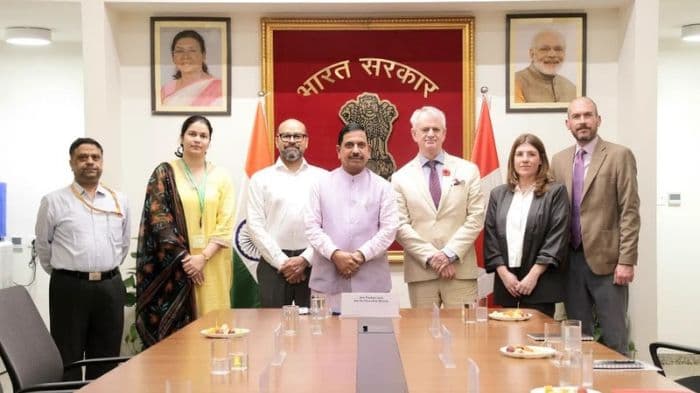
The latest meeting, held on Oct 22, between Union Education Minister Pralhad Joshi, Canadian High Commissioner Christopher Cooter and Trade Commissioner Amy Antonini, focused on expanding cooperation in education, research and innovation. The discussions covered the implementation of agreements announced during engagements between Prime Minister Narendra Modi and Canadian Prime Minister Mark Carney, stronger research partnerships, student mobility and the entry of Canadian universities into India under the National Education Policy (NEP) 2020.

The meeting follows a series of initiatives announced earlier in 2026 to strengthen academic and institutional links between the two countries
Education becomes part of India–Canada strategic partnership
Education and talent mobility were explicitly recognised as important components of the renewed India–Canada relationship in the joint statement issued during Canadian Prime Minister Mark Carney's visit to India from Feb 27 to March 2.
The statement described the movement of students, researchers and professionals between the two countries as mutually beneficial, contributing to stronger innovation ecosystems and economic growth. Both leaders agreed to deepen cooperation between higher education institutions through joint, dual-degree and twinning programmes, industry-aligned skills training, research partnerships in emerging technologies and the establishment of offshore campuses of leading Canadian institutions in India.
The leaders also agreed to revitalise the Joint Working Group on Higher Education, which provides an institutional mechanism for continued discussions on academic cooperation.
The education agenda is part of a broader effort to strengthen bilateral relations. The March joint statement acknowledged progress towards the gradual normalisation of ties, including more frequent ministerial engagements, the return of diplomatic representatives to their respective missions and the activation of institutional dialogue mechanisms.
By creating regular connections between universities, researchers and students, education partnerships offer another channel for engagement beyond government-to-government discussions.
300 Indian students to get research internship opportunities in Canada
One of the concrete initiatives announced during Carney's visit was an agreement between India's All India Council for Technical Education (AICTE) and Canada's Mitacs to expand the Globalink Research Internship programme.
Under the memorandum of understanding, 300 eligible Indian senior undergraduate students will be able to undertake fully funded, 12-week research internships at Canadian universities every year for three years, beginning in 2027.
The programme will cover research across disciplines, including science, engineering, mathematics, humanities and social sciences. Students will work on research projects hosted by Canadian academic faculty members, giving them opportunities to gain international research experience and establish academic connections.
The initiative is expected to strengthen links between Indian and Canadian institutions while supporting the development of research skills and talent mobility.
Mitacs, a Canadian organisation that connects academic institutions with industry and research partners, said the agreement would expand opportunities for Indian students to participate in innovation projects at Canadian post-secondary institutions.
13 university partnerships expand academic cooperation
University-level collaboration is another important part of the growing education relationship.
On Feb 28 Global Affairs Canada announced the launch of the Canada–India Talent and Innovation Strategy, alongside 13 new partnerships between Canadian and Indian universities. Launched by Universities Canada and Colleges and Institutes Canada, the strategy represents more than 20 Canadian institutions and aims to facilitate research collaboration, student exchanges, hybrid campuses and AI centres of excellence.
The partnerships cover a range of academic and research areas.
The University of Toronto and the Indian Institute of Science (IISc), for instance, signed an agreement focused on artificial intelligence research and education. The collaboration involves the University of Toronto's Temerty Centre for AI Research and Education in Medicine and other AI researchers.
Another agreement between Dalhousie University and SRM Institute of Science and Technology will support a nursing dual-degree programme, including 25 Indian Nursing Council-approved supernumerary seats, dual credentials and clinical experience in Canada.
The University of British Columbia and O.P. Jindal Global University also signed an agreement to facilitate student and faculty exchanges and research collaboration. Meanwhile, the University of the Fraser Valley and Panjab University agreed to expand student and faculty mobility, academic programming and research exchanges.
These partnerships show how cooperation is extending beyond student recruitment to include joint academic programmes, faculty exchanges and research activities.
The two governments also welcomed the conclusion of 24 education-related MoUs in their March 2 joint statement. This figure refers to the wider set of education agreements acknowledged by the leaders and is separate from the 13 university partnerships announced under the Talent and Innovation Strategy.
Canadian researchers to collaborate with Indian institutions
Research mobility is also being strengthened in the other direction.
Under Canada's Indo-Pacific Scholarships and Fellowships for Canadians programme, more than 85 Canadian graduate students and researchers from 11 Canadian post-secondary institutions are expected to travel to India to work with Indian academics.
The collaborations will cover areas including clean hydrogen, climate resilience, artificial intelligence, trade and supply chain resilience, and sustainable development.
The initiative is intended to encourage knowledge exchange and build research connections between institutions in both countries. It also gives Canadian researchers opportunities to work with Indian academics on issues relevant to shared economic, technological and environmental priorities.
The joint statement also welcomed a developing Joint Talent and Innovation Strategy, which aims to strengthen two-way talent flows through structured mobility, joint training pathways and research collaboration.
Canadian universities explore opportunities in India
The possibility of Canadian universities establishing a presence in India is another area of cooperation.
During the October meeting, Joshi and Canadian officials discussed facilitating the entry of Canadian universities into India under the NEP 2020 framework. The policy allows foreign universities to establish campuses in India, subject to regulatory requirements.
Earlier in February, a delegation of more than 20 Canadian university presidents visited India, with discussions focusing on expanding institutional partnerships and exploring opportunities for offshore campuses, academic exchanges and research collaboration.
The March joint statement also identified offshore campuses as part of the two countries' plans to deepen higher education cooperation.
For India, such partnerships could create additional opportunities for international academic collaboration and access to programmes offered by foreign institutions. For Canadian universities, they offer a route to build institutional links and engage with India's higher education sector.
Education partnerships offer a longer-term channel for engagement
The recent agreements indicate that education is being positioned as more than a student-mobility issue in India–Canada relations. The cooperation now spans university partnerships, research internships, faculty exchanges, emerging technologies and institutional collaboration.
Canada's Global Affairs department has described education and research partnerships with India as a means of building innovation ties and long-term cooperation. The two governments have also linked academic mobility with stronger people-to-people connections.
However, several of the announced initiatives are still at the agreement or planning stage. The AICTE–Mitacs internship programme, for example, is scheduled to begin in 2027, while the proposed expansion of Canadian university campuses and research partnerships will depend on their implementation.
The October meeting between Joshi and Canadian officials therefore adds to the ongoing effort to translate bilateral commitments into working academic collaborations. Their progress will determine how far education partnerships can contribute to sustained engagement between the two countries.
Why India–Canada relations hit a low
India–Canada relations deteriorated sharply in September 2023 after then Canadian Prime Minister Justin Trudeau alleged that there were credible indications of a potential link between Indian agents and the killing of Khalistani separatist Hardeep Singh Nijjar in British Columbia. India rejected the allegation as “absurd”, and the dispute led to diplomatic expulsions, reciprocal reductions in diplomatic presence and a prolonged freeze in high-level engagement.
Tensions deepened in 2024, with both countries taking further diplomatic action amid continuing allegations and counter-allegations.
The first signs of a thaw emerged after Mark Carney became Canada's prime minister in March 2025. At the G7 Summit in Kananaskis in June that year, Carney and Prime Minister Narendra Modi agreed to take calibrated steps to restore stability in the relationship.
The two countries reinstated their high commissioners in August 2025 and resumed senior-level discussions on security and law enforcement. Canadian Foreign Minister Anita Anand's visit to India in October 2025 resulted in a new roadmap covering trade, science and technology, education, research and people-to-people ties.
The thaw gathered pace with Carney's visit to India this year, the first bilateral visit by a Canadian prime minister since 2018. The two leaders agreed to renew the India–Canada strategic partnership and expand cooperation across trade, energy, critical minerals, technology, security and education.
They also acknowledged progress towards the gradual normalisation of ties, including the return of diplomatic representatives and more frequent ministerial-level engagement.
Prime Minister of India
By September 2026, both governments were describing the relationship as having sustained momentum. During their Foreign Office Consultations in New Delhi on Sep 2, officials reviewed cooperation in education, science and technology, security, defence and other areas.

Can two heads guide a PhD better than one? UK study explores team supervision

Gaza universities seek global academic support after Israeli strikes kill three staff members

India, Canada look to strengthen bilateral ties through education partnerships

Australian student visa delays leave international research scholars in limbo

Syria school curriculum changes spark backlash over altered images, historical figures
Can two heads guide a PhD better than one? UK study explores team supervision

11-year-old Egyptian girl beats 40 million students to win Dh500,000 in Dubai

South Korea's student suicide toll nears 1,000 in four years, with India's figures also drawing attention

Want to explore the world without leaving your classroom? Seoul students show how
When smart glasses become cheating tools: South Korea draws tougher exam rules

Can two heads guide a PhD better than one? UK study explores team supervision
Gaza universities seek global academic support after Israeli strikes kill three staff members
India, Canada look to strengthen bilateral ties through education partnerships
Australian student visa delays leave international research scholars in limbo
Syria school curriculum changes spark backlash over altered images, historical figures
Can two heads guide a PhD better than one? UK study explores team supervision
11-year-old Egyptian girl beats 40 million students to win Dh500,000 in Dubai
South Korea's student suicide toll nears 1,000 in four years, with India's figures also drawing attention
Want to explore the world without leaving your classroom? Seoul students show how
When smart glasses become cheating tools: South Korea draws tougher exam rules
Copyright© educationpost.in 2026 All Rights Reserved.