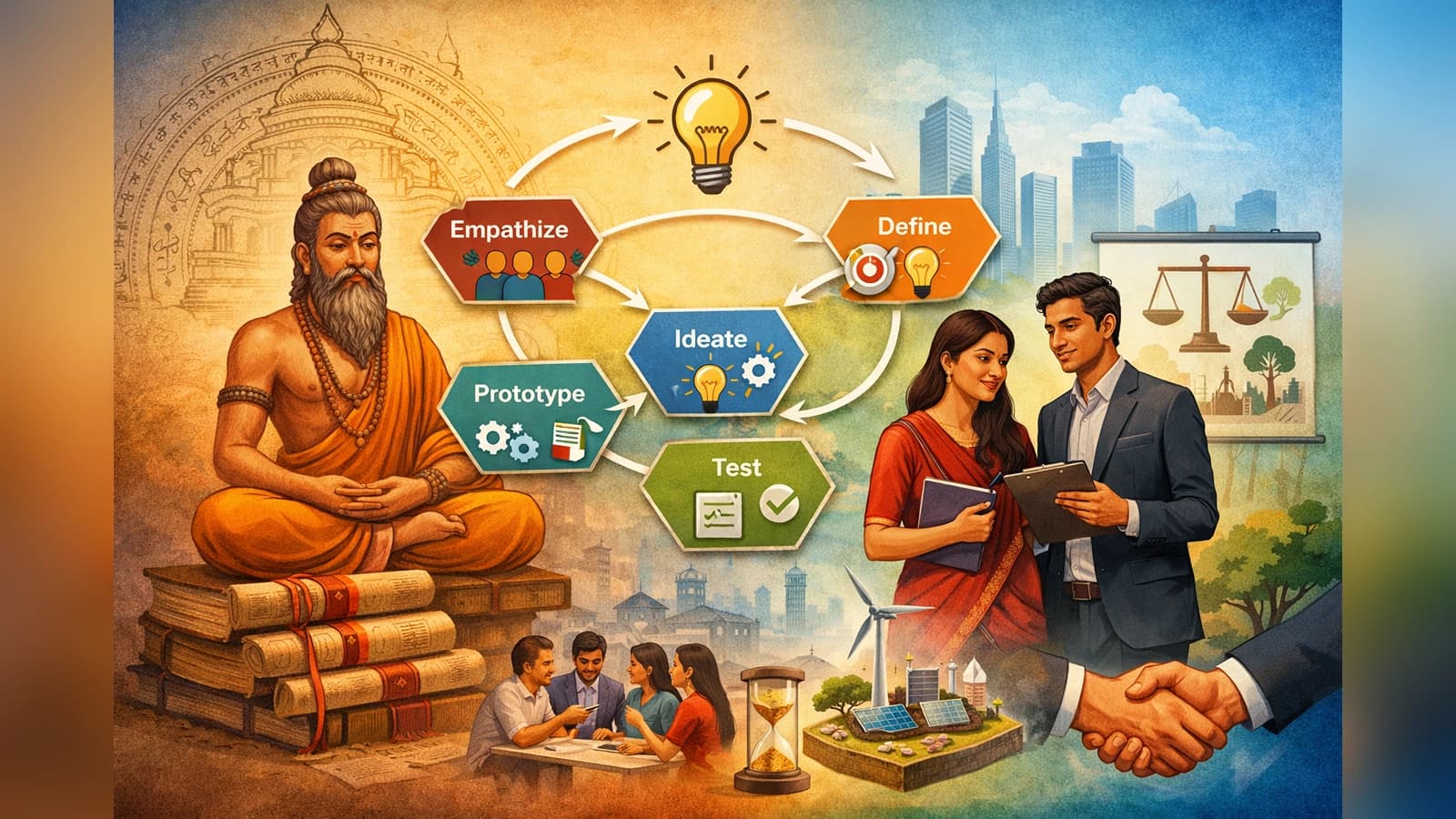
Indian Knowledge Systems (IKS) have gained significant attention in the landscape of higher education policy and academic discourse in recent years. Yet, the implementation of IKS in the business school context has been merely symbolic— limited to ancient narratives on ethics via lectures or folk antidotes that not only fall short on the grounds of student engagement but also are rather detached from everyday decision making in the Volatile, Uncertain, Complex and Ambiguous (VUCA) business world. Nonetheless, after extensive deliberation, now that IKS has found their dominance in business classrooms, what is at stake today is not curricular inclusion or policy washing of IKS to meet mandates and agendas, but pedagogical credibility —whether these systems are taught in ways that meaningfully advance managerial insight, strategic sense-making, ethical judgement, and long-term value creation. In this background, Design Thinking (DT), a human-centric process which is grounded in empathy, prototyping, and reflection— presents itself as a novel imperative. DT is a five-stage iterative problem-solving methodology involving stages of empathise, define, ideate, prototype and test stages to design meaningful solutions.
When IKS is framed within the principles of DT, students get to experience indigenous wisdom not as an abstract ancient philosophy, but as a practical toolkit for hands-on innovation, structured thinking, leadership and strategy for business and social transformation.

What’s in it for future managers?
In the world where contemporary management education blooms in the context of efficiency, synthesis, and analysis, popular opinion is contradictory— with continuous corporate failures from governance breakdowns, ethical frauds, and environmental neglect, what is revealed is a deeper deficit in Western knowledge systems followed by corporate education. This trembles the unquestioned high-throne Western system in the Indian context, that in this indigenous part of the world, the ability to reason both ethically and critically in complex problems calls for a look into ancient wisdom.
IKS offers guiding principles to address this critical challenge. Ideas such as dharma (responsibility), karma (awareness of consequence), nyaya (justice), and lokasangraha (collective welfare) outline structured ways to rethink about the dynamics of power, how to hold accountability, build critical judgment, design strong character, and create long-term value for all stakeholders alike. These ideas are not moral sermons, but tested systems which were indeed developed to navigate ambiguity and competing stakeholder interests.
DT as a Pedagogical Bridge:
DT is widely used in business schools to teach innovation. DT closely align with Indian epistemological traditions that emphasise contextual understanding, empathic inquiry, holistic reasoning and experimentation. Integrating IKS through DT does not call for a sudden transformation of faculty to become philosophers of ancient texts overnight; rather, it requires them to rethink learning narratives where ethical, empathic and creative reasoning emerges through practice.
Rather than merely treating DT as a standalone, value-neutral, Western problem-solving process, this workshop attempted to embed DT phases within indigenous epistemological frameworks rooted in Indian philosophy. Therefore, we mapped each stage of DT immersion with IKS principles rather than simply lecturing on dharma or nyaya. This approach integrated IKS ideas into live design projects. Students were divided into teams and introduced to a real-life business challenge, and were taken through DT with distinct tools at each stage, along with IKS perspectives at each stage. Concepts such as Karuna (compassion), Dharma (responsibility), and Seva (service) were presented the empathy stage with empathy maps, extreme user maps, contextual inquiry and Viveka (discernment) guides problem definition with point-of-view statemented job-to-be-done framework; Jugaad and Sahajta shape ideation through techniques like brainstorming, abstract laddering and round-robin; Abhyasa (iterative practice) underpins prototyping; and Lokasangraha (collective welfare) frames testing and impact evaluation.
Students were first asked to engage deeply with stakeholders to trace trade-offs and embrace social and ethical tensions. The aim was to introduce Indian Knowledge concepts from an interpretive lens rather than as prescriptive answers.
The workshop was designed with the objectives that upon its completion, students would develop a preliminary understanding of key ideas of IKS and their relevance to contemporary management challenges. Students would integrate IKS concepts such as Dharma and Viveka into DT’s authentic inquiry, problem definition, and innovation outcomes. The learning process would enable them to create solutions that attempt to balance business viability with the IKS principle of social welfare (IKS- Lokasangraha), thereby aligning DT’s innovation with societal needs. Furthermore, through continuous prototyping, feedback, and improvement (IKS- Abhyasa), students would foster reflective learning and problem-solving skills.
We evaluated student learning through an active blend of outcome-based and experiential learning frameworks. The team business challenge required students s to design a real-world business model, social innovation or prototype. They were encouraged to undertake field analysis and seek an understanding of indigenous innovation through the study of Indian enterprises, startups, or community initiatives that were committed to IKS-informed decision-making and frugal or inclusive innovation practices.
In this classroom initiative, management students worked on various real-world challenges, for instance, platform work insecurity, sustainability pressures on small businesses, and community displacement linked to infrastructure development. Teams conducted field interviews, stakeholder mapping, and impact analysis before proposing solutions. After their explorations and upon the completion of the workshop, student learning was assessed through presentations of their innovation process, value alignment, and impact outcomes, with evaluation based on conceptual clarity, effective integration of IKS principles, contextual relevance of their solutions, ethical grounding, quality of innovation, and potential societal impact. Individual reflective learning journals were assessed for students’ ability to critically reflect on the application of IKS concepts at each stage of the DT process, focusing on depth of deep insight, critical reasoning, creative thought, ethical considerations, and linkage to Indian philosophical ideas.
Learning from the Classroom:
Students described a change in how they approached business problems.
“This workshop was uncomfortable in a good way and extremely relevant. There was no single right answer, only better and worse choices to be made empathically,” one student shared. This expressed discomfort, however, became pedagogically productive. Students learned that true judgment comes not from some rule-book but from contrasting competing stakeholder claims in the lens of power asymmetries, and long-term consequences within specific social contexts. Empathy and wisdom emerged not as soft skills, but as a disciplined mode of reasoning grounded in situational responsibility (dharma) and consequence awareness (karma). “This process made me realise ethics is embedded in every business choice…, innovation didn’t feel value-neutral, every business choice was always a design choice but now felt also like an ethical choice.” Another student reflected, “Dharma stopped being an ancient or moral idea. It has now become a question I have to answer every time I prioritise one stakeholder over another.”
Faculty members observed a noticeable change in classroom dynamics. Discussions became meaningful, reflective, and more grounded in the lived realities of various stakeholders. Faculty quoted “Discussions became inclusive, ethically focused, and more grounded in real consequences.” Another faculty member quotes, “Design thinking gave students structure, and IKS gave them depth”. Other faculty remarked that “The quality of questions improved…students stopped asking…what is the right answer and started asking…who might be harmed if we choose this path?”. Another faculty reflected that “What is interesting about IKS is not only the philosophical depth alone, but its relevance to managerial dilemmas where rules fail and judgment matters.”
An interesting insight came from a faculty member who reflected that “We deliberately resisted the temptation to ‘teach’ values upfront. Instead, we let students struggle with real dilemmas and then offered IKS as a language to make sense of that struggle. I’ve grown to appreciate how embedding IKS through experiential design avoided moral preaching and encouraged genuine ethical reasoning.” Another faculty quoted “This approach feels more suited to Indian business realities than imported case studies alone.”
What are the key outcomes?
We traced three key outcomes that emerged from this short DT-IKS endeavour. First, students developed empathy and ethical reasoning. Instead of searching for universal rules or industry benchmarks or policy requirements, they learned to evaluate decisions not only contextually and empathetically but also ethically and indigenously.
Second, the environment acknowledged a sense of managerial humility. As one student quotes, “Earlier I thought good leaders always have answers…. but this workshop showed me that it's more…good leaders also know to ask better, deeper questions, listen, and understand what they don’t yet know…”. “We could observe the classroom discussions shifted from demonstrating expertise to exercising thoughtful restraint and humility, which is rarely emphasised in education,” observed a senior faculty member. It became evident that students began questioning ‘solution-first mindsets’ and ‘one more innovation-for-innovation’s sake’. They understood that not all problems need some one-shot technological modifications but more human centricity.
Third, faculty themselves reported renewed pedagogical engagement and exploration. One faculty member quoted, “The classroom became a site of exploration for faculty as well, not just for students.”
Implications:
For students, the nexus of DT and IKS helps them acknowledge innovation and ethics not as forces of competition but processes of mutual reinforcement to cultivate critical thinking, empathy, and reflexivity—capabilities which are central to leadership competence.
For instructors, this new direction in pedagogy calls for a conscious change in the role of instructors from being primary transmitters of knowledge to epistemic facilitators who guide students in their academic journey to navigate ambiguity, moral trade-offs, conflicting interests, and contradictory value systems, which impact everyday business decision-making. Various techniques can be explored by instructors, such as ‘reflective pauses’—through ideation scaffolds, dialogic inquiry, reflective sensemaking, structured debriefs, among others, that position IKS concepts distinct from prescriptive rules to interpretive resources.
The integration of IKS via DT allows management schools to advance globally relevant yet locally grounded education, which happens to be the explicit aspirations of National Economic Policy (NEP) 2020, Skill India, Atmanirbhar Bharat and National Innovation and Startup Policy by empowering graduates who are not only competent and innovative but also empathic and context-sensitive. These initiatives are also a part of synergy building with Sustainable Development Goals (SDG) such as SDG 4 (Quality Education), SDG 8 (Decent Work and Economic Growth) and SDG 12 (Responsible Consumption and Production) by shaping future leaders who leverage sustainability and social responsibility as forces of value creation in business settings.
Through capstones/internships/exchange programs/field project-based learning approaches, policymakers can incentivise the implementation of IKS to advance the commitment towards SDG 9 (Industry, Innovation and Infrastructure)and SDG 11 (Sustainable Cities and Communities) through Public–Private Partnerships (PPP) via accreditation and benchmarking frameworks, which reinforce innovation in instructional design.
For managers and industry practitioners, the implications are equally relevant. It goes without saying that leaders trained through DT–IKS pedagogies are more likely to responsively experiment their assumptions to maximise stakeholder value because they are well equipped to handle the complex challenges. This, in turn, advances SDG 17 (Partnerships for the Goals) because such leaders are capable of collaborating across community boundaries while maintaining legitimacy and trust.
Longitudinal and comparative studies across domains, institutions, and methodologies via future scholars could design evidence-based policy imperatives and contribute meaningfully to global conversations on sustainable development and local conversations on ancient wisdom, ethical judgment, and innovation.
Looking Ahead
Future leaders require more than technical or analytics competence—it requires humane wisdom rooted in an ancient context to navigate business uncertainties. By integrating IKS with DT, education systems can cultivate leaders who all— innovative, empathic, inclusive, reflective, responsible, critical and ethical.
As a faculty member remarked, “I think this is not about looking backwards into old text…. or maybe a nostalgic return or merely mandatory policy stances…. It has got more to do with using our ancient… intellectual heritage …which is indeed globally valued now… and DT brings humane empathy to design a more inclusive and innovative future for our world...we can make that happen with these initial steps….”
(This article is written by Arushi Bathla, Jindal School of Liberal Arts and Humanities, O.P. Jindal Global University, Sonipat, Haryana; Ashish Gupta, Faculty of Management, South Asian University (SAU), New Delhi; and Ginni Chawla, Indian Institute of Foreign Trade (IIFT), New Delhi. The views expressed are solely those of the authors and are personal in nature. This is an opinionated article, and Education Post does not endorse or take responsibility for the opinions expressed herein.)