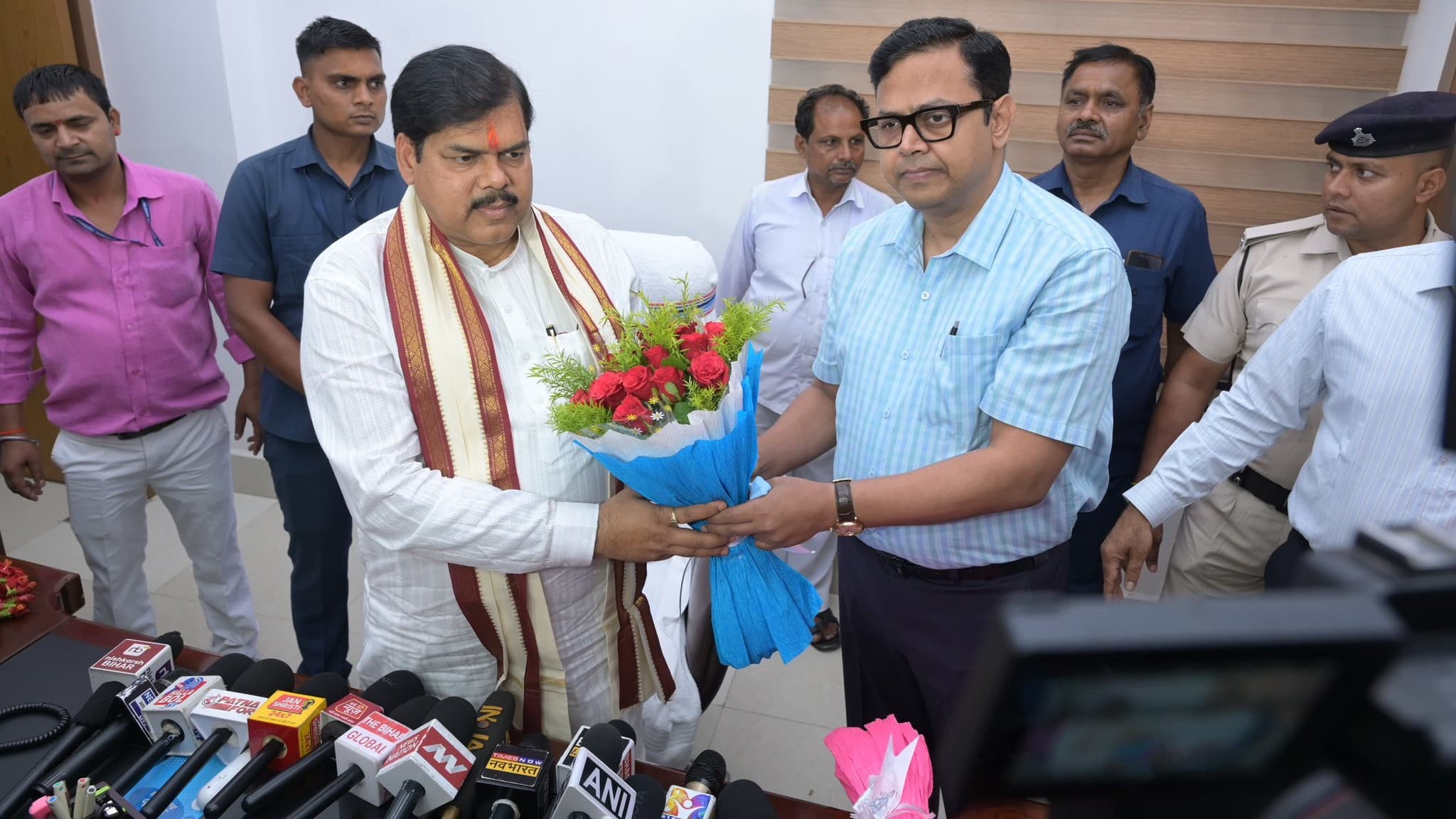
Bihar’s education system entered another turning point in May 2026 with Mithilesh Tiwari taking charge as the state’s new Education Minister in the Samrat Choudhary government.
The appointment came during a major political transition in Bihar, where the Bharatiya Janata Party formed the government under Samrat Choudhary, who was sworn in as the state’s 24th Chief Minister on April 15, 2026.

As of May 9, 2026, Mithilesh Tiwari officially heads the Education Department and has already signaled administrative reforms, faster grievance resolution, and changes in recruitment processes.
A Teacher Who Became Education Minister
Unlike many leaders who entered the education portfolio through political reshuffling alone, Mithilesh Tiwari often refers to his own journey as a teacher before becoming a minister.
After assuming office on May 8, he said he understood the department’s problems because he had personally experienced the struggles of students and teachers.
“I myself have been a teacher. I know where the problems exist within the department and what difficulties candidates have to go through. Arbitrary functioning will no longer be tolerated in the department.”
Before entering active politics, Tiwari worked as a tutor and also operated a coaching institute in Patna while pursuing a BA Honours degree in Economics.
His political journey began through the Akhil Bharatiya Vidyarthi Parishad in 1988, after which he formally joined the BJP in 1990. Over the years, he handled several organizational responsibilities within the party before contesting elections.
His first major electoral contest came in February 2005 from the Kateya Assembly constituency during the RJD government. He lost that election to BSP candidate Amarendra Kumar Pandey, also known as Pappu Pandey.
The BJP again fielded him in 2015 from Baikunthpur when the BJP and JD(U) contested separately. Tiwari won the election against the JD(U)-RJD alliance candidate.
Though he lost in the 2020 Assembly elections, he returned successfully in 2025 by defeating the RJD candidate from Baikunthpur.
Promises of Administrative Reform
Tiwari assumed office at a time when frustration among teacher recruitment aspirants, especially TRE-4 candidates, was already growing in Patna.
Soon after taking charge, he held preliminary meetings with departmental officials and promised faster disposal of pending matters. Tiwari said that “nothing will remain stuck” in the Education Department anymore.
He said that no issue would remain pending indefinitely and assured candidates that recruitment-related concerns would be resolved within fixed timelines. He also announced that the TRE-4 recruitment advertisement would be released soon.
Another major proposal introduced by the new minister is the “single window system,” which he said would improve transparency and accountability within the department.
According to Tiwari, files would no longer remain unnecessarily delayed, and officials would be directly answerable for administrative bottlenecks. He also emphasized value-based education alongside academics.
“Along with education, instilling good values in children will be our priority. If children are given strong moral values from the very beginning of their school life, they will play an important role in taking the nation forward,” said Tiwari.
“Along with education, values also hold great importance. I will urge all officials, staff members, and teachers associated with the Education Department to work in this direction so that children develop good values,” Tiwari added.
Before Tiwari, the department was headed by Sunil Kumar, a retired IPS officer and former Patna Senior Superintendent of Police who later chaired the Bihar Police Building Construction Corporation.
Years of Frequent Leadership Changes
The Bihar Education Department has witnessed extraordinary political instability over the last decade, with repeated ministerial changes affecting continuity in policy implementation and governance.
From 2015 to 2017, Ashok Choudhary served as Education Minister and focused on modernization of school infrastructure and monitoring systems. His tenure ended after the collapse of the ruling coalition triggered a cabinet restructuring.
In 2017, Krishna Nandan Prasad Verma took charge of the department and remained minister until 2020. His period in office was comparatively quieter, although major concerns such as teacher shortages, delayed examinations, and weak institutional governance continued.
The ministry changed hands again in 2020 when Vijay Kumar Chaudhary briefly became Education Minister before the portfolio was transferred to Mewalal Chaudhary.
Mewalal Chaudhary’s tenure became one of the shortest in Bihar’s political history. He resigned after just three days following renewed allegations related to irregularities in assistant professor appointments linked to his earlier academic role.
Following the controversy, the ministry briefly returned to Ashok Choudhary before Vijay Kumar Chaudhary resumed charge from 2020 to 2022.
His tenure focused largely on administrative discipline, but the department again underwent changes after a shift in political alliances.
Controversies Under Chandrashekhar Yadav
One of the most politically turbulent periods in the department began in August 2022, when RJD leader Chandrashekhar Yadav became Education Minister.
His tenure attracted nationwide attention due to controversial remarks on the Ramcharitmanas. On Jan 12, 2023, he said the text “spreads hatred” and described it as toxic.
Later, during an event organized by the Bihar Hindi Granth Academy on Hindi Diwas in September 2023, he compared portions of the text to “potassium cyanide” and said he would continue opposing it.
He cited verses from the Aranya Kand to support his argument regarding caste-based discrimination.
At the same time, his relationship with Additional Chief Secretary KK Pathak deteriorated publicly over administrative control, school timings, holidays, and functioning of the department.
The conflict became so severe that Chief Minister Nitish Kumar had to intervene personally to mediate between the minister and the senior bureaucrat.
As tensions escalated further and political pressure mounted, Chandrashekhar was removed from the ministry in early 2024.
A Period of Rapid Ministerial Changes
After Chandrashekhar’s removal, RJD leader Alok Kumar Mehta briefly became Education Minister in early 2024. However, his tenure lasted barely a week after the Mahagathbandhan government collapsed.
Once the NDA government returned to power on January 28, 2024, Vijay Kumar Chaudhary again handled the portfolio during a transition period lasting around 45 days.
The ministry was later reassigned to Sunil Kumar, who served from 2024 to 2025. His appointment came during one of the most unstable phases in the department’s history.
Within just the first three months of 2024, Bihar saw four education ministers: Chandrashekhar, Alok Kumar Mehta, Vijay Kumar Chaudhary, and Sunil Kumar.
Sunil Kumar’s tenure attempted to restore continuity after prolonged political uncertainty disrupted teacher recruitment drives, delayed policy execution, and slowed institutional reforms.
Impact on Bihar’s Education System
The repeated leadership changes over two decades have deeply affected Bihar’s education sector. Projects were frequently interrupted as each new minister introduced different priorities and administrative approaches.
Teacher recruitment processes suffered repeated delays due to changing policies, verification hurdles, litigation, and bureaucratic restructuring.
Efforts to modernize classrooms, strengthen digital learning, and improve examination systems often stalled midway because departments had to repeatedly adjust to new leadership.
Students and teachers across Bihar have consistently complained about delayed academic sessions, staff shortages, and inconsistent governance. The instability has become even more significant in light of the educational challenges already facing the state.
The ASER 2023 report highlighted serious learning deficits in Bihar. Around 30% of Class 5 students could read a Class 2 level text, while only nearly 20% could solve basic arithmetic problems.
Infrastructure gaps remain severe in many schools, particularly in rural districts where classrooms, laboratories, libraries, and functioning toilets continue to be inadequate. Digital learning also remains limited because of weak internet connectivity and poor access to technology.
Higher education institutions face separate structural problems, including outdated syllabi, faculty shortages, and irregular academic calendars. Every year, thousands of students leave Bihar to pursue professional and technical education elsewhere.
Expectations From the New Government
With the formation of the new BJP-led government under Samrat Choudhary, expectations surrounding Bihar’s education system have intensified once again.
Teachers’ associations, students, and parents are now demanding long-term policy continuity instead of repeated administrative disruptions.
Many believe the success of the new administration will depend not only on recruitment announcements and reforms but also on whether the department can finally maintain stable leadership long enough to implement lasting structural changes.
For now, Mithilesh Tiwari has inherited one of Bihar’s most politically sensitive and administratively challenging departments, where public expectations remain high and patience increasingly limited.









.jpg&w=256&q=75)
