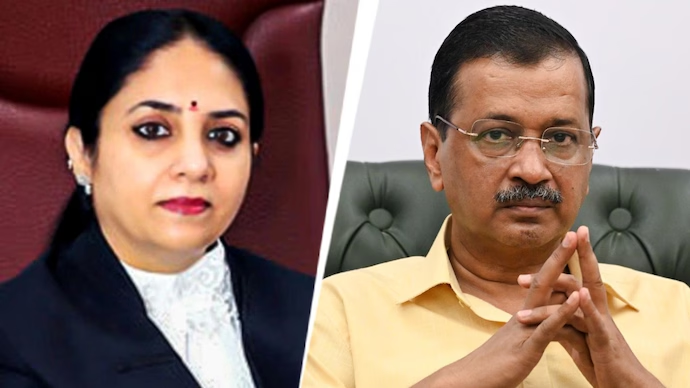
In a major setback for AAP chief Arvind Kejriwal, the Delhi High Court on April refused his plea seeking Justice Swarana Kanta Sharma’s recusal from hearing the Delhi liquor policy case, with the judge delivering a firm defense of judicial independence and declaring that justice cannot be made to bow before pressure.
Justice Sharma rejected allegations of bias and lack of fairness raised by Kejriwal, asserting that courts must remain guided only by the Constitution and the rule of law.

“My oath is to the Constitution. My oath has taught me that justice does not bend under pressure. Justice does not yield to any pressure. I will decide and adjudicate fearlessly without any bias. I will not recuse from this case,” she said.
Strong rebuke to recusal plea
Kejriwal had sought the judge’s withdrawal from hearing a Central Bureau of Investigation (CBI) petition linked to the excise policy case, claiming a “grave, bona fide and reasonable apprehension” that the proceedings before her may not be impartial.
In an order that lasted nearly 90 minutes, Justice Sharma dismissed the plea in strong terms, warning that allowing such allegations without evidence could damage confidence in the judiciary.
“The floodgates can't be opened to sow seeds of mistrust,” she observed, adding that Kejriwal had failed to cite any political statement or material that suggested ideological prejudice.
She reiterated that judges are presumed impartial unless proven otherwise.
“There is a presumption of impartiality of a judge and that presumption has to be rebutted by the litigant seeking recusal,” she said.
‘Judiciary put on trial’
Justice Sharma said the applications filed by Kejriwal and other accused had, in effect, placed the judiciary itself in the dock.
“The litigant has put the judiciary on trial. I choose the path to resolve the controversy. The strength of the judiciary lies in its strong resolve,” she remarked.
Addressing objections over her participation in events organized by the Akhil Bharatiya Adhivakta Parishad (ABAP), the judge clarified that these were professional and social programmes, including discussions on new criminal laws and Women’s Day events.
“Many judges have been participating in those events. Such participation cannot be used to insinuate ideological bias,” she said.
‘Catch-22 situation created’
Justice Sharma said the plea had created a no-win scenario where questions would be raised whether she recused or continued.
“It is a Catch-22 situation. Whether I recuse or do not recuse, questions will arise. The applicant has created a win-win situation for himself,” she said.
She also rejected allegations of conflict of interest arising from her children serving as panel counsel for the central government.
The judge said no connection had been shown between their professional roles and the present case, noting that none of them were linked to the liquor policy matter.
She further underlined that preventing judges’ family members from practising law would violate their fundamental rights.
“If the wife of a politician can become a politician, if the children of a politician can become politicians, how can it be said that the children of a judge can't enter the profession of law?” she asked.
Courtroom not a theatre of perception
Justice Sharma made it clear that dissatisfaction with possible outcomes cannot become grounds for seeking a judge’s removal.
“Merely stating that one will not get relief from the court cannot be a ground to seek recusal,” she said.
“A courtroom cannot be a theatre of perception. If this court withdraws in absence of any demonstrable cause, it would attach weight to allegations which carry none,” she added.
The judge warned that stepping aside in such circumstances would wrongly signal that judges are aligned with political ideologies.
Calling recusal the easier route, she said it would have offered “a quiet exit,” but added that yielding to media narratives and unverified attacks would amount to an abdication of duty.
Background of the case
The development comes after a trial court on February 27 discharged Kejriwal and 22 others in the Delhi liquor policy case. The order was challenged by the CBI before the Delhi High Court.
On March 9, Justice Sharma issued notice on the CBI’s plea and stayed the trial court’s direction for departmental proceedings against the investigating officer. She also described certain findings of the lower court as “erroneous” and asked the trial court to defer proceedings under the Prevention of Money Laundering Act (PMLA), which flows from the CBI FIR.
Following that order, Kejriwal and co-accused Manish Sisodia, Durgesh Pathak, Vijay Nair, Arun Pillai and Chanpreet Singh Rayat moved applications seeking her recusal.
Kejriwal had argued that since the judge’s son and daughter were panel counsel for the central government, a potential conflict of interest arose. The court has now decisively rejected that argument.




.jpg&w=256&q=75)
.jpg&w=256&q=75)
.jpg&w=256&q=75)