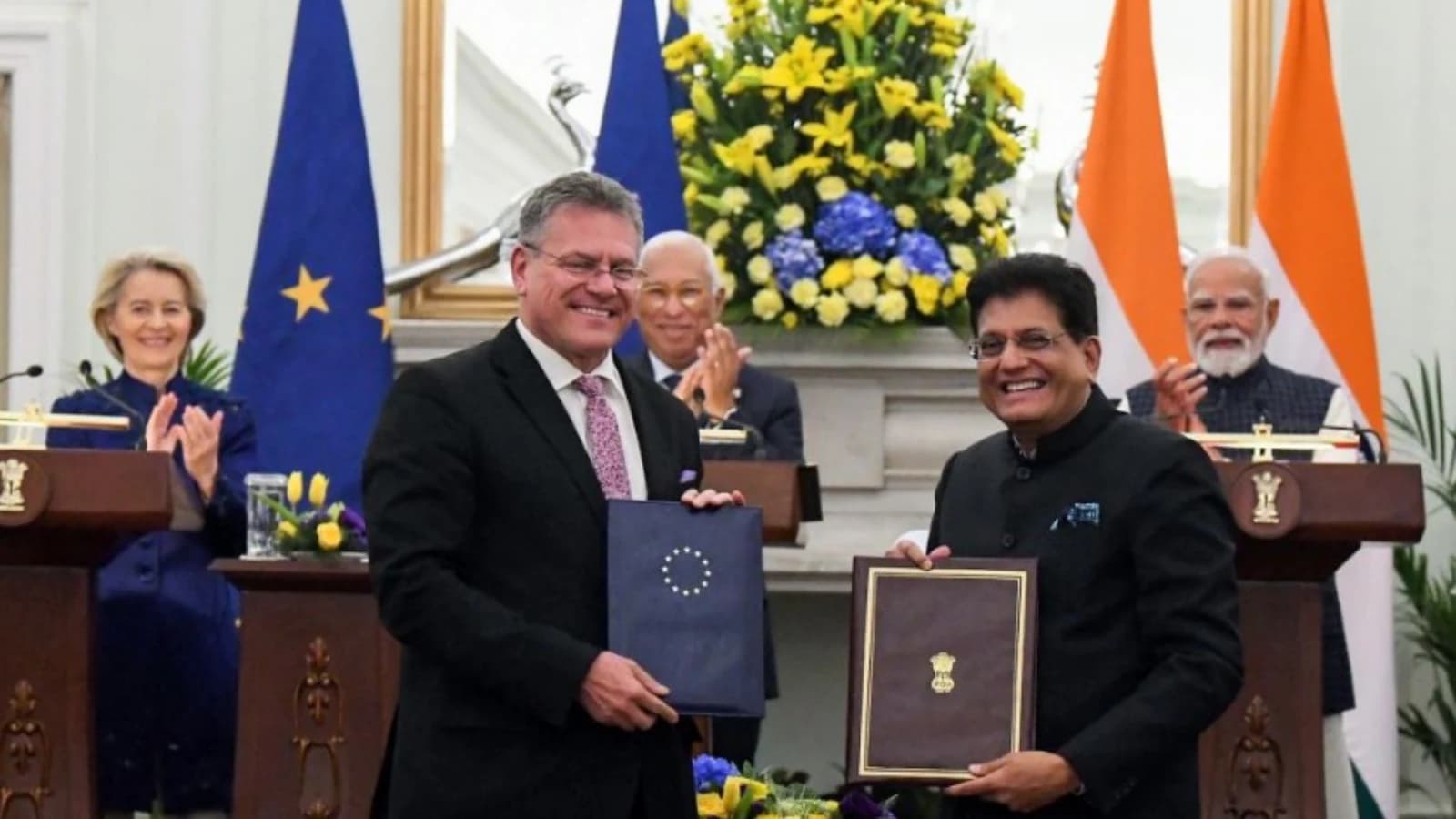
India is looking to significantly ramp up its manufacturing capabilities through technology transfer, investments and deeper strategic cooperation with Europe — a partnership that goes far beyond market access and tariff reductions, Union Commerce and Industry Minister Piyush Goyal said, following the conclusion of negotiations for a Free Trade Agreement (FTA) with the European Union.
In an interview with The Indian Express, Goyal underscored that the proposed deal marks a broader economic and geopolitical alignment rather than a conventional trade pact. “The fact is that this is much more than just trade. It is a strategic and defence partnership… there is financial integration, a mobility partnership going forward, and the European Union has also said it would like to do an Investment Protection Agreement,” he said.

Defense spending opens window for India
Goyal pointed to Europe’s sharp increase in defence expenditure — driven by a reconfiguration of transatlantic security ties — as a major opportunity for India’s manufacturing and defence sectors.
“We have entered into a strategic defence partnership… €800 billion is their budget for the next five years,” he said, referring to the EU’s ‘ReArm Europe’ initiative aimed at strengthening defence readiness by 2030. The scale of spending, he indicated, could prompt European countries to outsource parts of defence manufacturing, opening the door for Indian industry.
Carbon tax impact limited, offset mechanisms in place
Addressing concerns around the European Union’s Carbon Border Adjustment Mechanism (CBAM), Goyal said Indian exporters would face limited impact as domestic carbon taxes would be recognised and adjusted.
“The carbon taxes we pay will be recognised there, so that part can be offset. And more and more of our steel mills are becoming efficient. In any case, their carbon footprint will be low, so we won’t be required to pay too much carbon tax,” he said. CBAM imposes a levy on imports produced through carbon-intensive processes.
Beyond this, Europe is actively supporting India’s decarbonization efforts. “A joint fund of €500 million has already been announced. This is just the beginning,” the minister said.
Auto sector largely insulated
On concerns in the automobile sector, Goyal clarified that the bulk of India’s domestic market would remain unaffected. “None of the small automobiles sold in India — which make up about 90 per cent of the market — are impacted. The cars where we have opened up and given quotas in a graded manner are in the luxury segment,” he said.
Why India and EU see the deal as win-win
The FTA is widely viewed as a strategic opportunity for Indian manufacturing to scale up and position itself as a credible alternative to China for the 27-member European bloc.
To fully leverage the agreement, Goyal said Indian industry must expand capacity and improve quality. “Industry has to ramp up production and ramp up quality,” he said, adding that the government is conducting extensive outreach not only with major industry bodies but also with regional and local chambers.
“Chambers in Mumbai, Chennai, Rajkot, Kolkata and elsewhere are being engaged. There are many MSMEs keen to understand how tariff reductions apply to the sectors they operate in,” he said.
Procurement kept out over reciprocity concerns
On government procurement — excluded from the EU deal despite featuring in some of India’s earlier agreements, including with the UK and UAE — Goyal said negotiations hit a roadblock over reciprocity.
“I told the EU: you want government procurement, get me a commitment from all 27 member states that they’ll allow it. They said that’s the competence of member states. I said, then why should I give you my government procurement? Reciprocity is a principle of this government,” he said.
Deals from a position of strength
Emphasising India’s evolving trade strategy, Goyal said the country is now negotiating agreements from a position of confidence. “An FTA is about the future, not the past. We have only done deals with developed countries — eight agreements covering 37 countries, all developed economies,” he said.
The EU pact, he suggested, reflects India’s ambition to align trade with long-term industrial growth, strategic autonomy and global manufacturing leadership.






.jpg&w=256&q=75)
.jpg&w=256&q=75)