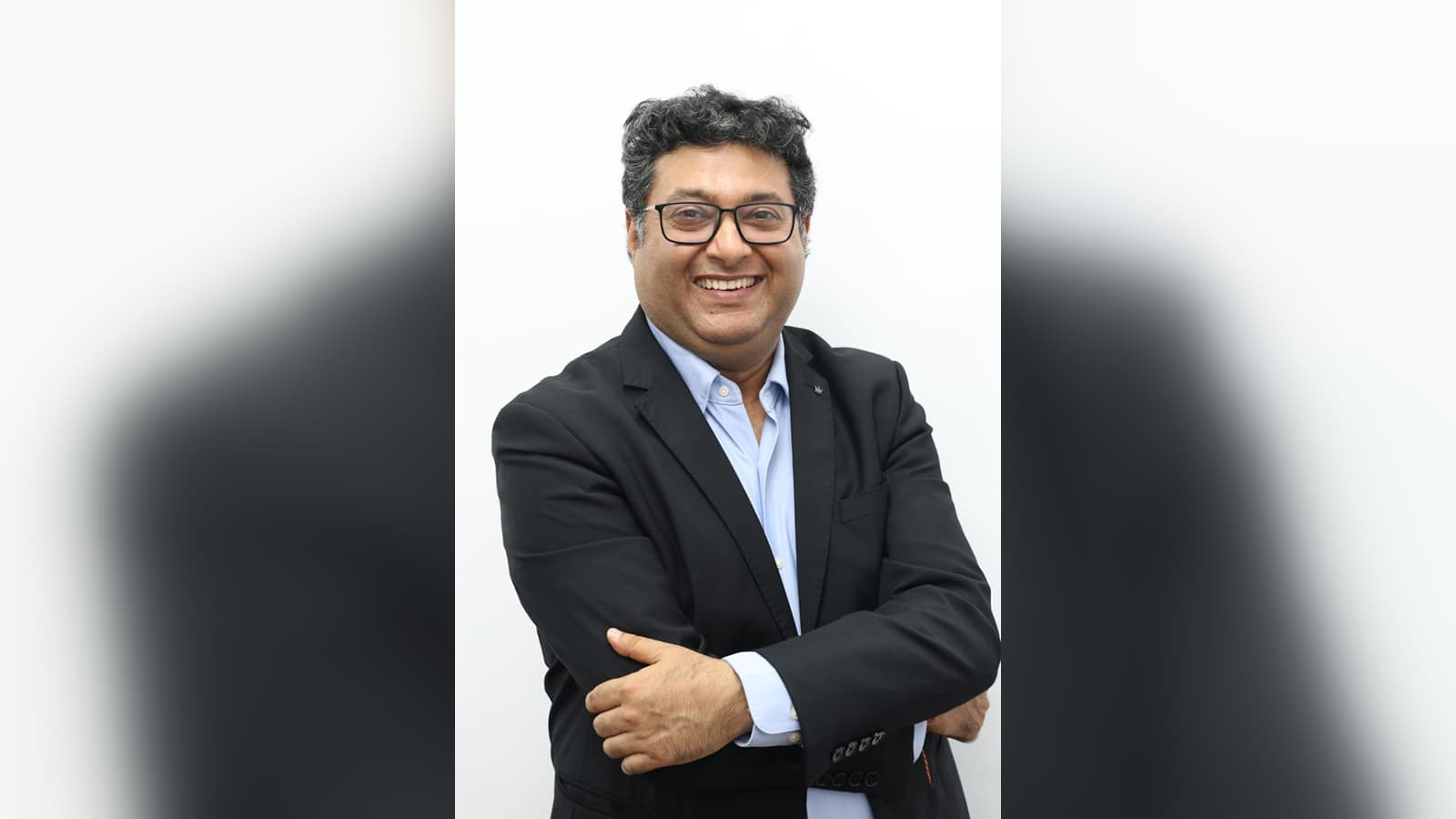
As financial products become increasingly accessible to young Indians, the bigger challenge is ensuring they understand the decisions behind them. In this interview with Education Post’s Prabhav Anand, Himanshu Vyapak, MD & CEO, FinX, examines the widening gap between financial access and financial understanding. He makes a case for moving financial education beyond terminology and theory towards practical, decision-based learning. From budgeting, credit and investment risk to navigating financial influencers and misinformation, Vyapak outlines what students need to learn before making real-world financial choices. He also discusses how universities and industry can collaborate through simulations, competitions, case studies and experiential learning to build financially responsible young adults.
1. Young Indians today have unprecedented access to digital banking, credit and investment platforms. How can education ensure that this access is matched by adequate financial understanding?

Access and understanding have to grow together. Technology has made financial products considerably easier to access, but an easier interface does not necessarily make a financial decision easier to understand.
This is where education has an important role. Students should not only learn what a financial product is, but also how to evaluate it — what the associated risks are, what the costs are, what the time horizon is and whether it is appropriate for a particular financial objective.
SEBI’s Investor Survey 2025 highlights the gap quite clearly. While 63% of households reported awareness of at least one securities-market product, only 9.5% participated in the securities market. The survey also found that only 36% of current investors demonstrated moderate or high knowledge of securities markets.
That tells us that awareness is only the starting point. Education needs to move towards application and decision-making. Students should be given opportunities to work through practical situations involving savings, borrowing, investing, risk and financial planning.
The objective should not be to create young investors simply because investment platforms are accessible. It should be to create young people who are capable of making informed financial choices when they do encounter these products.
2. You have advocated making financial literacy a part of college education. What should a basic financial-literacy curriculum for undergraduate students include?
At the undergraduate level, financial literacy should be treated as a life skill rather than a specialised finance subject.
A basic curriculum should cover personal budgeting and cash-flow management, saving, banking, credit and responsible borrowing, insurance, taxation, inflation, compounding, investing, risk-return relationships, mutual funds and basic capital-market concepts. It should also include digital financial safety, fraud awareness and the ability to distinguish credible financial information from promotional or misleading content.
The other important element is decision-making. Students should be presented with situations they are likely to encounter — taking an education or personal loan, managing their first salary, choosing between saving and investing, understanding a financial product or evaluating a claim about returns.
There is also a strong case for introducing students to the idea of financial goals. The right financial decision is not the same for everyone. A student saving for a near-term requirement should approach money differently from someone planning for a long-term goal.
The curriculum therefore needs to answer a simple question: not just “What is this financial product?”, but “How do I decide whether this is appropriate for me?”
3. Through FinX’s National Mutual Fund Olympiad, you have interacted with thousands of students. What have these interactions revealed about the gap between students’ financial knowledge and their actual understanding of investment decisions?
One of the clearest lessons for us has been that knowing a financial term and being able to apply that knowledge are two different things.
The first edition of the Franklin Templeton National Mutual Fund Olympiad brought together more than 10,000 students from 400+ colleges across India. The programme was designed around financial-market fundamentals, mutual funds, asset allocation and practical decision-making rather than only textbook-based knowledge.
What that experience reinforced for us is that students are curious about financial markets, but curiosity does not automatically translate into financial understanding. A student may know what a mutual fund is, for example, but still need to understand how risk, time horizon, diversification and investment objectives influence a decision.
This is consistent with the broader picture emerging from SEBI’s Investor Survey 2025. The survey found that only 36% of current investors possessed moderate or high knowledge of securities markets, despite 63% of households being aware of at least one securities-market product.
That gap is precisely why experiential financial education matters. The objective should be to move students from recognising financial terminology to being able to reason through a financial decisio
4. Social media and financial influencers are increasingly shaping how young people learn about money. Should colleges also teach students how to assess financial information and identify misinformation?
Absolutely. Financial literacy today has to include information literacy.
Students are consuming financial information from a much wider range of sources than previous generations. The challenge is no longer only whether information is available; it is whether a young person can assess its credibility, understand its context and recognise when education crosses into advice or promotion.
SEBI’s Investor Survey 2025 found that 62% of investors rely on recommendations from friends, family or social media instead of registered intermediaries. SEBI has also highlighted misleading advice from unregistered finfluencers as an investor-protection concern.
Colleges can therefore teach students some basic questions to ask before acting on financial information: Who is providing this information? Are they qualified or regulated? Is the claim supported by evidence? Is risk being discussed alongside potential returns? Is there a commercial interest involved?
I don't think the answer is to tell students to avoid social media. That is unrealistic. The more useful approach is to teach them how to navigate it responsibly.
In a digital financial environment, knowing how to question information is becoming as important as knowing the information itself.
5. FinX focuses on bridging the gap between academia and the financial industry. How can industry and universities work together to make financial education more practical and relevant for students?
The relationship needs to move beyond guest lectures and occasional campus events.
Universities bring the academic environment and access to students, while the industry brings current knowledge of products, customer behaviour, technology, regulation and the skills required in the workplace. Bringing those strengths together can make learning much more relevant.
This can happen through industry-designed case studies, simulations, internships, practitioner-led sessions, competitions, live projects and curriculum inputs. Students should get opportunities to work through situations that resemble the decisions and problems they will encounter outside the classroom.
FinX's approach has been built around this connection between academia and industry. Our programmes bring together education, skilling and employability, while our partnerships with institutions help take industry-oriented BFSI learning to students. The recent launch of our Kolkata campus is also part of this effort to strengthen the connection between academia and the financial-services industry.
The larger objective should be to ensure that students don't have to wait until their first job to understand how the industry actually works.
6. You have previously emphasised that financial literacy is most effective when students “learn by doing.” Which experiential approaches—simulations, competitions or industry interactions—do you believe have the strongest impact on students?
I don't think there is one format that works for every student. What matters is whether the experience requires the student to apply knowledge rather than simply recall it.
Simulations can help students understand how decisions change outcomes. Competitions can create engagement and encourage students to prepare. Industry interactions can provide context that a textbook cannot. Case studies and projects can bring all of these elements together.
Our experience with the National Mutual Fund Olympiad has particularly reinforced the value of competition as an entry point. The first edition brought together more than 10,000 students across 400+ colleges and used an interactive format to take financial-market concepts beyond conventional classroom learning.
But the competition itself is not the end objective. The real value comes when the competition becomes a gateway to further learning.
For financial education, I would therefore favour a combination: learn the concept, apply it in a simulated or practical situation, discuss it with practitioners and then reflect on the decision. That is much more likely to create lasting understanding than a purely theoretical approach.
7. Young investors are increasingly exposed to equities, mutual funds and other complex financial products. How should educators teach investment risk without encouraging speculative behaviour among students?
The first principle should be that financial education should not be confused with encouraging investment.
A student can learn about equities, derivatives or mutual funds without being encouraged to invest in them. In fact, understanding a product properly should make a person more conscious of the risks involved.
The starting point should therefore be risk itself — volatility, time horizon, diversification, liquidity, potential loss and the relationship between risk and expected return. Students should also understand the difference between investing for a financial goal and taking a short-term position based on a market movement.
SEBI's Investor Survey 2025 found that fear of financial losses, lack of knowledge and perceived complexity are among the barriers to securities-market participation.
That makes the role of educators particularly important. We should not frame financial markets as a quick route to wealth. Equally, we should not make them appear so complicated that students disengage altogether.
The right message is simple: understand the product, understand the risk and understand why you are considering it before making a decision.
8. What is the most important change India’s education system needs to make to create a generation that is not just financially literate, but capable of making responsible financial decisions?
I would make one fundamental shift: move financial education from knowledge-based learning to decision-based learning.
India does not have an information shortage. Young people today can find explanations of almost any financial product within seconds. The bigger challenge is helping them determine what information is credible, understand the risks and apply it to their own circumstances.
Education therefore needs to give students opportunities to practise financial decisions before they have to make them with their own money.
A student should be able to create a budget, evaluate a loan, understand the impact of interest and inflation, compare financial products, assess investment risk and identify misleading financial information.
If we can make that kind of practical financial decision-making a normal part of education, we will move from producing students who know financial terminology to young adults who can use financial knowledge responsibly.
That, ultimately, is what financial literacy should mean.










.webp&w=256&q=75)