


The recognition highlights Gauhati University’s research contributions, with six academics featuring in the global citation-based listing and strengthening the institution’s scientific profile in Northeast India.
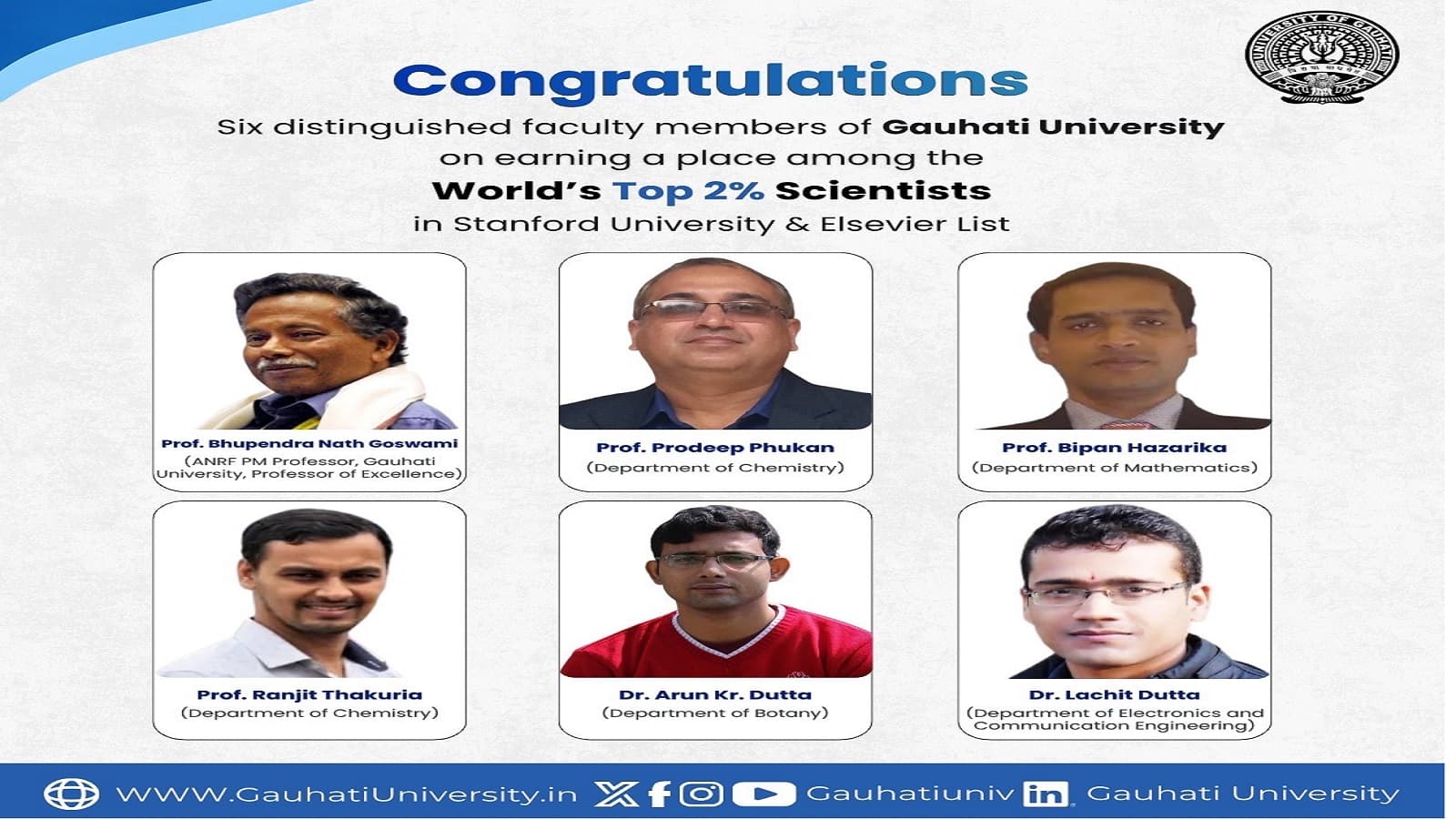
Gauhati University has secured significant recognition in the global research community, with six of its faculty members featuring in the 2026 World’s Top 2% Scientists list. The achievement underscores the university’s contribution to scientific research and its growing presence in international academic circles.
The list is associated with Stanford University and Elsevier, a global academic publishing and research analytics company. It identifies influential researchers using publication and citation data alongside other bibliometric indicators to assess research impact. The latest recognition places Gauhati University among the prominent academic institutions in Northeast India in terms of representation.

The six faculty members included in the 2026 list represent multiple academic disciplines at Gauhati University. They are:
Professor Bhupendra Nath Goswami – ANRF Prime Minister Professor and Professor of Excellence
Professor Prodeep Phukan – Department of Chemistry
Professor Bipan Hazarika – Department of Mathematics
Professor Ranjit Thakuria – Department of Chemistry
Dr Arun Kumar Dutta – Department of Botany
Dr Lachit Dutta – Department of Electronics and Communication Engineering
Their inclusion reflects research contributions across chemistry, mathematics, botany, electronics and communication engineering, as well as the broader scientific research ecosystem.
The global database draws on research led by Stanford University professor John P. A. Ioannidis and his collaborators. It uses bibliometric indicators to evaluate the research impact of scientists across different disciplines.
The indicators include citation counts, the h-index, the co-authorship-adjusted hm-index and other measures incorporated into the assessment framework. These metrics help identify researchers whose published work has received substantial recognition through academic citations.
The listing should be understood as a citation-based research database rather than a conventional academic award. Inclusion indicates a researcher’s standing under the methodology and dataset used for the relevant edition.
Gauhati University Vice-Chancellor Professor Nani Gopal Mahanta congratulated the faculty members on their inclusion in the international list.
He described the recognition as a matter of pride for the university and expressed confidence that the achievement would motivate researchers to explore new ideas, pursue innovation and maintain high standards in their academic and research activities.
The recognition also reflects the role of faculty research in strengthening the university’s academic reputation and contributing to the wider research community.
The latest inclusion builds on the university’s earlier representation in the World’s Top 2% Scientists list. Gauhati University had also reported faculty members’ inclusion in the 2025 edition, demonstrating its continued engagement with research and higher education.
With six faculty members recognised in the 2026 listing, the university has added another milestone to its research profile. The achievement highlights the importance of sustained academic research, interdisciplinary collaboration and the production of scholarly work with international reach.
For Assam and the wider Northeast, the recognition brings attention to the region’s higher education institutions and their contribution to scientific knowledge and research development.

NIOS October Exam 2026: Class 10, 12 Theory Hall Tickets Released; Download Link Here
Haryana Open School Exams 2027: BSEH Extends Application Deadline to October 31
Gauhati University Places Six Faculty Members in World’s Top 2% Scientists List 2026
DU VC asks DUSU leaders to lead drug-free campus campaign, proposes wellness centers

Russia seeks to curb multiple university applications with upfront payment rule
.jpg&w=256&q=75)
From Class 8 to hospital owner: Rajasthan Police expose alleged fake doctor registration

Who will lead Keralam's universities? Government begins steps to appoint permanent VCs
%20(1)%20(1).jpeg&w=256&q=75)
Why does cracking JEE Advanced depend on coaching? IIT Kanpur Director calls for a revamp
.jpg&w=256&q=75)
NEET-PG 2026 answer key row: Supreme Court seeks NBEMS response on missing question papers
.png&w=256&q=75)
42 Iraqi universities feature in QS Arab Region University Rankings 2027

NIOS October Exam 2026: Class 10, 12 Theory Hall Tickets Released; Download Link Here
Haryana Open School Exams 2027: BSEH Extends Application Deadline to October 31
Gauhati University Places Six Faculty Members in World’s Top 2% Scientists List 2026
DU VC asks DUSU leaders to lead drug-free campus campaign, proposes wellness centers
Russia seeks to curb multiple university applications with upfront payment rule
From Class 8 to hospital owner: Rajasthan Police expose alleged fake doctor registration
Who will lead Keralam's universities? Government begins steps to appoint permanent VCs
Why does cracking JEE Advanced depend on coaching? IIT Kanpur Director calls for a revamp
NEET-PG 2026 answer key row: Supreme Court seeks NBEMS response on missing question papers
42 Iraqi universities feature in QS Arab Region University Rankings 2027
Copyright© educationpost.in 2026 All Rights Reserved.