


The prototype mimics natural skin by forming wrinkles as it bends and supporting tissue repair, but sensory functions and long-term durability remain challenges.
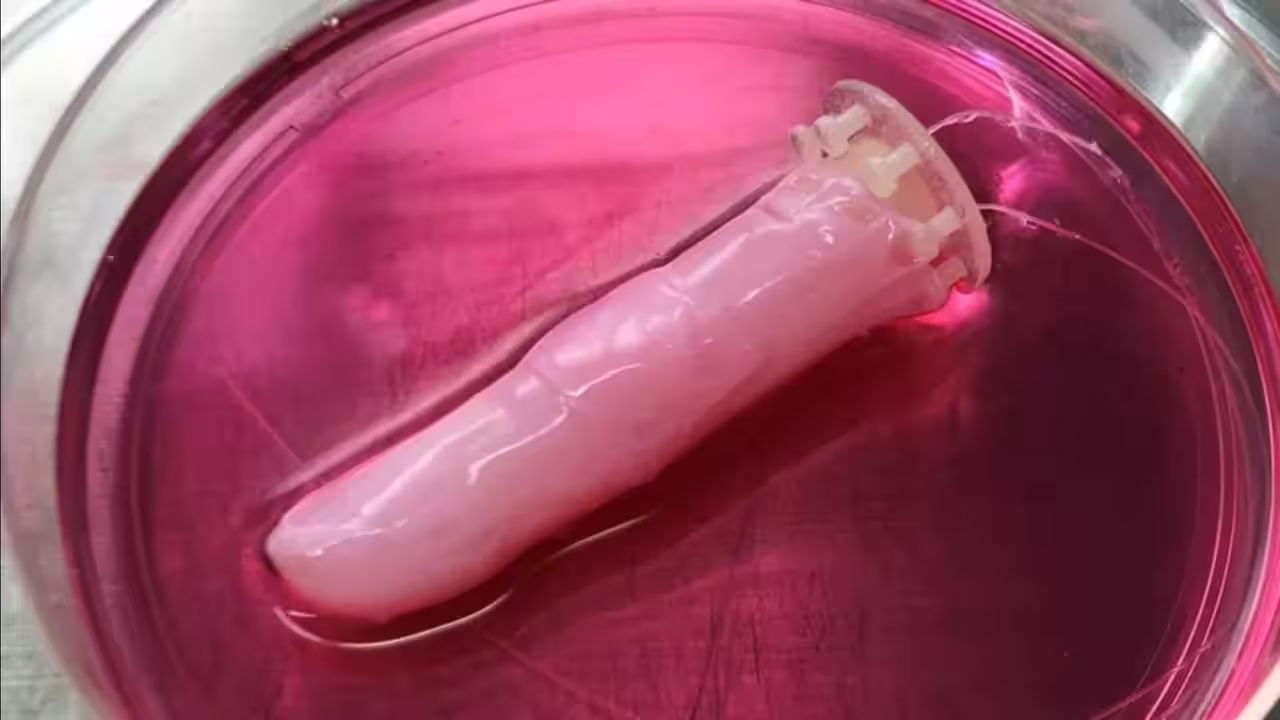
Researchers at the University of Tokyo have developed a robotic finger covered in living human skin, marking a significant step towards machines that more closely resemble the human body.
Unlike conventional robots covered with silicone or other synthetic materials, the prototype uses cultured human skin cells to create a living layer over a moving robotic structure. The skin can wrinkle naturally as the finger bends and has demonstrated a limited ability to repair damaged tissue with assistance.

The findings were published on June 9, 2022, in the journal Matter. The research was led by biohybrid engineer Shoji Takeuchi and his team at the University of Tokyo.
The development could advance research into humanoid robots, engineered skin and medical testing. However, the technology remains experimental and is not ready for commercial use.
How researchers developed the living robotic skin
The team used a tissue-moulding technique to grow two layers of human skin around the robotic finger.
Researchers first immersed the finger in a solution containing collagen and human dermal fibroblasts, cells that help form connective tissue. This created a dermal layer around the robotic structure.
They then applied human keratinocyte cells to develop an outer epidermal layer, completing a skin-like covering that extended across all three joints of the finger.
The resulting tissue displayed certain barrier properties associated with natural skin. The experiment also demonstrated that living human skin could be grown over a moving robotic structure without preventing its movement.
The project involved Takeuchi and co-authors Michio Kawai, Minghao Nie, Haruka Oda and Yuya Morimoto.
Robotic finger forms natural wrinkles
One of the most notable findings was the skin's ability to respond naturally to movement.
As the robotic finger bent, the living tissue formed wrinkles around its joints, resembling the creases that appear on human fingers. These wrinkles developed through the movement of the tissue rather than being artificially shaped onto the robot's surface.
The researchers also examined how the skin responded to injury. After cutting the inner skin layer, they placed a collagen sheet over the damaged area. Cells surrounding the wound gradually replaced the damaged tissue over approximately seven days.
However, the healing process was not fully autonomous. Researchers had to apply the collagen sheet manually, meaning the prototype could not independently detect and repair an injury.
The robotic finger also did not demonstrate the ability to sense touch, temperature or pain. Developing these functions and improving tissue repair remain important areas for further research.
Challenges that living robotic skin must overcome
Despite the promising results, several obstacles stand between the laboratory prototype and practical use.
Maintaining living cells: Human skin cells need adequate nutrients, moisture and suitable environmental conditions to survive. Providing these consistently on a working robot remains a major engineering challenge.
Ensuring long-term durability: Researchers must determine how to keep the tissue healthy and functional over extended periods, particularly when exposed to repeated movement and environmental changes.
Adding sensory capabilities: The prototype has not demonstrated the ability to detect touch, temperature or pain. Integrating biological tissue with functional sensing systems will require further development.
Scaling up the technology: Growing living skin around a small robotic finger is considerably easier than covering an entire humanoid robot. Larger structures would require more sophisticated tissue-growth, attachment and maintenance systems.
Developing autonomous healing: Although the experiment demonstrated limited tissue repair, the need for a manually applied collagen sheet highlights how far the technology remains from independent wound healing.
Potential applications beyond humanoid robots
Living robotic skin could open new avenues in biohybrid robotics, a field that combines biological materials with mechanical systems.
Potential applications include:
These remain potential applications rather than established uses of the current prototype.
What it means for robotics
The University of Tokyo experiment demonstrates that living human skin can be cultivated over a moving robotic structure while retaining certain biological properties.
The ability to form natural wrinkles and support assisted tissue repair offers researchers new insights into how living materials might function alongside mechanical systems. The findings could help shape future work on robots designed to interact more naturally with humans.
Yet significant questions remain about tissue maintenance, nutrient delivery, durability, sensory feedback and autonomous healing.
For now, living robotic skin remains a laboratory technology rather than a commercially available solution. Further research will be needed before it can become a practical component of humanoid robots, medical devices or other real-world systems.

4 dead in Oregon school shooting in US, teen gunman killed

Clashes erupt in Argentina over delayed university funding law
University of Tokyo scientists develop robotic finger covered in living human skin

WCC reviews global education initiatives, sets future priorities

Sapienza, Bologna lead Italy’s 2026 university attractiveness ranking
4 dead in Oregon school shooting in US, teen gunman killed
University of Tokyo scientists develop robotic finger covered in living human skin
Wits University and Bidvest launch R6 million research chair in AI and smart technologies

At least 30 children dead in Pakistan school roof collapse

Planning to study in Japan? Key changes to language certificates, tuition fees and student visas

4 dead in Oregon school shooting in US, teen gunman killed
Clashes erupt in Argentina over delayed university funding law
University of Tokyo scientists develop robotic finger covered in living human skin
WCC reviews global education initiatives, sets future priorities
Sapienza, Bologna lead Italy’s 2026 university attractiveness ranking
4 dead in Oregon school shooting in US, teen gunman killed
University of Tokyo scientists develop robotic finger covered in living human skin
Wits University and Bidvest launch R6 million research chair in AI and smart technologies
At least 30 children dead in Pakistan school roof collapse
Planning to study in Japan? Key changes to language certificates, tuition fees and student visas
Copyright© educationpost.in 2026 All Rights Reserved.