


Revised images and historical accounts spark accusations of ideological interference, as parents warn of risks to cultural diversity and national identity.
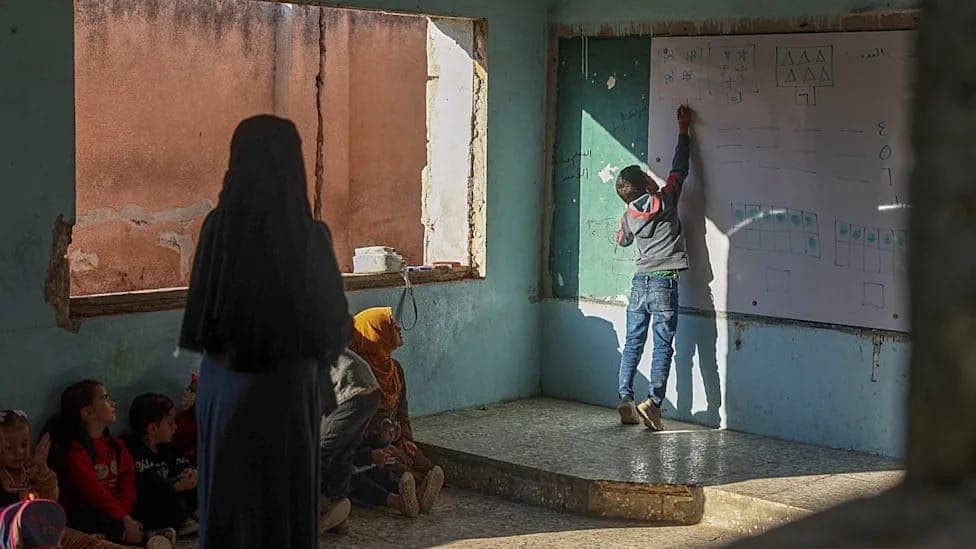
A sweeping controversy has erupted in Syria over changes to school textbooks, with the removal of famous artworks, digitally altered images of women and revisions to historical content triggering widespread criticism from parents, activists and education observers.
The changes, documented through comparisons of different textbook editions circulating on social media, have raised questions about the government's approach to educational reform and whether efforts to remove material associated with the former regime are extending into a broader reshaping of the country's cultural and historical narrative.

Among the most contentious alterations are illustrations of female characters modified to include hijabs or long robes, photographs of women deleted entirely, and statues, sculptures and paintings covered, removed or replaced. Even internationally recognised artworks, including Leonardo da Vinci's celebrated Mona Lisa, have reportedly disappeared from some textbooks.
The revisions have affected textbooks across several grades, including early primary classes, seventh grade and the sixth-grade Social Studies book.
Famous artworks and historical figures caught in the changes
Some of the most striking alterations involve visual representations of women and children. A drawing of a girl skipping rope alongside two children was removed from an early-years textbook, while illustrations of female characters were digitally modified.
The treatment of historical figures has also drawn criticism. A painting depicting Phoenician princess Elissar, traditionally regarded as the founder of Carthage, was removed and replaced with another portrait in which her chin and neck had been digitally covered. Another widely circulated example showed a pharaonic statue dressed in a striped shirt, prompting ridicule on social media, with users comparing its appearance to a prison uniform.
Critics have questioned why historical and artistic representations are being altered to conform to contemporary standards, arguing that such interventions risk distorting the cultural and historical context in which the original works were created.
Changes to history lessons raise deeper concerns
Beyond illustrations, revisions to historical and civic education content have intensified the controversy.
Comparisons of textbook editions have highlighted changes in the portrayal of prominent national and pan-Arab figures, as well as passages concerning Syria's struggle against Ottoman and French rule.
One particularly contentious revision concerns the Syrian national figures executed by Ottoman governor Jamal Pasha on May 6. In the revised material, those executed are reportedly described as agents of Britain and France rather than being presented as symbols of the national movement resisting Ottoman rule.
The removal of an image of Sultan Pasha al-Atrash and its replacement with a photograph of Sheikh Saleh al-Ali has also prompted questions about the selection criteria. A photograph of former Egyptian president Gamal Abdel Nasser has reportedly been deleted.
Other changes include the omission of Iskenderun district and the occupied Syrian Golan from a school map, as well as the removal of a paragraph highlighting the role of Syrian women in resisting the French Mandate. For critics, these revisions go beyond routine textbook updates and raise fundamental questions about how national history, collective memory and citizenship are being presented to a new generation.
Parents fear impact on children's understanding of diversity
For many parents, the controversy is not simply about altered drawings or missing paintings. It concerns the values children absorb through the education system and the kind of society school curricula encourage them to understand.
Speaking to Euronews, Alia, the mother of a lower-secondary pupil, said she had initially overlooked the changes because of the poor print quality and lack of detail in the illustrations. She questioned the rationale behind digitally modifying images of historical figures, particularly by adding religious clothing to their depictions. Replacing the illustrations with new drawings, she suggested, would have been more appropriate than altering original works.
Alia warned that presenting women through a single visual standard could give children a distorted understanding of social diversity and undermine the values of coexistence and mutual respect. She argued that Syria's priority should be meaningful educational reform, with curricula reflecting global developments and equipping pupils with the knowledge and skills needed for the future.
In her view, focusing on superficial visual changes instead of improving educational content risks reinforcing ideological divisions and encouraging intolerance rather than strengthening a shared sense of citizenship.
Jaber, the father of a primary-school girl, expressed similar concerns, arguing that the changes could embed particular ideological positions in children's minds through the education system. He called on international organisations working on children's rights to intervene to protect pupils' right to balanced and neutral education.
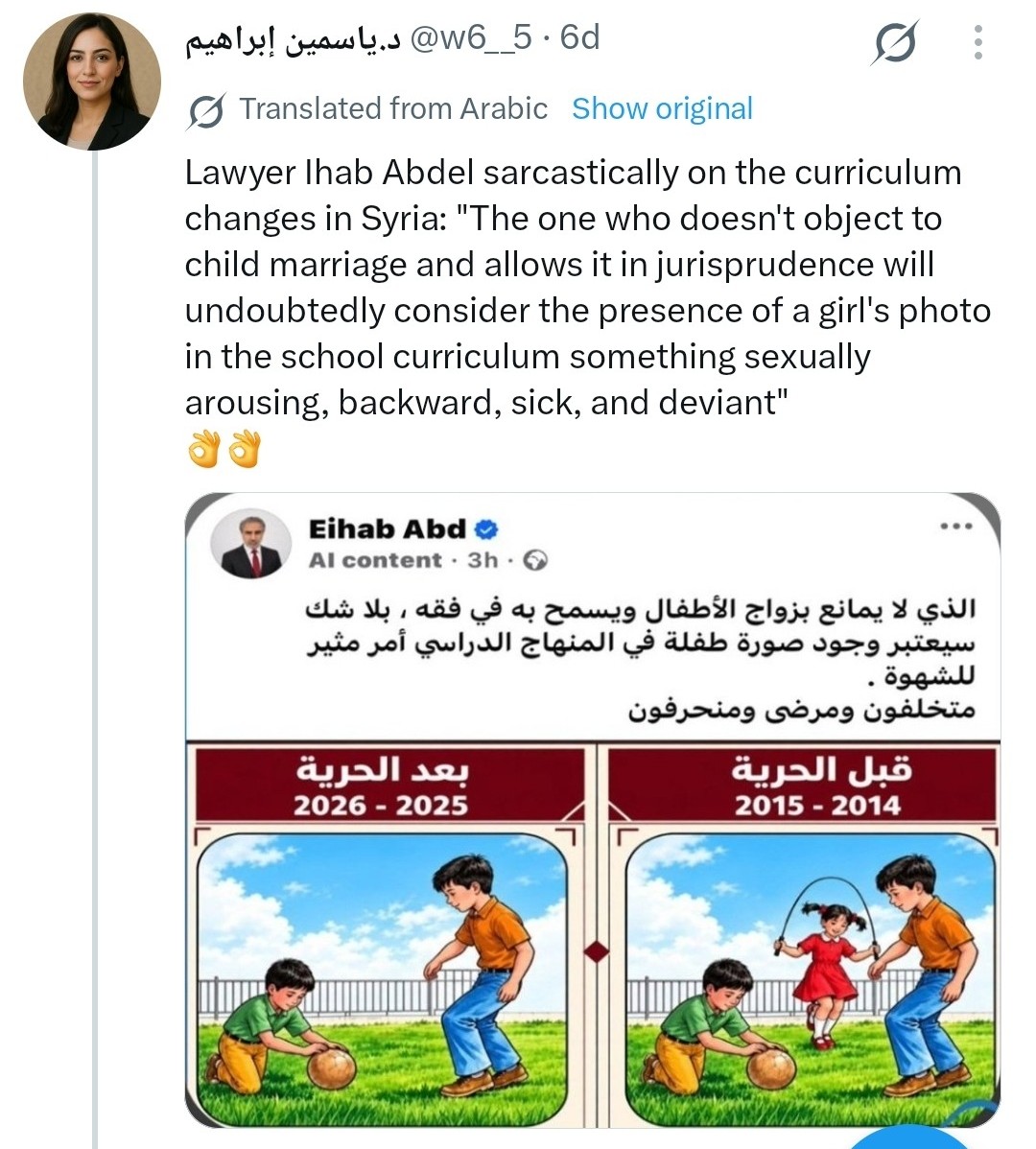
Contrasting the debate over textbook illustrations with advances in technology, he told Euronews: "While the world has reached leaps forward in developing artificial intelligence, we in Syria are still drowning in sterile arguments over covering women's images and deleting artworks from school textbooks".
Social media turns textbook changes into a wider debate
The controversy has also generated widespread satire, particularly over what critics describe as inconsistent and poorly executed alterations. One example repeatedly shared online features a female doctor in a first-grade textbook who appears wearing a hijab on one page and without one on another.
The inconsistency has prompted questions about whether the amendments were carried out under a coherent set of editorial and educational standards. However, the debate has moved well beyond the quality of illustrations. Critics argue that removing internationally recognised artworks and altering historical representations could narrow children's exposure to different cultures, artistic traditions and ways of life.
In a country shaped by considerable religious, cultural and social diversity, they fear that a one-sided approach to education could marginalise parts of Syria's shared heritage. At the same time, some observers caution against treating every textbook revision as evidence of a coordinated ideological agenda. They argue that a fair assessment requires access to the official guidelines governing the changes, a clear account of their scope and an examination of the principles underpinning the new curriculum.
They also distinguish between removing propaganda and symbols associated with the former regime, which may be part of a legitimate curriculum review, and altering historical artworks, civic education material and representations of social diversity.
Education Ministry rejects allegations of new changes
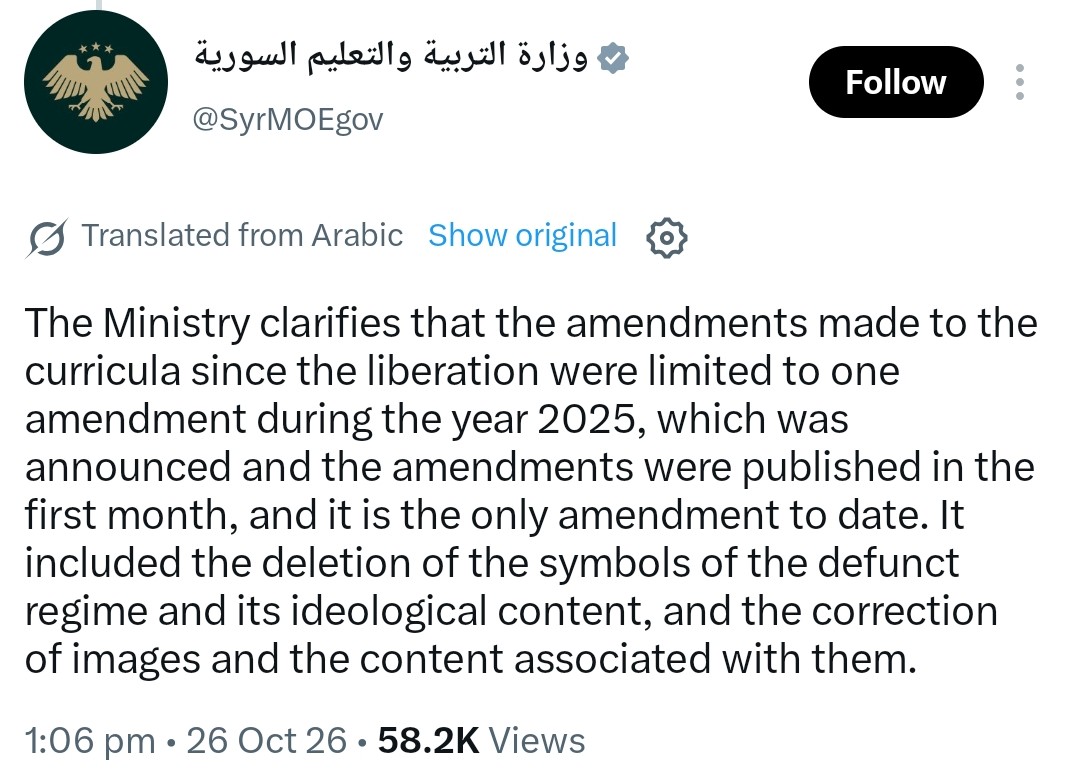
Syria's Ministry of Education has rejected reports circulating on social media about further changes to textbook images and content, describing the claims as inaccurate. In an official statement issued on Monday, the ministry said no new amendments had been approved to the curricula currently in use for the academic year.
It maintained that changes introduced after the fall of the former regime were limited to a single revision, announced and detailed in January 2025. These amendments, it said, focused primarily on removing symbols and ideological material associated with the ousted government and correcting related content, particularly in Social Studies and Islamic Education following their merger and unification. The ministry said its curriculum development plans were designed to reflect the aspirations of Syrians, strengthen citizenship and national belonging, promote respect for the law and encourage respect for others.
It also announced that a national curriculum framework had been completed, with modern educational standards placing learners at the centre of the teaching process. The proposed framework aims to develop critical thinking, analytical abilities, creative problem-solving, life skills and digital competencies. New curricula are expected to be introduced gradually through approved procedures.
.jpeg)
To support its position, the ministry released original textbook samples and images that it said demonstrated the visual and social diversity represented in the learning material. It also urged media organisations and the public to verify information through official channels and avoid spreading rumours.
However, the statement failed to settle the controversy. Activists and education observers challenged the ministry's denial, pointing to comparisons of textbooks already distributed in schools and accusing officials of failing to address the documented alterations.
Unified curriculum adds another dimension
The dispute comes as Syria moves towards establishing a unified national curriculum following years of educational fragmentation.
On August 17, 2026, the Ministry of Education announced that unified curricula would be adopted across all provinces for the 2026–2027 academic year, building on the previous year's textbooks, known as the 'Damascus curriculum'. The ministry said it had completed the preparation of national curriculum standards and was preparing to move into the textbook drafting stage.
Earlier, on September 14, Education Minister Mohammad Abdulrahman Turko told a parliamentary hearing that images and symbols associated with the former regime had been removed from the last two editions of school textbooks. He also confirmed that a single curriculum had been adopted across the provinces, with a two-year transition period for pupils who had previously studied under different curricula.
Turko said the national standards for developing the new curriculum had been referred to the Higher Council for Education for approval before the textbook-writing process begins. As Syria attempts to rebuild and unify its education system, the textbook controversy has exposed a much bigger challenge: ensuring that curriculum reform does not become a battleground over identity, history and ideology.
For pupils growing up in a country marked by years of conflict and division, schoolbooks are more than teaching materials. They are among the first places where children encounter their country's past, its cultural heritage and the diversity of the society around them. How that story is told could have lasting implications for the generations expected to shape Syria's future.
Syria school curriculum changes spark backlash over altered images, historical figures
University of Lincoln makes lecture recordings compulsory, sparking staff union dispute
11-year-old Egyptian girl beats 40 million students to win Dh500,000 in Dubai

UN highlights need for media literacy as AI reshapes how young people access information
Canadian university graduates retain wage advantage as full-time job prospects soften
11-year-old Egyptian girl beats 40 million students to win Dh500,000 in Dubai
South Korea's student suicide toll nears 1,000 in four years, with India's figures also drawing attention
Want to explore the world without leaving your classroom? Seoul students show how
When smart glasses become cheating tools: South Korea draws tougher exam rules

Jeans out, formals in: Bihar rolls out stricter rules for government school staff

Syria school curriculum changes spark backlash over altered images, historical figures
University of Lincoln makes lecture recordings compulsory, sparking staff union dispute
11-year-old Egyptian girl beats 40 million students to win Dh500,000 in Dubai
UN highlights need for media literacy as AI reshapes how young people access information
Canadian university graduates retain wage advantage as full-time job prospects soften
11-year-old Egyptian girl beats 40 million students to win Dh500,000 in Dubai
South Korea's student suicide toll nears 1,000 in four years, with India's figures also drawing attention
Want to explore the world without leaving your classroom? Seoul students show how
When smart glasses become cheating tools: South Korea draws tougher exam rules
Jeans out, formals in: Bihar rolls out stricter rules for government school staff
Copyright© educationpost.in 2026 All Rights Reserved.