


The Irish Council presidency’s plan would reduce funding for the next Horizon Europe programme by nearly 10%, prompting researchers and lawmakers to argue that Europe needs greater investment to compete in science and technology.
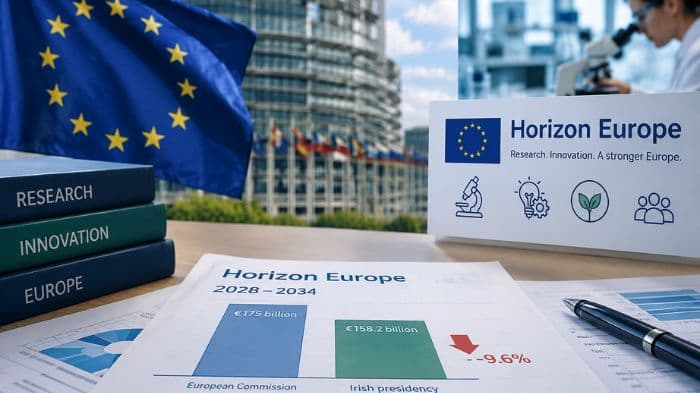
A proposal to reduce the budget of the European Union’s next research and innovation programme by nearly 10% has drawn criticism from research organisations and lawmakers, who warn that lower funding could weaken Europe’s scientific capacity and ambitions in emerging technologies.
The Irish presidency of the Council of the European Union has proposed allocating approximately €158.2 billion to the next Horizon Europe programme, also known as Framework Programme 10 (FP10), for 2028–2034. This is about €16.8 billion less than the €175 billion proposed by the European Commission, a reduction of 9.6%.

The proposal forms part of a broader effort to reach agreement among EU member states on the bloc’s next seven-year budget. It is a negotiating position rather than a final funding decision, and the budget remains subject to discussions involving member states, the European Commission and the European Parliament.
Research community calls for a larger allocation
Research organisations have argued that the proposed funding level falls short of what Europe needs to sustain research excellence, develop new technologies and remain competitive internationally.
EU-LIFE, an alliance of European research institutes, has called for at least €200 billion for FP10. It has argued that stable and predictable investment is essential for research institutions to recruit talent, maintain collaborations and plan long-term scientific projects.
A group of research and university organisations has also stressed the importance of protecting research funding as the EU considers spending priorities for the next budget cycle. Their concerns extend to the potential consequences for scientific discovery, innovation and the development of technologies that support European industries.
The debate is taking place as the EU seeks to strengthen its position in areas such as artificial intelligence, quantum technologies, advanced manufacturing and clean energy. Research advocates argue that these ambitions require sustained investment rather than reductions in funding commitments.
European Parliament lawmakers oppose the proposed reduction
Christian Ehler of the European People’s Party and René Repasi of the Socialists and Democrats, the European Parliament’s co-rapporteurs on Horizon Europe, have criticised the Council’s proposed cut.
In a joint statement on Oct 10, the lawmakers warned that reducing the programme’s funding could make it harder to secure parliamentary approval for the next EU budget. They said the agreement would require an absolute majority in Parliament and cautioned that the proposed reduction could cost votes during negotiations.
The European Parliament’s position is relevant because the EU’s long-term budget requires approval through negotiations between the member states and Parliament. The Council’s proposal therefore does not settle the final allocation for research and innovation.
Research funding forms part of a wider budget dispute
The proposed reduction in FP10 is part of a broader revision of the EU’s 2028–2034 multiannual financial framework. The Irish presidency’s negotiating plan seeks to cut €141 billion from the European Commission’s overall proposal, representing an 8% reduction.
The revised plan would allocate about €1.62 trillion to the seven-year budget in 2025 prices. While the overall budget would remain larger than the current 2021–2027 framework, the proposed changes would reduce funding for several areas, including research and innovation-related spending.
The Irish presidency has presented the revised budget as an attempt to bridge differences between member states over spending priorities and the amount governments should contribute. However, the proposal has faced criticism from both those seeking deeper cuts and those concerned that reductions would undermine the EU’s policy objectives.
What the budget decision could mean for researchers
Horizon Europe is the EU’s principal funding programme for research and innovation. It supports collaborative projects involving universities, research institutes, businesses and other organisations across Europe and beyond.
The final budget will influence the scale of research calls, the resources available for scientific collaboration and the opportunities for institutions to pursue projects over the 2028–2034 period. Researchers and universities are concerned that a lower allocation could limit the programme’s ability to support ambitious, long-term work.
The funding debate also involves the relationship between Horizon Europe and the proposed European Competitiveness Fund, a separate instrument intended to support industrial innovation and strategic priorities. Negotiators must determine how these programmes will work together without weakening support for collaborative research and scientific excellence.
Negotiations continue ahead of the next budget cycle
The Irish presidency’s proposal is expected to inform discussions among EU leaders and institutions as they seek an agreement on the next long-term budget. The final allocation for FP10 will depend on the outcome of those negotiations.
Research organisations continue to press for a larger allocation, arguing that scientific research underpins Europe’s economic development, technological capabilities and ability to address challenges in health, energy and the environment.
The dispute is therefore not only about the size of a funding programme. It also concerns how the EU balances immediate budget constraints with its longer-term ambitions for research, innovation and global competitiveness.

What Is Section 163 of BNSS and Why Has It Been Imposed in Delhi? Explained

Yale University president apologises after hot mic captures remarks about student activists

Emirati AI researcher wins MBZUAI fellowship for Oxford research
NYU Abu Dhabi welcomes 24 UAE students to 2026–27 Sheikh Mohamed bin Zayed Scholars Program

IIT Kharagpur Launches Free AI Tutor, Online GATE-JAM Preparation Platform for Students
What Is Section 163 of BNSS and Why Has It Been Imposed in Delhi? Explained
Emirati AI researcher wins MBZUAI fellowship for Oxford research
IIT Kharagpur Launches Free AI Tutor, Online GATE-JAM Preparation Platform for Students
.jpg&w=256&q=75)
Sorbonne Abu Dhabi study detects 83 vertebrate taxa along urban coastline

UNESCO flags India’s rural education gap: 59 girls for every 100 boys

What Is Section 163 of BNSS and Why Has It Been Imposed in Delhi? Explained
Yale University president apologises after hot mic captures remarks about student activists
Emirati AI researcher wins MBZUAI fellowship for Oxford research
NYU Abu Dhabi welcomes 24 UAE students to 2026–27 Sheikh Mohamed bin Zayed Scholars Program
IIT Kharagpur Launches Free AI Tutor, Online GATE-JAM Preparation Platform for Students
What Is Section 163 of BNSS and Why Has It Been Imposed in Delhi? Explained
Emirati AI researcher wins MBZUAI fellowship for Oxford research
IIT Kharagpur Launches Free AI Tutor, Online GATE-JAM Preparation Platform for Students
Sorbonne Abu Dhabi study detects 83 vertebrate taxa along urban coastline
UNESCO flags India’s rural education gap: 59 girls for every 100 boys
Copyright© educationpost.in 2026 All Rights Reserved.