


Dr Mohamed Almarei will spend two years at the University of Oxford exploring how artificial intelligence can predict and control biological systems.
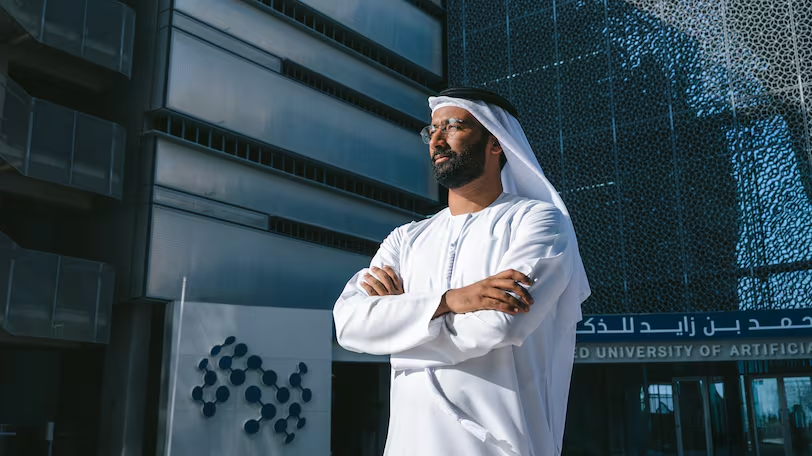
An Emirati researcher is set to take his work in artificial intelligence (AI) and synthetic biology to the University of Oxford after being named the first recipient of the Ruwwad AI Scholars (RAIS) Fellowship, an initiative launched by the Mohamed bin Zayed University of Artificial Intelligence (MBZUAI).
Dr Mohamed Almarei will undertake a fully funded, two-year research placement at Oxford, where he will explore how AI-driven models can improve scientists’ understanding of complex biological systems and support more sustainable methods of biological production.

The fellowship aims to support Emirati postdoctoral researchers and academic leaders who integrate AI into their research by connecting them with leading international institutions to deepen their expertise and strengthen their research capabilities.
“AI is becoming increasingly important to how we approach scientific research, particularly in fields such as biology, where complexity has long limited our ability to predict outcomes,” Dr Almarei told The National.
From bioengineering to AI-driven research
Dr Almarei holds a doctorate in bioengineering from Imperial College London, where his research focused on engineering biological systems for more sustainable bioproduction.
His decision to pursue research at Oxford took shape after he encountered the work of Professor Jean-Baptiste Lugagne and attended his presentation at the AI, Engineering Biology and Beyond conference in Bristol in January.
Describing the encounter as a turning point, Dr Almarei said the research offered approaches to questions that had emerged from his own work. He subsequently contacted Professor Lugagne and chose his laboratory for the fellowship placement.
“His research demonstrated how machine-learning could help predict cellular behaviour without requiring a complete understanding of every underlying process,” Dr Almarei said.
At Oxford, he plans to combine his experimental bioengineering experience with data-driven AI models to investigate how scientists can better predict and control living systems.
The research could help reduce dependence on expensive laboratory experiments while improving the design of biological systems used in production.
“The aim is to develop accurate models that help us decrease our reliance on costly wet-lab experiments and design better biological systems for more reliable and sustainable biological production,” he said.
Building AI expertise for the UAE
Dr Almarei’s fellowship comes as the UAE expands its investment in AI research, infrastructure and specialised talent, with Abu Dhabi pursuing plans to integrate the technology more deeply into government services and the wider economy.
The emirate is also preparing to host a joint UAE-US AI Campus, while the Abu Dhabi government has set a goal of becoming fully AI-native by 2027.
For Dr Almarei, the opportunity to work at Oxford is not simply about advancing his research abroad. He hopes to bring the expertise he gains back to the UAE and contribute to the country’s growing scientific and technological capabilities.
“The UAE has made AI a national priority, investing in research, education and the development of specialised talent,” he said.
“Contributing to the UAE's future has always been part of my ambition. For me, success means gaining expertise that advances my research and strengthens the knowledge and capabilities I can bring back to the UAE.”
Fellows returning from their placements will also be considered for faculty positions at MBZUAI, offering a potential route for researchers to continue their work and mentor emerging talent in the country.
Research with wider impact
Beyond his Oxford placement, Dr Almarei hopes to build a research career that connects scientific discovery with practical economic and societal benefits.
He aims to publish influential work in leading scientific journals, contribute to the wider research community and help train the next generation of scientists.
“I see myself conducting research with both economic and societal impact, contributing to high-impact publications in world-class journals that reach the wider scientific community and mentoring the next generation of researchers on scientific rigour and integrity for the betterment of humanity,” he said.
His appointment as the inaugural Ruwwad AI Scholar highlights the fellowship’s ambition to develop Emirati research talent through international collaboration and help translate advanced AI expertise into scientific progress at home and abroad.

What Is Section 163 of BNSS and Why Has It Been Imposed in Delhi? Explained

Yale University president apologises after hot mic captures remarks about student activists
Emirati AI researcher wins MBZUAI fellowship for Oxford research
NYU Abu Dhabi welcomes 24 UAE students to 2026–27 Sheikh Mohamed bin Zayed Scholars Program
IIT Kharagpur Launches Free AI Tutor, Online GATE-JAM Preparation Platform for Students
What Is Section 163 of BNSS and Why Has It Been Imposed in Delhi? Explained
Emirati AI researcher wins MBZUAI fellowship for Oxford research
IIT Kharagpur Launches Free AI Tutor, Online GATE-JAM Preparation Platform for Students
.jpg&w=256&q=75)
Sorbonne Abu Dhabi study detects 83 vertebrate taxa along urban coastline

UNESCO flags India’s rural education gap: 59 girls for every 100 boys

What Is Section 163 of BNSS and Why Has It Been Imposed in Delhi? Explained
Yale University president apologises after hot mic captures remarks about student activists
Emirati AI researcher wins MBZUAI fellowship for Oxford research
NYU Abu Dhabi welcomes 24 UAE students to 2026–27 Sheikh Mohamed bin Zayed Scholars Program
IIT Kharagpur Launches Free AI Tutor, Online GATE-JAM Preparation Platform for Students
What Is Section 163 of BNSS and Why Has It Been Imposed in Delhi? Explained
Emirati AI researcher wins MBZUAI fellowship for Oxford research
IIT Kharagpur Launches Free AI Tutor, Online GATE-JAM Preparation Platform for Students
Sorbonne Abu Dhabi study detects 83 vertebrate taxa along urban coastline
UNESCO flags India’s rural education gap: 59 girls for every 100 boys
Copyright© educationpost.in 2026 All Rights Reserved.