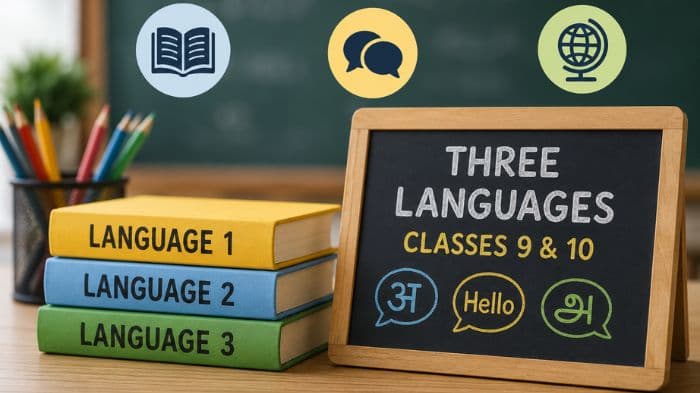
The Central Board of Secondary Education (CBSE) has made the study of three languages compulsory for students in Classes 9 and 10 from July 1, 2026, as part of the implementation of the National Education Policy (NEP) 2020 and the National Curriculum Framework for School Education (NCF-SE) 2023.
Under the revised language policy, students will now study three languages identified as R1, R2 and R3. CBSE has clarified that at least two of these must be native Indian languages. Students can choose a foreign language only if the other two selected languages are Indian languages, or they may opt for the foreign language as an additional fourth subject.

The decision marks a significant shift in the Board’s secondary education structure and expands the three-language formula to higher classes in line with the NEP’s emphasis on multilingual learning and the promotion of Indian languages.
No Board exam for the third language
One of the key features of the policy is that the third language, or R3, will not be part of the Class 10 Board examination system. Instead, the subject will be assessed internally by schools. CBSE said the move was intended to reduce academic pressure on students while still encouraging multilingual education.
The Board also clarified that no student would be prevented from appearing in the Class 10 Board examinations because of their performance in the third language. However, marks obtained in the subject will still appear on the CBSE certificate.
Why CBSE introduced the change
The language reform is linked directly to the National Education Policy 2020, which advocates multilingualism and recommends that students learn more than one Indian language during their schooling years. The NCF-SE 2023 further expanded on this recommendation by proposing structured language learning across school stages.
CBSE said the revised structure aims to strengthen linguistic diversity, improve cultural understanding and encourage students to engage more deeply with Indian languages alongside English and other global languages.
The Board’s circular noted that language learning at the secondary stage would focus on communication skills, reading comprehension, written expression and grammatical understanding.
What languages students can choose
Schools will be allowed to select languages from the CBSE-approved subject list, provided the requirement of two Indian languages is met. The Board has not restricted schools to Hindi alone, and students may choose from several scheduled Indian languages depending on school availability.
Foreign languages such as French, German or other international language options may still be offered, but only under the condition that the remaining two language choices are Indian languages.
According to CBSE, textbooks for Class 6-level R3 courses in 19 scheduled Indian languages will be made available before July 1. For other languages, schools may use State Council of Educational Research and Training (SCERT) material and state-level resources.
Transition plan for schools
Since the 2026-27 academic session had already begun in April, CBSE said it would adopt a “transitional approach” while implementing the revised scheme.
Until dedicated secondary-level textbooks become available, students in Class 9 will temporarily use Class 6 R3 textbooks for the chosen language, supplemented by local literature such as poems, short stories and non-fiction texts selected by schools.
CBSE also acknowledged that many schools currently face shortages of qualified language teachers. To address this, it has allowed schools to adopt interim measures such as using teachers from other subjects who know the language, hiring retired teachers, sharing teachers through Sahodaya school clusters and using hybrid or virtual teaching models.
Exemptions and flexibility
The Board has provided certain relaxations under the policy. Children with Special Needs (CwSN) may receive exemptions in accordance with the Rights of Persons with Disabilities (RPwD) Act, 2016. Foreign students and CBSE schools located outside India may also be given flexibility on a case-by-case basis.
Political debate over language policy
The implementation of the three-language formula has already triggered political debate, especially in southern states where concerns over Hindi imposition have historically surfaced whenever language policy changes are introduced.
However, CBSE has maintained that the policy does not mandate Hindi specifically and instead focuses broadly on promoting Indian languages and multilingual education in line with national policy goals.