


The initiative includes recruiting and training over 10,000 teachers, with classes beginning at Grade 1 to improve enrollment and expand access to English and Kannada instruction.
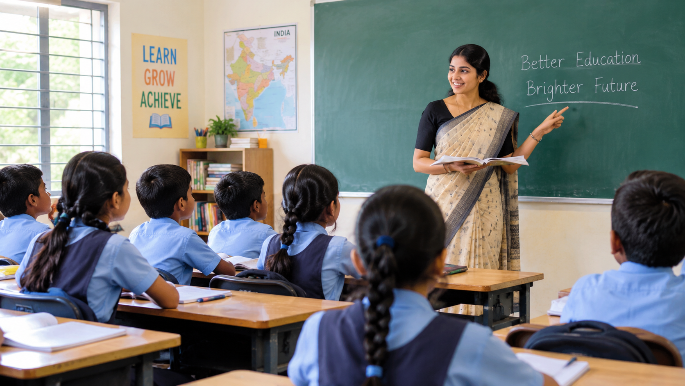
Karnataka will extend bilingual education to all government-run schools by June 2027, allowing students to study in both Kannada and English from the primary level.
The state government has postponed its earlier plan to introduce the system across all schools this year due to a shortage of trained and qualified teachers.

School Education and Literacy Minister Madhu Bangarappa said the department was working toward implementing the initiative across the state next year. More than 9,500 government schools currently offer bilingual education.
Addressing representatives of private schools at the recent 'Namma Shaale Namma Javabdari' event, the minister said, “Next year, we will offer bilingual education at all government schools.”
He said the department had directed local authorities to make the necessary infrastructure arrangements before the expansion. Most government schools already have additional classrooms, and the immediate requirement is to appoint teachers who can teach in both languages.
The initiative aims to strengthen government schools' ability to compete with private institutions and attract more students to state-run schools. Bilingual education will be introduced from the primary level, beginning with Grade 1.
The department has also started the recruitment process for more than 10,000 teachers. Those selected will receive training to handle classes in both Kannada and English.
How many Karnataka government schools currently offer bilingual education?
Of the 46,757 government schools operating across Karnataka, 9,522 currently provide bilingual education. The state plans to expand the facility to the remaining schools by June 2027.
The government has also introduced Lower Kindergarten (LKG) and Upper Kindergarten (UKG) classes in approximately 7,500 government schools. All these schools offer bilingual education, giving children access to Kannada and English instruction from the pre-primary stage.
Madhu Bangarappa said the absence of kindergarten classes had previously discouraged parents from enrolling their children in government schools. Many families preferred private institutions because they offered LKG and UKG facilities.
He said the introduction of kindergarten classes and bilingual instruction had helped attract students to government schools, particularly in the Kalyana Karnataka region.
“Earlier, children were not attracted to government schools because LKG and UKG classes were unavailable and this was forcing parents to admit them at private schools. After the introduction of kindergarten and bilingual education, some schools at Kalyana Karnataka region have witnessed high admissions. Last year, LKG and UKG classes were launched in 1,008 government schools across the Kalyana Karnataka region. Within 42 days, 48,000 students were enrolled,” stated Madhu Bangarappa.
The minister cited the enrollment figures from Kalyana Karnataka to highlight the response to the introduction of pre-primary education. A total of 1,008 government schools in the region started LKG and UKG classes last year, enrolling 48,000 students within 42 days.
Why has Karnataka decided to expand bilingual education in government schools?
The state government's decision is aimed at making government schools more attractive to parents who increasingly consider English-language instruction while selecting schools for their children.
By offering Kannada and English together, the department intends to provide families with an additional medium of instruction without requiring them to move their children to private institutions.
The expansion will begin at the primary level, with bilingual education available from Grade 1. The recruitment and training of more than 10,000 teachers form part of the preparations for implementing the system across the state.
The State Education Policy Commission has also recommended introducing bilingual education in government schools. However, the proposal has faced objections from several academicians who argue that the move could weaken or destroy Kannada-medium schools.
Responding to these concerns, Bangarappa said parents should have the freedom to decide the language in which their children receive education. He said the government would provide both options rather than impose a particular medium of instruction.
Madhu Bangarappa added, “Parents have the right to choose the medium of instruction. We cannot insist but we can offer both Kannada and English. Let them choose.”
What is the status of bilingual education in Bengaluru government schools?
The bilingual education initiative has also been introduced in government schools across Bengaluru North and Bengaluru South.
Of the 1,465 government schools in the two educational districts, 1,103 have received permission to introduce bilingual sections for students from Grade 1.
Bengaluru South has 730 government schools, while Bengaluru North has 373 schools covered under the permission granted for bilingual education.
The government has been selecting schools for the program based on student enrollment figures and applications received from educational districts.
Last year, 11,555 schools identified as potential institutions applied to introduce bilingual education across 33 educational districts. The first 15 schools in each taluk with the highest student enrollment were selected to offer the program.
When was bilingual education first announced in Karnataka government schools?
The proposal to introduce bilingual education in government schools was earlier announced by H D Kumaraswamy during his tenure as Karnataka chief minister.
The state has since expanded the initiative to thousands of government schools, with the current government planning to extend it across all state-run institutions by June 2027.
The latest expansion plan will depend on the availability of trained teachers and the readiness of schools to offer instruction in both Kannada and English. The department has already directed local authorities to prepare the required infrastructure and begun the recruitment process to meet the staffing requirements.

Can AI blackboards change how mathematics is taught in India? China's new technology offers glimpse

Tamil Nadu renews NEET abolition demand, seeks Class 12 marks for medical admissions
Karnataka plans bilingual education across 46,757 govt schools by June 2027

Karnataka CM seeks private school support to improve rural education and curb migration to cities

Hindustan Group of Institutions Hosts Christmas Cake Mixing Ceremony at Guindy Campus
Can AI blackboards change how mathematics is taught in India? China's new technology offers glimpse
Tamil Nadu renews NEET abolition demand, seeks Class 12 marks for medical admissions
Karnataka plans bilingual education across 46,757 govt schools by June 2027
Karnataka CM seeks private school support to improve rural education and curb migration to cities

JEE Main 2027: NTA allows NRI candidates to use passports for Session 1 registration

Can AI blackboards change how mathematics is taught in India? China's new technology offers glimpse
Tamil Nadu renews NEET abolition demand, seeks Class 12 marks for medical admissions
Karnataka plans bilingual education across 46,757 govt schools by June 2027
Karnataka CM seeks private school support to improve rural education and curb migration to cities
Hindustan Group of Institutions Hosts Christmas Cake Mixing Ceremony at Guindy Campus
Can AI blackboards change how mathematics is taught in India? China's new technology offers glimpse
Tamil Nadu renews NEET abolition demand, seeks Class 12 marks for medical admissions
Karnataka plans bilingual education across 46,757 govt schools by June 2027
Karnataka CM seeks private school support to improve rural education and curb migration to cities
JEE Main 2027: NTA allows NRI candidates to use passports for Session 1 registration
Copyright© educationpost.in 2026 All Rights Reserved.