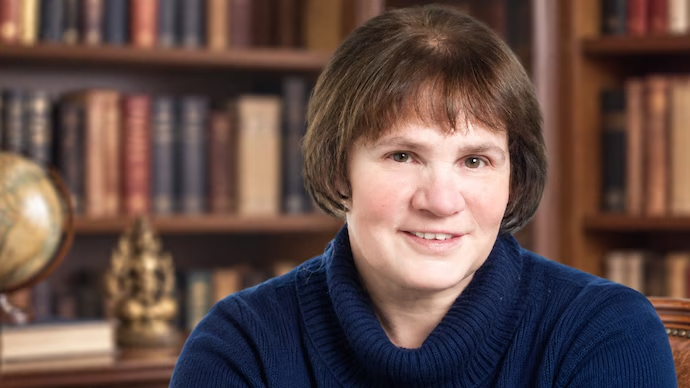
Some journeys begin with a plan. Others begin with a language. For Dr Liudmila Khokhlova, that language was Hindi.
Born in Russia in 1945, Khokhlova was thousands of kilometres away from India when she made a choice that would shape her academic life. At Moscow State University, she took up Hindi language and literature at a time when the language was far from an obvious choice for a young Russian student.

In 1970, she completed her master’s degree in Hindi language and literature. Four years later, she earned a doctorate in Indian linguistics, with research comparing Hindi and Rajasthani.
Decades later, that academic journey was recognised by India.
President Droupadi Murmu conferred the Padma Shri on Khokhlova on June 23, 2026, for her contribution to Literature and Education, particularly her work in Indian languages and Indological studies.
For Khokhlova, however, the honour appeared to bring as much humility as pride.
“When I came to know that I had received such a big award, of course I was very happy. I felt very proud. But I feel that I have not done such a big thing that I should receive such a big award,” she said in Hindi.
Her words reflected a career built not around a single achievement, but decades of teaching, research, translation and engagement with Indian languages.
From a Moscow classroom to Indian linguistics
At Moscow State University, Khokhlova went on to teach Hindi and Punjabi to undergraduate and postgraduate students.
Her academic work expanded beyond language teaching into the history and structure of New Indo-Aryan languages, Hindi-Urdu grammar, syntax and linguistics.
Behind the technical subjects was a broader academic pursuit — understanding how languages evolve, how people communicate and how linguistic traditions reveal connections between cultures.
Over the years, her scholarship extended across Hindi, Punjabi and other Indian languages.
According to the Government of India’s Padma Awards citation, Khokhlova has authored six books and 92 research papers in Russian, English and Hindi.
Her association with India also took her beyond books and classrooms. She undertook academic visits and training at Jawaharlal Nehru University in 2007 and 2013 and at the University of Hyderabad in 2016, besides participating in lectures and other academic engagements.
When Hindi opened the door to Punjabi
Khokhlova’s engagement with India’s languages did not end with Hindi.
Her scholarship eventually led her into Punjabi language, Sikh history and religious literature. She translated Guru Nanak’s Jap Ji from Punjabi into Russian and also translated Jap Sahib, associated with Guru Gobind Singh.
For Indian readers, these texts are part of a familiar religious and cultural tradition. For Russian readers, their translation offered an opportunity to encounter those traditions through their own language.
That made Khokhlova’s work more than an exercise in linguistics.
Translation became a bridge — carrying ideas, literature and cultural traditions across languages and countries.
A lifetime spent with Indian languages
What began as a decision by a young Russian student to study Hindi eventually became a lifelong academic engagement with India.
From Hindi and Rajasthani linguistics to Punjabi and Sikh literature, Khokhlova’s work has brought Indian languages into Russian academic and cultural spaces while also deepening scholarly links between India and Russia.
The Padma Shri now stands as formal recognition of that contribution.
Yet, even after receiving one of India’s highest civilian honours, Khokhlova says she hopes to continue doing more.
Her journey, in many ways, remains rooted in the same language that first drew her towards India more than five decades ago — Hindi.