India's Green Economy May Generate Millions of Jobs by 2035: Are Universities Ready?
Renewable energy, electric vehicles and sustainable manufacturing are creating new career opportunities, but India's universities face growing pressure to bridge the green skills gap.
By Priyanka Pathak · Updated
India's transition towards a green economy is expected to create millions of employment opportunities across renewable energy, electric vehicles, green hydrogen, climate finance and sustainable manufacturing. However, a major question remains: are India's universities adequately preparing students for the skills required by these emerging industries?
The issue has gained importance following the release of the QS World University Sustainability Rankings 2027, which indicate improving sustainability-related performance among Indian higher education institutions. According to the rankings, more than 70% of Indian university entries improved in the Employability and Outcomes category.
IIT Delhi emerged as the highest-ranked Indian institution at 194th globally, followed by IIT Kharagpur at 224th and the University of Delhi at 237th. India also increased its representation in the global top 500, with 13 institutions compared with five in 2023.However, improved university rankings do not automatically translate into graduates possessing the technical and practical skills required by green industries.
Green hiring rises as demand for specialised skills increases
The expansion of India's green economy is changing the skills employers expect from graduates. Knowledge of renewable energy, carbon management, energy efficiency and sustainable business practices is becoming increasingly relevant across industries.
LinkedIn's Global Green Skills Report 2026 indicates that India's share of green hiring increased by 31%, while the share of green-skilled talent in the workforce grew by 29%. This suggests that employers are increasingly seeking professionals with sustainability-related expertise, including in sectors not traditionally associated with environmental work.
Green skills are no longer limited to environmental scientists or renewable energy engineers. Finance professionals need to understand climate-related risks and environmental, social and governance (ESG) reporting. Engineers are expected to consider energy efficiency and emissions reduction, while technology and management professionals increasingly encounter sustainability requirements in their work.
India's green transition could generate millions of jobs
A study released by the Council on Energy, Environment and Water (CEEW) and the Natural Resources Defense Council (NRDC) in June 2026 estimated that India's clean energy targets could generate more than 44 lakh full-time-equivalent jobs.
The projections are linked to India's target of achieving 500 GW of non-fossil fuel energy capacity and the National Green Hydrogen Mission. Rooftop solar could account for approximately 43% of the estimated employment opportunities.
The study also found that more than 6.5 lakh workers joined selected clean energy sectors between FY 2023 and FY 2026.
A separate report by the International Forum for Environment, Sustainability and Technology (iFOREST), titled India's Green Jobs Moment: Pathways to Build a Future-Ready Workforce, estimates that employment in key green sectors could increase to more than 54 lakh by 2035.
These projections cover areas such as renewable energy, green hydrogen, electric vehicle manufacturing, charging infrastructure and formal recycling. The findings underline the importance of developing a skilled workforce alongside investments in green infrastructure.
Are Indian universities updating their curricula?
Several higher education institutions have started introducing specialised programmes and subjects related to sustainability, renewable energy and environmental technology. However, integrating green skills into mainstream degree programmes remains a major challenge.
At the Indian Institute of Technology (IIT) Delhi, the BTech in Energy Engineering covers energy resources, energy systems and sustainable technological solutions. The programme also includes project and internship requirements, providing opportunities for practical exposure.
IIT Hyderabad's Greenko School of Sustainability offers postgraduate education in sustainable engineering, including areas such as sustainable energy systems, infrastructure and industrial processes.
The TERI School of Advanced Studies in New Delhi offers specialised education in renewable energy engineering and management, covering technologies such as solar, wind, biomass and hydrogen.IIT Bombay also incorporates environmental engineering subjects, including climate change, environmental management and pollution-control technologies.
These initiatives demonstrate that sustainability education is gaining importance in Indian higher education. Nevertheless, the challenge is to extend such learning beyond specialised institutions and programmes to universities across the country.
Practical training and industry partnerships are essential
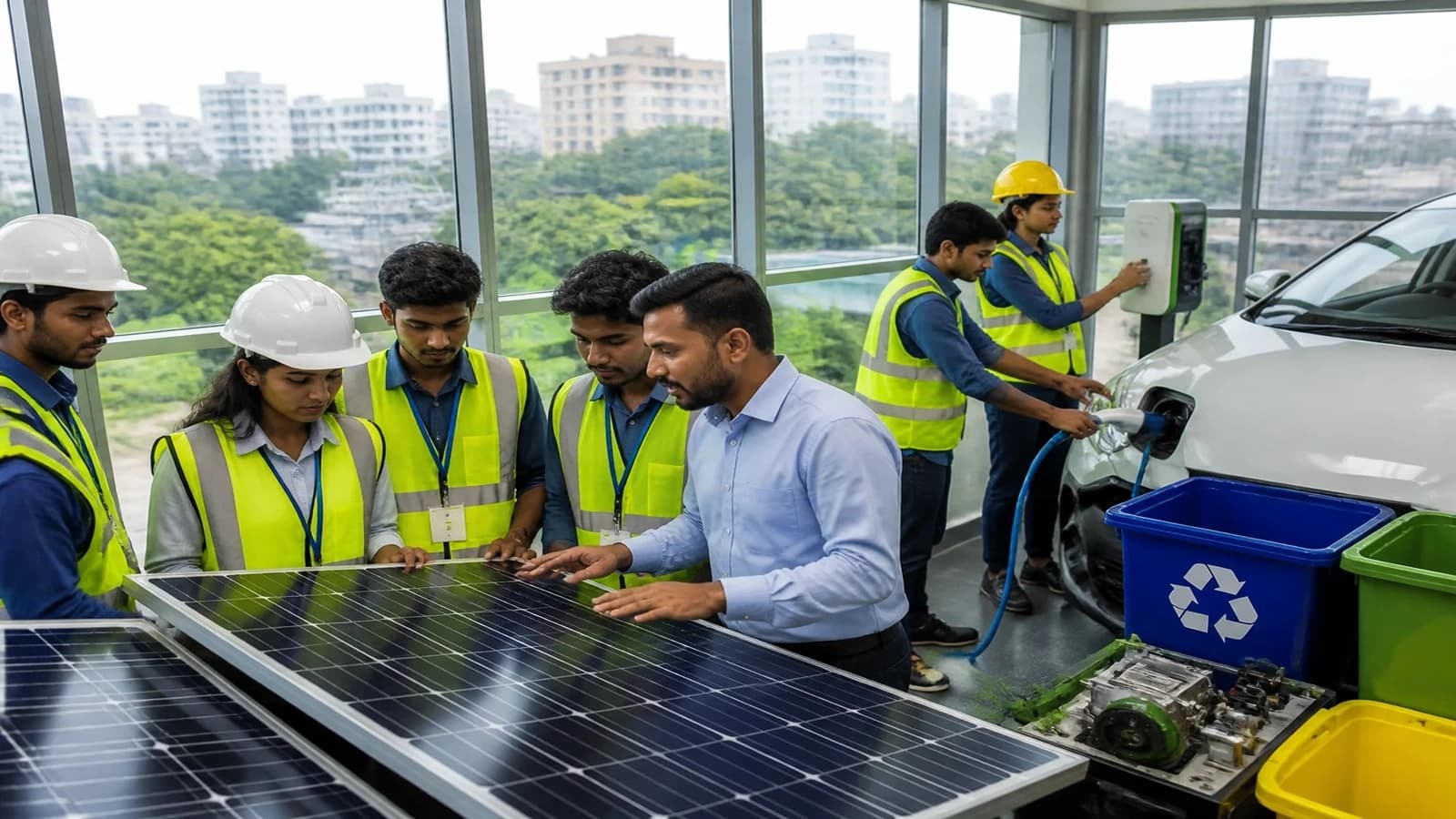
Introducing new subjects alone may not be sufficient to prepare students for employment in the green economy. Universities also need to provide practical experience through laboratory work, internships, industry collaborations and apprenticeship programmes.Students pursuing engineering, science, commerce and management degrees should have opportunities to understand how sustainability principles are applied in real workplaces.
For example, engineering students could work on energy-efficiency projects, while management and finance students could gain exposure to carbon markets, ESG reporting and sustainable investment practices.
Industry partnerships can help universities identify changing skill requirements and update academic programmes accordingly. Apprenticeships and workplace-based learning can also help bridge the gap between theoretical knowledge and professional expectations.
Employers increasingly seek sustainability-related expertise
The demand for green skills is expanding beyond companies directly involved in renewable energy and environmental protection.Employers increasingly value professionals who can combine their core academic qualifications with knowledge of sustainability, resource management and environmental regulations.
An engineer may need expertise in energy-efficient technologies, while a financial analyst may be expected to understand climate-related financial risks. Similarly, professionals in manufacturing, logistics and information technology may need to identify ways to reduce emissions and improve resource efficiency.
This changing employment landscape makes interdisciplinary education particularly important. Universities will need to ensure that students graduate with both subject-specific expertise and an understanding of sustainability challenges.
Women's participation in green jobs remains low
Gender representation is another important concern in India's emerging green workforce.
The CEEW-NRDC study found that women accounted for only 11% of the surveyed workforce in solar and wind deployment and manufacturing. It also reported that approximately 62% of women employed in these sectors were working in non-technical positions, including administration, accounting and human resources.
The findings highlight the need to improve women's access to technical education, vocational training and employment opportunities in emerging green industries.Universities and skill-development institutions can play an important role by encouraging female students to pursue courses in renewable energy, engineering, environmental technology and other specialised fields.
Scholarships, industry internships, practical training and inclusive recruitment practices could further improve women's participation.
Can universities prepare graduates for India's green economy?
India's transition towards a sustainable economy presents a significant opportunity for higher education institutions. However, converting employment projections into actual career opportunities will require coordinated efforts from universities, government agencies, industries and skill-development organisations.
The QS Sustainability Rankings 2027 indicate that Indian universities are making progress in sustainability-related performance. However, rankings alone cannot establish whether graduates possess the practical capabilities required by emerging industries.
Universities must focus on updating curricula, expanding industry partnerships, strengthening research facilities and introducing hands-on learning opportunities.As India's green economy expands, the success of higher education institutions will increasingly depend on their ability to produce skilled, adaptable and industry-ready graduates.
The central challenge is no longer simply creating more degree programmes. It is ensuring that students acquire the knowledge and practical skills needed to participate in India's evolving green economy.
Also read