IISc professor Mahesh Kakde wins 2026 Ramanujan Prize for contributions to algebraic number theory
His research on noncommutative Iwasawa theory, Gross-Stark and Brumer-Stark conjectures has implications for Hilbert’s 12th problem and advances understanding of number fields and zeta functions.
Pragya Kumari08 October 2026 07:46
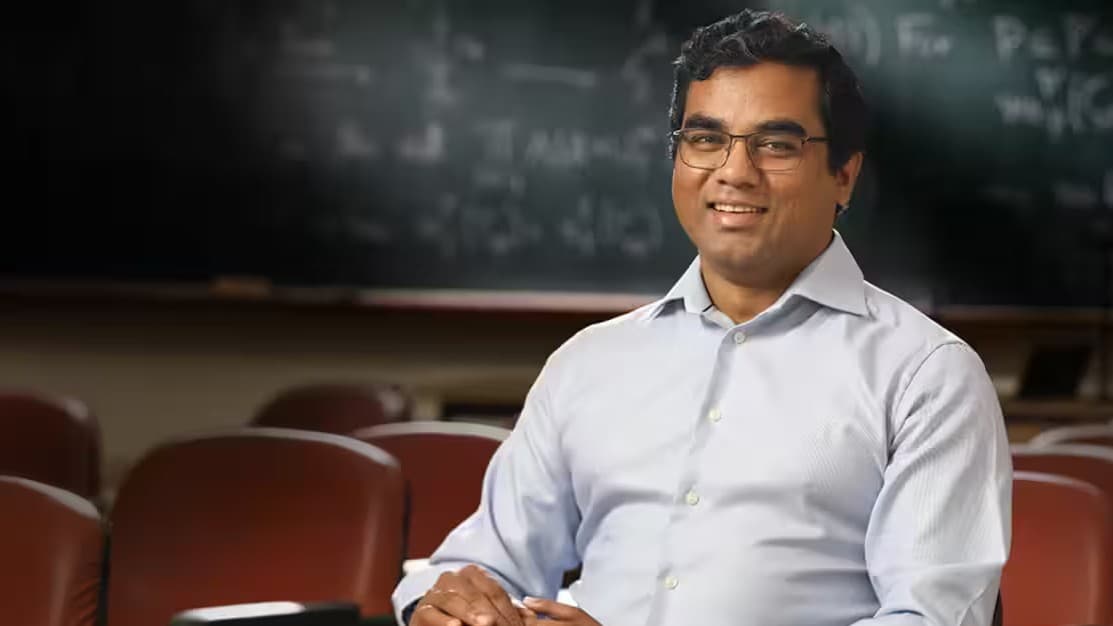
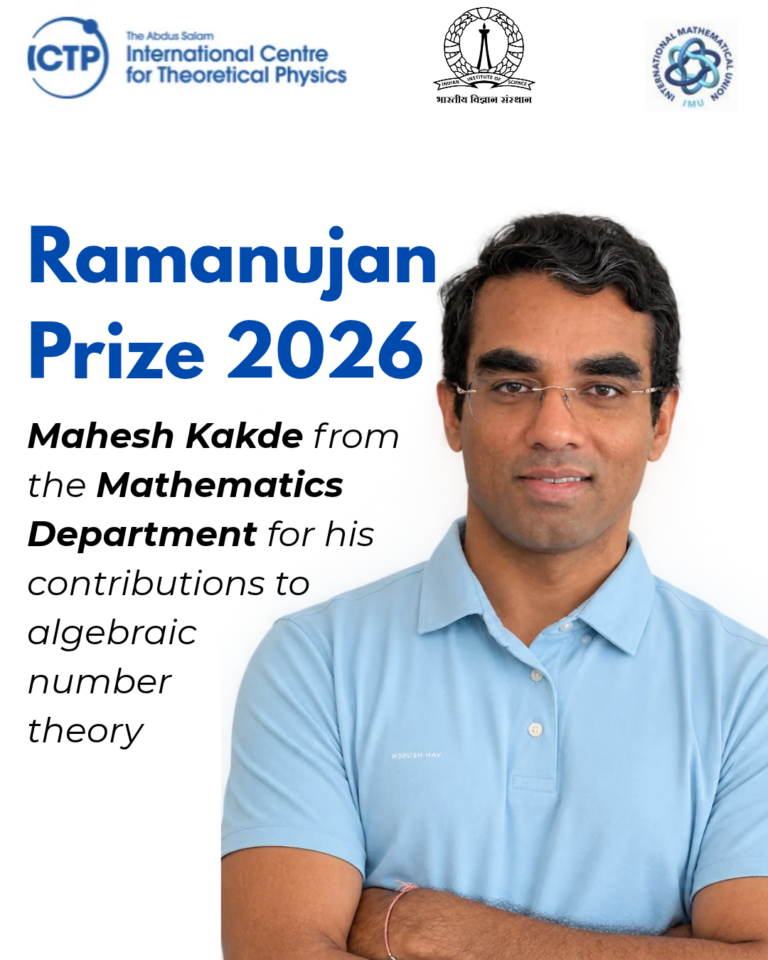
Indian mathematician and Indian Institute of Science (IISc), Bengaluru, professor Mahesh Kakde has won the 2026 Ramanujan Prize for Young Mathematicians from Developing Countries for his contributions to algebraic number theory.
The International Centre for Theoretical Physics (ICTP) and the International Mathematical Union (IMU) announced the award on Sept 30, 2026, while IISc announced Kakde's achievement on Oct 7. The prize recognizes outstanding mathematical research carried out by young researchers working in developing countries.
Kakde was recognized for his fundamental results in noncommutative Iwasawa theory and his work on the Gross-Stark and Brumer-Stark conjectures. His research also has implications for Hilbert's 12th problem, one of the 23 mathematical problems presented by German mathematician David Hilbert in 1900.
The Ramanujan Prize has been awarded annually since 2005 and is jointly administered by ICTP and IMU. It is named after legendary Indian mathematician Srinivasa Ramanujan and carries a cash award of US$10,000.
Kakde's work in algebraic number theory
Kakde is a professor in the Department of Mathematics at IISc Bengaluru, where his research focuses on number theory and arithmetic geometry.
Algebraic number theory uses structures such as fields and groups to study integers and their generalizations and to explore deeper relationships between numbers and mathematical structures.
One of Kakde's major areas of research is Iwasawa theory, which examines how arithmetic properties change as mathematical systems are extended through increasingly large and complicated fields.
His work includes fundamental results in noncommutative Iwasawa theory, where the mathematical structures involved do not necessarily follow the simpler rules found in commutative settings.
These results have helped mathematicians understand complex relationships between arithmetic objects as mathematical systems become more intricate.
Kakde has also made important contributions to the Gross-Stark and Brumer-Stark conjectures, which are long-standing questions in algebraic number theory.
His research with mathematicians including Samit Dasgupta and Kevin Ventullo has produced important results related to the Gross-Stark conjecture.
Kakde and Dasgupta have also worked on the Brumer-Stark conjecture and related questions involving mathematical objects such as number fields, zeta functions and L-functions.
ICTP describes algebraic number theory as a field that “uses structures such as fields and groups to study problems involving integers and their generalisations.”
Connection to Hilbert's 12th problem
Kakde's research also connects to Hilbert's 12th problem, which was included in the famous list of 23 mathematical problems that David Hilbert presented at the International Congress of Mathematicians in Paris in 1900.
The 12th problem broadly asks whether important numbers and field extensions can be described systematically through special functions and other mathematical structures.
Kakde's research has implications for this problem, particularly through work addressing important cases involving totally real fields. The Indian government's citation for his Shanti Swarup Bhatnagar Award noted that his work contributed to a p-adic resolution of Hilbert's 12th problem for totally real fields.
His research does not mean that the general form of Hilbert's 12th problem has been completely solved. Instead, his work has addressed important cases and advanced mathematicians' understanding of the deep connections involved.
From IISc Bengaluru to Cambridge and back
Kakde was born and educated in India. He completed his Bachelor of Mathematics at the Indian Statistical Institute in Bengaluru before moving to the University of Cambridge in the United Kingdom.
At Cambridge, he completed a Master of Mathematics and later earned a PhD in pure mathematics in 2008.
After completing his doctorate, Kakde worked as an instructor of mathematics at Princeton University. He later joined University College London as a research associate and subsequently worked at King's College London.
He returned to India and joined IISc as a professor in August 2019. He has since continued his research in number theory and arithmetic geometry at the Bengaluru-based institute. He is also a visiting researcher at the Tata Institute of Fundamental Research in Mumbai.
A series of major academic honors
The Ramanujan Prize adds to a growing list of major distinctions received by Kakde for his contributions to mathematics.
He received the Infosys Prize in Mathematical Sciences in 2022 for his work in algebraic number theory and was an invited speaker at the 2022 International Congress of Mathematicians, where he presented work on the Brumer-Stark conjecture with Samit Dasgupta.
In 2023, Kakde was included in the Asian Scientist 100 list, which recognizes leading researchers, academics and innovators across Asia. He also received the London Mathematical Society's Whitehead Prize in 2023 and was elected a Fellow of the Indian Academy of Sciences.
His other distinctions include the 2023 Frontiers of Science Award, which he shared with Dasgupta and Kevin Ventullo, and the Vigyan Yuva Shanti Swarup Bhatnagar Award in Mathematical Sciences in 2024.
What is the Ramanujan Prize?
The Ramanujan Prize for Young Mathematicians from Developing Countries was established in 2005 to recognize young mathematicians from developing countries who have made outstanding contributions to mathematical sciences while working in developing countries.
The award is administered jointly by ICTP and IMU. Eligibility includes being under 45 years of age and conducting outstanding research while working in a developing country. The selection committee considers both the quality of the research and the circumstances in which the researcher has carried out the work.
The prize carries a cash award of US$10,000 and is selected by a committee of eminent mathematicians in consultation between ICTP and IMU.
The award is named after Srinivasa Ramanujan, the Indian mathematician whose work in number theory continues to influence mathematical research more than a century after his death. Ramanujan lived from 1887 to 1920.
Kakde's award makes him the fifth Indian recipient of the Ramanujan Prize. Earlier Indian recipients include Sujatha Ramdorai in 2006, Amalendu Krishna in 2015, Ritabrata Munshi in 2018 and Neena Gupta in 2021.
Indian mathematicians previously recognized
Sujatha Ramdorai of the Tata Institute of Fundamental Research received the Ramanujan Prize in 2006 for her work in the arithmetic of algebraic varieties and contributions to noncommutative Iwasawa theory.
Amalendu Krishna received the award in 2015 for his work in algebraic K-theory, algebraic cycles and the theory of motives. He was also recognized in the Asian Scientist 100 in 2016.
Ritabrata Munshi received the prize in 2018 for his work in number theory, including research into the analytic properties of L-functions and automorphic forms. He has been associated with the Indian Statistical Institute in Kolkata and the Tata Institute of Fundamental Research in Mumbai.
Neena Gupta became the second Indian woman to receive the award in 2021 for her contributions to affine algebraic geometry and commutative algebra. The Ramanujan Prize committee described Gupta's work as showing “impressive algebraic skill and inventiveness."
Why Kakde's work matters
Kakde's research deals with some of the most difficult and abstract questions in modern number theory. At its core, algebraic number theory seeks to uncover structures and relationships that explain how numbers behave beyond basic arithmetic.
Iwasawa theory examines how arithmetic properties evolve as mathematical systems become increasingly complex. Kakde's work in its noncommutative setting has helped advance understanding of these structures, while his research on the Gross-Stark and Brumer-Stark conjectures has connected different areas of number theory.
His work also contributes to broader efforts to understand questions that have remained central to mathematics for generations, including problems connected to Hilbert's 12th problem.
For students, Kakde's academic journey also illustrates the role of sustained research and curiosity in mathematics. His career has involved years of work on highly specialized questions that often cannot be reduced to a single formula or straightforward calculation.
Rather than focusing only on textbook problems, advanced mathematical research often begins with questions about why certain structures behave in particular ways and whether apparently separate mathematical ideas are connected. Kakde's research represents this deeper approach to mathematics, combining long-term study with efforts to resolve difficult problems in number theory.
The 2026 Ramanujan Prize recognizes that contribution and highlights the strength of mathematical research being conducted in India and other developing countries.