


Court Rejects Blanket Restrictions, Calls for Targeted Measures to Ensure Online SafetyThe Supreme Court on October 15 held that access to and use of the internet is a fundamental right of every individual, including children, irrespective of their age. A bench comprising Justices J B Pardiwala and K V Chandran observed that children's safety and freedom must be protected together, rejecting blanket restrictions on internet access in the name of online safety. The ruling comes amid proposals by states such as Karnataka and Andhra Pradesh to restrict children's screen time, alongside international efforts to limit minors' access to social media. The court emphasised that the internet is an important source of education, information and communication, particularly for children living in remote areas. The matter arose from proceedings concerning online child sexual exploitation and abuse material (CSEAM). In 2024, the Supreme Court held that viewing, possessing and failing to report the possession of such material could attract criminal liability under the Protection of Children from Sexual Offences (POCSO) Act and the Information Technology Act. While examining compliance with its earlier directions, the court considered the global trend of restricting children's social media access and declined to endorse blanket bans. The bench relied on earlier judgments, including Anuradha Bhasin v. Union of India (2020), which recognised constitutional protection for freedom of speech and expression through the internet, and Pragya Prasun v. Union of India (2025), which recognised digital access as an intrinsic component of the right to life under Article 21. Targeted Safeguards and Accountability for Online Platforms The Supreme Court held that restrictions on fundamental rights must satisfy three requirements: legal authorisation, a legitimate state objective and proportionality. It observed that measures intended to protect children should target harmful content and those responsible for it rather than penalise children by denying them internet access. The bench also raised concerns that age-based restrictions could require continuous collection of sensitive personal information, increasing the risks of surveillance and data misuse. It warned that children might migrate to unregulated platforms that could expose them to greater dangers. Instead, the court suggested measures such as parental consent and supervision, child-friendly account settings, private-by-default profiles, restrictions on contact from unknown adults and stronger moderation of harmful content and advertisements. It clarified that the government could restrict access to inherently harmful material, including adult-content websites. The court also directed the Union government to establish a National Hash and URL List Database for CSEAM, with entries verified by at least three trained human analysts. It prescribed timelines for reporting removals and acknowledging complaints, and called for consideration of exemplary monetary penalties and forfeiture of revenue generated through paid access to such material. The Union government must frame guidelines, amend the Information Technology Rules where necessary and submit an affidavit before the next hearing on December 10, 2026. The judgment establishes that protecting children online requires proportionate safeguards that address harmful content while preserving their fundamental rights.
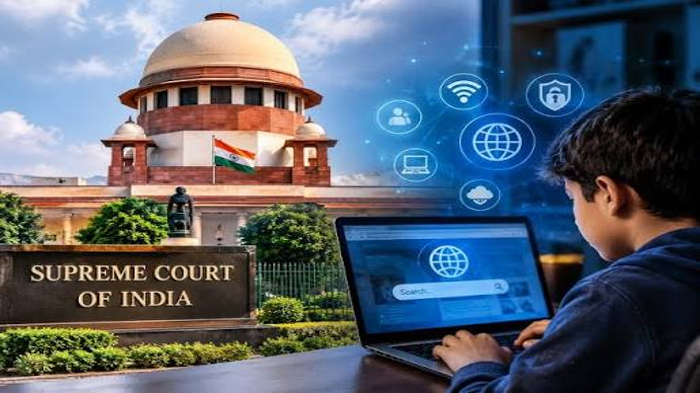
The Supreme Court on October 15 held that access to and use of the internet is a fundamental right of every individual, including children, irrespective of their age. A bench comprising Justices J B Pardiwala and K V Chandran observed that children's safety and freedom must be protected together, rejecting blanket restrictions on internet access in the name of online safety.
The ruling comes amid proposals by states such as Karnataka and Andhra Pradesh to restrict children's screen time, alongside international efforts to limit minors' access to social media. The court emphasised that the internet is an important source of education, information and communication, particularly for children living in remote areas.

The matter arose from proceedings concerning online child sexual exploitation and abuse material (CSEAM). In 2024, the Supreme Court held that viewing, possessing and failing to report the possession of such material could attract criminal liability under the Protection of Children from Sexual Offences (POCSO) Act and the Information Technology Act. While examining compliance with its earlier directions, the court considered the global trend of restricting children's social media access and declined to endorse blanket bans.
The bench relied on earlier judgments, including Anuradha Bhasin v. Union of India (2020), which recognised constitutional protection for freedom of speech and expression through the internet, and Pragya Prasun v. Union of India (2025), which recognised digital access as an intrinsic component of the right to life under Article 21.
The Supreme Court held that restrictions on fundamental rights must satisfy three requirements: legal authorisation, a legitimate state objective and proportionality. It observed that measures intended to protect children should target harmful content and those responsible for it rather than penalise children by denying them internet access.
The bench also raised concerns that age-based restrictions could require continuous collection of sensitive personal information, increasing the risks of surveillance and data misuse. It warned that children might migrate to unregulated platforms that could expose them to greater dangers.
Instead, the court suggested measures such as parental consent and supervision, child-friendly account settings, private-by-default profiles, restrictions on contact from unknown adults and stronger moderation of harmful content and advertisements. It clarified that the government could restrict access to inherently harmful material, including adult-content websites.
The court also directed the Union government to establish a National Hash and URL List Database for CSEAM, with entries verified by at least three trained human analysts. It prescribed timelines for reporting removals and acknowledging complaints, and called for consideration of exemplary monetary penalties and forfeiture of revenue generated through paid access to such material.
The Union government must frame guidelines, amend the Information Technology Rules where necessary and submit an affidavit before the next hearing on December 10, 2026. The judgment establishes that protecting children online requires proportionate safeguards that address harmful content while preserving their fundamental rights.
RMS CET 2026 Registration Closes Tomorrow; Apply for Class 6 and 9 Admissions
Supreme Court Recognises Internet Access as Fundamental Right for Children

Qatar Plans Local Defence Production Hub Amid Rising Gulf Tensions

Blackstone Plans to Double India Investment to $100 Billion

Three FLAME University Professors Feature in 2026 Stanford–Elsevier Top 2% Scientists List

CCPA reports 3,940 delistings in crackdown on online sale of explosive substances
UGC seeks governors’ intervention as 82 Tamil Nadu institutions face 150 fee-refund complaints
Engineering Must Build Foundations, Not Chase Every Trend: Dr. Arya Kumar Bhattacharya

France protests escalate as Macron rejects minister’s resignation, students block Louvre

France protests turn violent as Paris reports 855 arrests, fresh clashes erupt

RMS CET 2026 Registration Closes Tomorrow; Apply for Class 6 and 9 Admissions
Supreme Court Recognises Internet Access as Fundamental Right for Children
Qatar Plans Local Defence Production Hub Amid Rising Gulf Tensions
Blackstone Plans to Double India Investment to $100 Billion
Three FLAME University Professors Feature in 2026 Stanford–Elsevier Top 2% Scientists List
CCPA reports 3,940 delistings in crackdown on online sale of explosive substances
UGC seeks governors’ intervention as 82 Tamil Nadu institutions face 150 fee-refund complaints
Engineering Must Build Foundations, Not Chase Every Trend: Dr. Arya Kumar Bhattacharya
France protests escalate as Macron rejects minister’s resignation, students block Louvre
France protests turn violent as Paris reports 855 arrests, fresh clashes erupt
Copyright© educationpost.in 2026 All Rights Reserved.