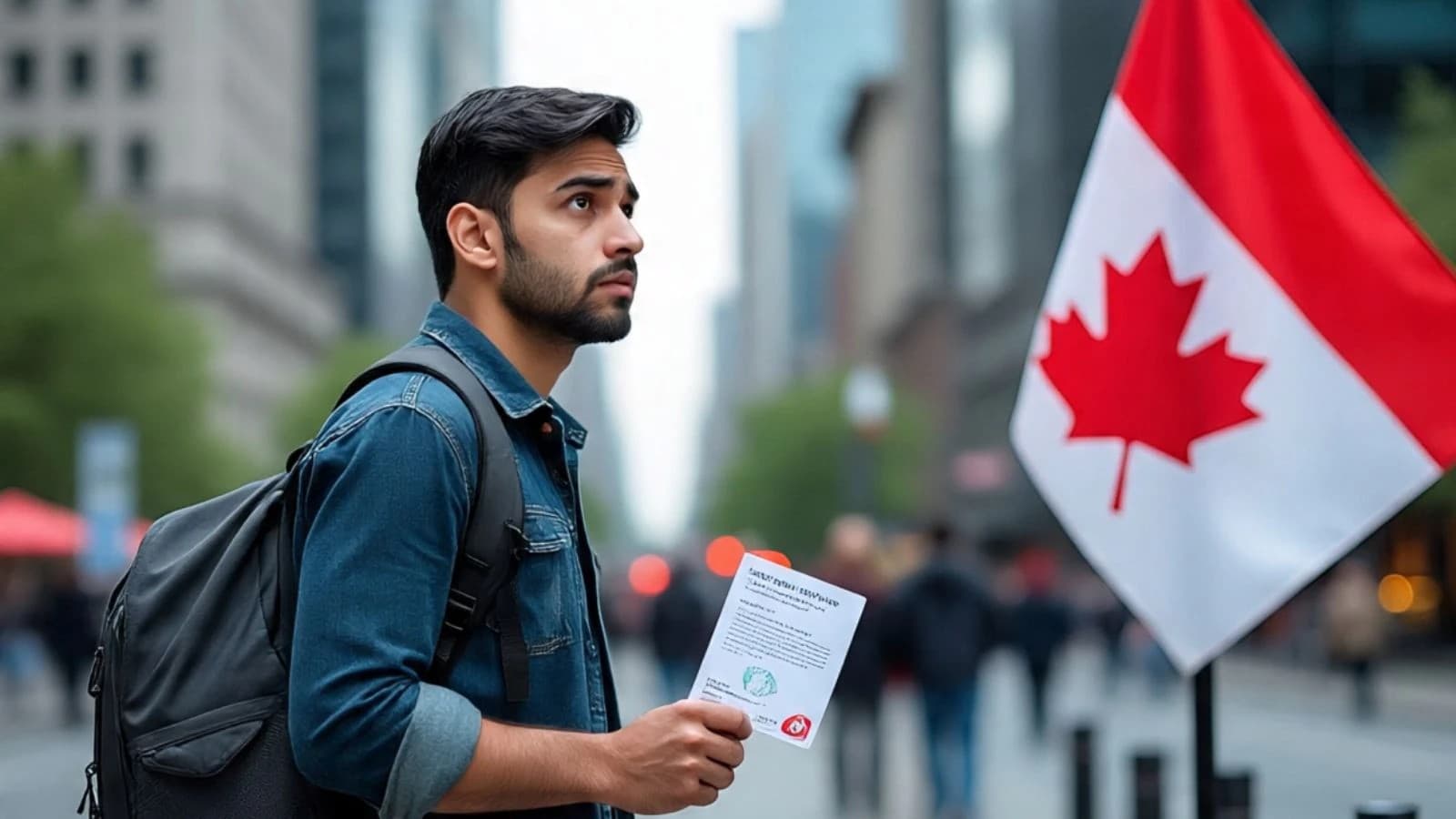
Canada’s international education sector is facing a sharp slowdown as tighter immigration rules reshape what was once one of the country’s most successful export industries.
Data from Immigration, Refugees and Citizenship Canada (IRCC) shows that new international student arrivals between January and August 2025 fell by 59.7% compared to the same period last year, signaling a deep structural shift rather than a short-term dip.

In August 2025, Canada welcomed only 45,380 new study-permit holders, a steep drop from 79,795 in August 2024.
Overall, the total number of international students in the country declined by 21%, with 802,425 permit holders recorded at the end of August, down from 1,020,045 a year earlier.
The reduction in new arrivals is already translating into a smaller student population nationwide. The slowdown, experts say, is largely the result of Ottawa’s recalibration of its international education policies.
Stricter study permit caps, higher financial requirements, and limited post-study work options have combined to create a more selective system. Under the revised rules, Canada has imposed a nationwide ceiling on study permits, trimmed by another 10% for 2025.
The cap restricts intake across provinces and forces institutions to work within fixed allocations. This has disrupted the recruitment cycles of many colleges that had built their growth on continuous international intake.
Another major change is the introduction of Acceptance-Letter Verification (ALV), which requires institutions to digitally confirm each admission before a student can apply for a visa.
While intended to curb fraud, the system has slowed processing and bunched approvals closer to academic start dates, creating uncertainty for students and institutions alike.
Financial requirements have also become more demanding. The proof-of-funds threshold was doubled from CAD 10,000 to CAD 20,635 to account for higher living expenses, but the move has made Canada far less accessible for students from cost-sensitive markets such as India, Nigeria, and Kenya.
Meanwhile, restrictions on post-graduation work permits (PGWP) have further changed the value proposition.
The work visa is now limited to select programs tied to labor market needs, excluding many short-term diplomas and private college tie-ups.
The government has also tightened access to spousal work permits, affecting households that depended on dual incomes to manage living expenses.
Together, these measures have produced a clear outcome: fewer students entering Canada, higher financial barriers, and a narrower path to long-term settlement.
Ottawa describes the approach as a pursuit of “sustainability,” but it has also muted one of the country’s strongest soft-power engines.
The effects are visible across Canadian campuses and communities. With international student numbers down by nearly 60%, college towns are seeing quieter cafés, lower rental demand, and reduced retail activity.
Universities, which relied heavily on higher international tuition fees to fund research and faculty salaries, are beginning to feel financial strain.
Smaller institutions that depended on global enrollments are among the most affected, with some already scaling back programs or staff.
For Indian students, the policy changes carry particular weight. India accounts for nearly 39% of all international students in Canada, far surpassing other source countries. The steep drop in new arrivals has left thousands of Indian families reconsidering their plans.
What was once viewed as a clear “study-work-settle” pathway now comes with higher savings requirements, longer wait times, and fewer post-study opportunities.
Education consultants in India say inquiries are shifting toward Germany, the UK, and Australia, where visa policies and living expenses are perceived as more predictable.
Canada’s multicultural appeal and academic reputation remain intact, but its accessibility has narrowed considerably.
In its effort to ensure integrity and manage housing pressures, Canada has succeeded in cooling an overheated system.
The result, however, is a leaner and more exclusive education landscape, one that trades scale for sustainability and openness for control.