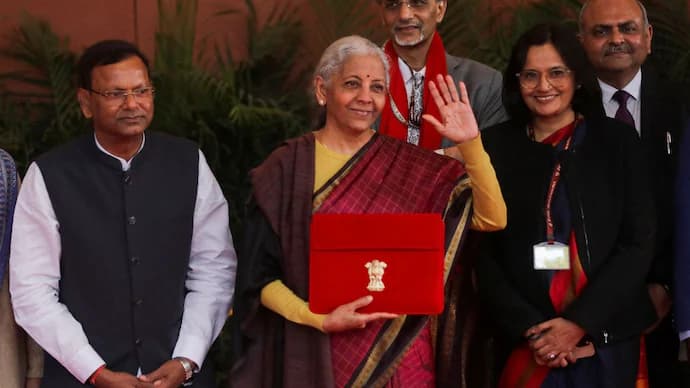
Presenting her ninth consecutive Union Budget, Finance Minister Nirmala Sitharaman on February 1 placed education, skills and youth employability at the centre of the government’s economic strategy, announcing a series of initiatives aimed at aligning learning with jobs, enterprise and emerging sectors.
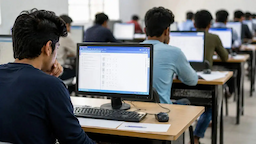
Among the headline measures, Sitharaman announced the setting up of content creator laboratories in 15,000 secondary schools and 500 colleges to strengthen India’s Animation, Visual Effects, Gaming and Comics (AVGC) ecosystem—an initiative pitched as a major push to the country’s fast-growing “orange economy”.

The labs, she said, would equip students with hands-on exposure to digital creativity and new-age skills, creating pathways from classrooms to the creative economy. “This initiative will help nurture talent early and position India as a global hub for AVGC content,” the Finance Minister said.
Education-to-employment bridge
Deepening the focus on skills and services-led growth, Sitharaman proposed the creation of a high-powered ‘Education to Employment and Enterprise’ standing committee, tasked with recommending measures to make the services sector a “core driver of Viksit Bharat”.
The committee will identify priority areas for growth, employment and exports, assess the impact of emerging technologies such as artificial intelligence on jobs, and suggest interventions to future-proof India’s workforce. The government aims to raise India’s share in global services exports to 10% by 2047, she said.
Education-linked skilling also found place in rural and traditional sectors. Sitharaman announced the Mahatma Gandhi Gram Swaraj Yojana to strengthen khadi and handloom through training, skilling, production support and quality control, alongside plans to set up mega textile parks in challenge mode.
Economic backdrop and growth outlook
Ahead of the Budget, the Finance Minister tabled the Economic Survey 2025–26, which projected India’s real GDP growth for FY27 at 6.8%–7.2%, citing strong domestic demand despite global headwinds. The government estimates GDP growth at 7.4% in FY26, driven by consumption and investment.
Addressing Parliament, Sitharaman said the government’s policy choices over the past decade had delivered stability, fiscal discipline and sustained growth. “These measures have helped us make substantial strides in poverty reduction and improvement in the lives of our people,” she said.
She also underlined the challenges posed by the global trade environment, noting that “trade and multilateralism is imperative” amid uncertainty.
Sectoral push and infrastructure expansion
Beyond education, the Budget outlined interventions across six priority areas, including manufacturing, strategic and frontier sectors, healthcare and advanced technology.
In infrastructure, Sitharaman announced that development would continue in tier-2 and tier-3 cities with populations above five lakh, reinforcing their role as emerging growth centres.
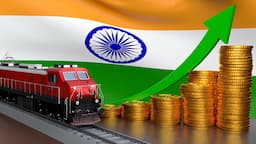
She also unveiled seven high-speed railway corridors—Mumbai–Pune, Pune–Hyderabad, Hyderabad–Bengaluru, Hyderabad–Chennai, Chennai–Bengaluru, Delhi–Varanasi and Varanasi–Siliguri—describing them as “growth connectors” to boost economic integration.
Big-ticket investments
The Budget proposed several large-scale investments over the next five years:
- ₹20,000 crore for Carbon Capture Utilisation and Storage (CCUS) technologies to scale up end-use applications
- ₹10,000 crore under ‘Bio Pharma Shakti’ to develop India as a global biopharma manufacturing hub
- A dedicated initiative to promote high-quality sports goods manufacturing and research, aimed at positioning India as a global supplier of affordable sports equipment
In the minerals sector, Sitharaman announced that Odisha, Kerala, Andhra Pradesh and Tamil Nadu will establish dedicated rare earth mineral corridors.
Guiding principles of the Budget
Laying out the philosophical framework of Budget 2026, Sitharaman said it was guided by three “kartavyas”: accelerating growth and resilience, fulfilling people’s aspirations by building their capacities, and ensuring sab ka saath, sab ka vikas so that every family and region has access to opportunities.
With elections due in several states and global trade negotiations—particularly with the US and EU—under close watch, Budget 2026 signals a clear intent: use education and skills as the launchpad for long-term, inclusive growth.