


Strikes target anti-ship missiles as allies hesitate to join escort mission amid escalating Gulf tensions.
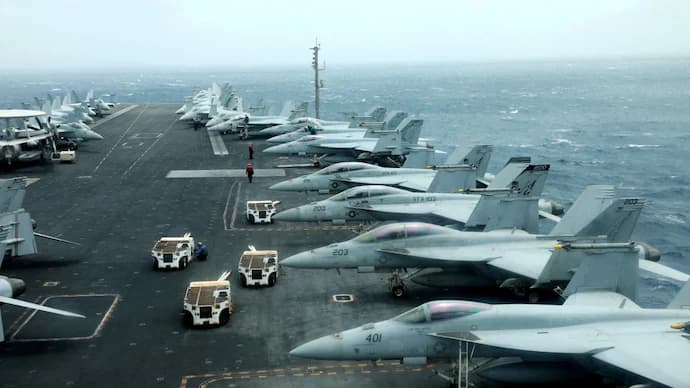
In a significant escalation of the ongoing conflict, the United States launched precision strikes on Iranian missile installations along its southern coastline near the Strait of Hormuz, deploying multiple 5,000-pound (2,200-kg) bunker-buster bombs, according to US Central Command.
The military said the operation targeted Iranian anti-ship cruise missiles positioned to threaten vessels navigating the strategic waterway, a critical artery for global energy supplies. In a statement posted early March 18 (IST), the command confirmed the use of “deep penetrator munitions” against hardened missile sites, describing the weapons as a direct risk to international shipping.

The strikes came just hours after Donald Trump acknowledged growing reluctance among North Atlantic Treaty Organization allies to support Washington’s proposal for a naval escort mission through the strait. While backing the broader US-Israel campaign, several member nations have stopped short of committing military assets.
“Everyone agrees with us, but they don't want to help… we think it's pretty shocking,” Trump said, underscoring frustration within Washington over the lack of allied participation.
European powers signaled clear hesitation. Germany’s Foreign Minister Johann Wadephul ruled out direct involvement, while Emmanuel Macron said France would “never” deploy ships until tensions de-escalate.
The Strait of Hormuz—through which roughly 20% of the world’s oil supply flows—has effectively remained shut since early March amid intensifying hostilities between Iran and the US-Israel alliance. The disruption has rattled global markets, driving up fuel prices and amplifying concerns over energy security.
With key allies holding back and the conflict entering its third week, Washington’s unilateral military action signals a sharpening phase in an already volatile standoff over one of the world’s most critical trade corridors.

Loughborough University appoints Professor Nichola Callow as Pro Vice-Chancellor for education

From digital pets to AI robots: How Hong Kong schools are reshaping classroom learning

Why Are Nearly 2,000 MBBS Seats Still Vacant After NEET Counselling 2026?

Ghaziabad School Introduces Global Lexile Framework to Assess Reading Skills of Students

SRMIST to Host National Conference on Regenerative Biology and Bioengineering from November 3
From digital pets to AI robots: How Hong Kong schools are reshaping classroom learning
Why Are Nearly 2,000 MBBS Seats Still Vacant After NEET Counselling 2026?

King's College London, Cranfield University agree to merge in August 2027

Hong Kong plans weekly AI and coding lessons for children: Is India ready for the shift?

Who handles student discipline? Singapore schools look beyond teachers, lessons India can learn

Loughborough University appoints Professor Nichola Callow as Pro Vice-Chancellor for education
From digital pets to AI robots: How Hong Kong schools are reshaping classroom learning
Why Are Nearly 2,000 MBBS Seats Still Vacant After NEET Counselling 2026?
Ghaziabad School Introduces Global Lexile Framework to Assess Reading Skills of Students
SRMIST to Host National Conference on Regenerative Biology and Bioengineering from November 3
From digital pets to AI robots: How Hong Kong schools are reshaping classroom learning
Why Are Nearly 2,000 MBBS Seats Still Vacant After NEET Counselling 2026?
King's College London, Cranfield University agree to merge in August 2027
Hong Kong plans weekly AI and coding lessons for children: Is India ready for the shift?
Who handles student discipline? Singapore schools look beyond teachers, lessons India can learn
Copyright© educationpost.in 2026 All Rights Reserved.