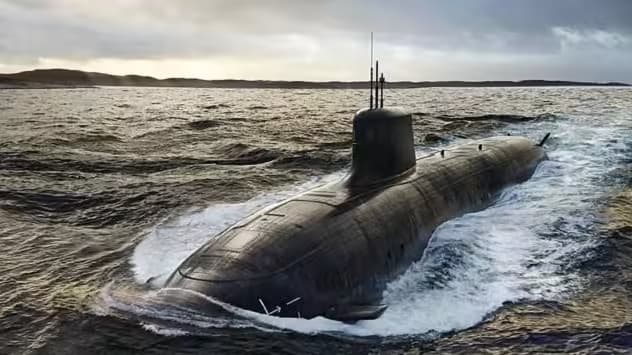
The United States has begun a formal review of the landmark AUKUS submarine agreement with Australia and the United Kingdom, raising new questions over the future of one of the West’s most ambitious defense collaborations in the Indo-Pacific.
According to a US defense official quoted by the BBC, the Pentagon is reassessing the pact to ensure it aligns with President Donald Trump’s “America First” doctrine. “The department is reviewing AUKUS as part of ensuring that this initiative of the previous administration is aligned with the President’s America First agenda,” the official stated.

The review is being led by Elbridge Colby, a senior Pentagon strategist known for his skepticism of the deal. Colby has voiced concern over the transfer of high-end nuclear submarine technology to allies, calling it the “crown jewel” of U.S. defense capability—especially at a time of global strategic uncertainty.
Despite Washington’s internal review, Australia has responded with confidence and calm. “I’m very confident this is going to happen,” Defence Minister Richard Marles told ABC Radio Melbourne. “You just need to look at the map to understand that Australia absolutely needs to have a long-range submarine capability.”
Marles framed the review as standard protocol for any incoming U.S. administration reassessing legacy agreements. “This is a multi-decade plan. There will be governments that come and go,” he said.
AUKUS: A high-stakes Indo-Pacific pact
Signed in 2021 under the Biden administration, AUKUS is a trilateral security pact aimed at counterbalancing China's influence in the Indo-Pacific. It grants Australia access to nuclear-powered submarine technology previously shared only with the UK, making it the second nation to benefit from such a transfer.
The pact, valued at A$368 billion (US$239 billion), includes Australia purchasing up to five second-hand Virginia-class submarines from the US in the 2030s, while co-developing a next-generation AUKUS-class submarine with the UK.
A $2 billion payment is scheduled for 2025 to help upgrade U.S. submarine shipyards, with Australia having already paid $500 million this year.
Production, spending and pressure
The US review will also scrutinize the lagging production rates of Virginia-class submarines, raising concerns about whether the U.S. can meet both its own fleet needs and supply Australia on schedule. Colby and others have flagged this as a potential bottleneck.
In parallel, Washington is pushing Canberra to increase its defense spending from 2% to 3.5% of GDP. Prime Minister Anthony Albanese has committed to 2.3%, citing capability-based rationale over symbolic targets.
Albanese is expected to meet President Trump at the G7 summit in Canada to discuss the AUKUS roadmap and allied burden-sharing.
A spokesperson for the Australian government downplayed the review, saying such evaluations are expected from a new administration. “There is clear and consistent support for AUKUS across the full political spectrum in the US,” the official said.
The UK Ministry of Defence echoed this sentiment, calling the pact “one of the most strategically important partnerships in decades.”
However, any wavering by the U.S. could hand a geopolitical win to Beijing. China has accused AUKUS of fuelling a regional arms race and undermining stability across the Indo-Pacific.